
I can still feel the jolt I got the first time I actually read this passage. I don’t mean skimming it during a sleepy Sunday sermon or nodding along to a sanitized, flannel-graph version in Sunday School. I mean really reading it—letting the ink bleed into reality. The mental image stopped me cold. We love to picture Jesus as the gentle shepherd, holding a lamb, maybe smiling softly with a halo glowing just right. But here? Here, in the chaos of the temple courts, we get something visceral. Something raw. Something undeniably dangerous.
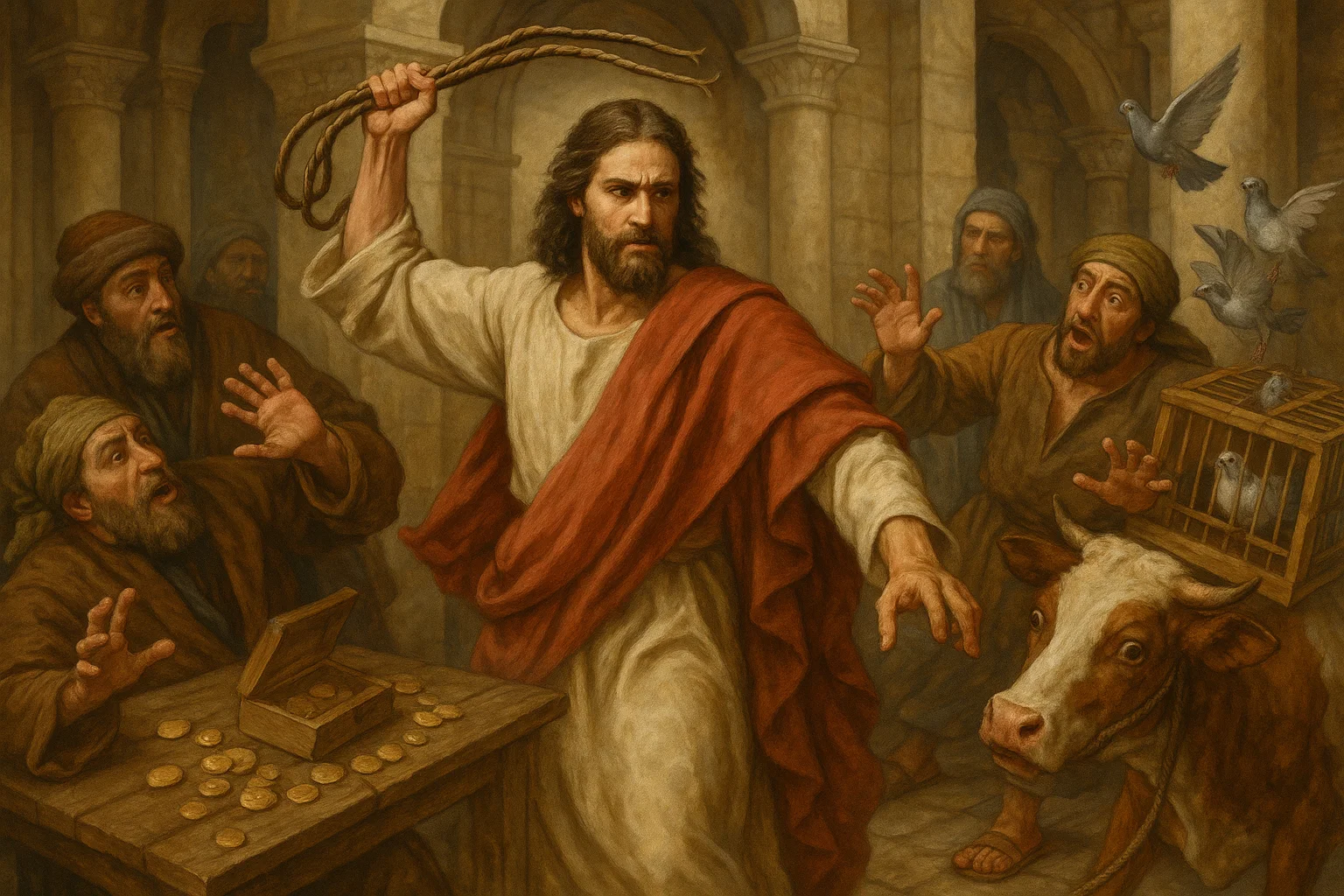
The air wouldn’t have smelled like incense; it would have reeked of manure, sweat, and greed. The noise was likely deafening—the bellowing of cattle, the shouting of haggling merchants, the clinking of coins. Into this mess steps the Messiah. And he doesn’t politely ask them to keep it down. He doesn’t form a committee to discuss noise violations.
John 2:15 hits us with the reality: “And making a whip of cords, he drove them all out of the temple, with the sheep and oxen. And he poured out the coins of the money-changers and overturned their tables.”
This wasn’t a temper tantrum. It was a calculated, passionate reclamation of sacred ground. As a guy who has spent decades trying to figure out what it means to follow this man, I find this moment to be one of the most defining glimpses into who Jesus actually is. It challenges our passivity. It forces us to ask brutal questions about what we tolerate in our own spiritual lives. So, let’s dive into this scene, strip away the stained-glass distance, and figure out what really went down that day in Jerusalem.
More in John Chapter 2 Category
Key Takeaways
- Calculated Action: Jesus didn’t snap in a blind rage; he sat down and braided a whip, showing deliberate, terrifying intent.
- Holy Jealousy: This wasn’t about being irritable; it was about “zeal for the Father’s house” consuming him.
- Double Cleansing: John records this early, unlike the other Gospels, which suggests Jesus likely had to clean house twice.
- Authority Over Chaos: He disrupted the economic status quo to restore spiritual order—hitting them where it hurt: their wallets.
- Modern Application: We have to look at our own lives (the modern temple) and hunt down the “tables” that need flipping.
Why Does the Image of Jesus with a Whip Shock Us?
We want a safe Savior. I remember sitting in a pew as a kid, looking at a painting of Jesus. He looked soft. He looked like he wouldn’t hurt a fly, let alone disrupt a marketplace. But John 2:15 shatters that domesticated image. It rattles us because it introduces a Jesus who is dangerous to the status quo.
If I’m honest, I prefer a God who endorses my lifestyle rather than one who flips my tables. The shock comes from the physical nature of the act. Think about it—making a whip takes time. Have you ever tried to braid rope or heavy leather? You don’t do that in a split second of seeing red.
I remember a situation years ago where I witnessed a friend getting ripped off by a contractor—badly. My initial reaction was just to shout, to get in the guy’s face. But that wouldn’t have fixed anything. True intervention required me to cool off, sit down, document the fraud, and come back with a legal plan that actually stopped the guy. That’s a pale shadow of what we see here. Jesus sat down. He gathered cords—likely the rushes used for bedding the cattle. He plaited them together. Every twist of his hands was a meditation on holiness. This wasn’t a loss of control; it was holiness in motion.
What Was Actually Happening in the Temple Courts?
To get the anger, you have to get the setting. This wasn’t a quiet church foyer with plush carpet. This was the Court of the Gentiles. God designed this specific area as the only place where non-Jews could come to pray and seek the Creator. It was supposed to be a house of prayer for all nations.
But by the time Jesus walked in, the religious mafia had turned it into a stockyard. Pilgrims traveled from all over the known world for Passover. They couldn’t drag their own sacrificial animals hundreds of miles without them getting blemished. So, the temple authorities provided a “convenience.” They sold approved animals right there on site.
And the money? You couldn’t use Roman coin to pay the temple tax—it had Caesar’s face on it, a graven image. You had to exchange your denarii for the Tyrian shekel. The money changers provided this service, but they charged a predatory fee. It was price gouging in the name of Yahweh. They were exploiting the poor who just wanted to worship. When you see that context, the whip in John 2:15 makes perfect sense. He wasn’t just clearing a room; he was defending the marginalized from religious extortion.
Did Jesus Lose His Temper or Find His Zeal?
There is a massive canyon between human anger and righteous indignation. My anger? It usually stems from my ego. I get ticked off when someone cuts me off in traffic because they disrespected me. I get mad when my plans fail because I am inconvenienced.
Jesus’ anger was entirely different. It had nothing to do with ego and everything to do with love. He saw the barrier these merchants created between the people and God.
The disciples watched this explosion of activity—coins rolling across the pavement, tables crashing, heavy animals scattering—and a verse popped into their heads. Psalm 69:9: “Zeal for your house will consume me.” Zeal is a hot word. It means a burning passion that won’t be extinguished. Jesus loved the Father so much that he physically could not stand to see the Father’s house turned into a bazaar.
Think about it this way: If you came home and found strangers trashing your parents’ living room, selling junk, and disrespecting your family, would you politely ask them to leave? No. You’d throw them out. That isn’t hatred; that is love for your family.
How Does the “Whip of Cords” Change Our View of Grace?
We love to pit grace against judgment, acting like they’re enemies. But John 2:15 shows us they are two sides of the same coin. Grace isn’t ignoring sin. Grace is removing the obstacles that keep us from God. Sometimes, grace looks like a hug. Other times, grace looks like a whip.
If a surgeon finds a tumor, he doesn’t gently pat it and tell it to behave. He cuts it out. That surgery is violent, there’s blood, but it is life-saving. The merchants and money changers were a cancer on the spiritual life of Israel. Jesus loved the people too much to let the infection remain.
I once had a mentor call me out on a destructive habit I was nursing. He didn’t use a physical whip, but his words stung like one. He flipped the tables of my excuses. I was mad. I felt attacked. But looking back? That was one of the kindest things anyone has ever done for me. He cleared the temple of my heart so I could actually breathe again.
What Does This Teach Us About Commercializing Faith?
This narrative serves as a blaring siren for the modern church. We live in an era where the gospel often gets packaged as a product to be consumed. “Buy this book, and your life will be perfect.” “Sow this seed money, and God will owe you a blessing.”
We might not have oxen and sheep in our lobbies, but do we have transactional attitudes in our hearts? Do we view God as a cosmic vending machine where we insert good deeds and extract favors?
- The Transaction Trap: Thinking we can buy God’s favor with our behavior or our wallet.
- The Gatekeeping Trap: Creating cultural barriers that keep “outsiders” from feeling welcome to find God.
- The Comfort Trap: Prioritizing our own convenience over the messy work of true worship.
When we read John 2:15, we need to look around our own spiritual communities with fresh eyes. Are we facilitating worship, or are we conducting business? Jesus has zero tolerance for using godliness as a means of financial gain.
Why Is It Significant That He Drove Out “Sheep and Oxen”?
Details matter in Scripture. John specifically mentions the sheep and the oxen. These were the heavy hitters of the sacrificial system. Doves were for the poor; oxen were for the wealthy. By driving out the large animals, Jesus effectively shut down the entire sacrificial system for the day.
He interrupted the flow of religion. Why? Because the system had become an idol. They were trusting in the ritual rather than the relationship. They thought the blood of bulls could cover the stench of their greed.
This act foreshadows the ultimate sacrifice. Jesus himself is the Lamb of God. He was about to replace all those sheep and oxen with his own blood. He cleared out the shadows to make room for the substance. In a way, he was saying, “You don’t need these animals anymore. You need me.”
How Do We Reconcile This with “Turn the Other Cheek”?
This is the question that stumps people. Jesus taught non-violence. He taught us to love our enemies. So, how does the Jesus of the Sermon on the Mount coexist with the Jesus of John 2:15?
The distinction lies in the purpose. “Turn the other cheek” refers to personal insults and personal defense. If someone slaps you, you don’t retaliate. You absorb the hate. You break the cycle of vengeance.
But the temple cleansing wasn’t self-defense. Jesus wasn’t defending his own honor; he was defending the honor of God and the rights of the worshippers. He was standing up for the vulnerable who were being exploited by the religious elite.
Passive acceptance of injustice is not a Christian virtue. Meekness does not mean weakness. Meekness is power under control. Jesus had all the power in the universe, and he focused it like a laser beam on the corruption in the temple.
Is Your Body the Temple That Needs Cleansing?
The New Testament shifts the location of the temple. It is no longer a building in Jerusalem; it is the believer. 1 Corinthians 6:19 says, “Or do you not know that your body is a temple of the Holy Spirit within you…?”
This terrifies me, honestly. If Jesus reacted that strongly to the corruption in a stone building, how does he feel about the corruption in my heart?
I have to ask myself: What tables need overturning in my life right now?
- Is there a table of greed?
- Is there a table of hidden lust?
- Is there a table of bitterness I’ve been polishing?
We often try to tidy up these areas when we know Jesus is watching. But John 2:15 reminds us that he isn’t just watching; he is entering. He wants to drive out the things that crowd out his presence. It might be painful. We might like our little tables of compromise. But if we want his presence, we have to accept his cleansing.
What Can We Learn From His Use of Authority?
Notice that no one stopped him. The temple police didn’t arrest him. The massive, muscular merchants didn’t tackle him. Why?
There was an undeniable authority in his presence. He walked in not as a visitor, but as the Owner. The Gospel of John talks about his “glory” often. In this moment, the veil slipped. They saw the King reclaiming his castle.
We often live like we own our lives. We treat Jesus like a guest we invite over on Sundays for tea. But he is the Owner. He has the right to rearrange the furniture. He has the right to throw out the trash. Acknowledging his authority is the first step toward true freedom.
How Does This Event Point to the Resurrection?
Immediately after this dramatic scene, the Jewish leaders demand a sign. “What sign do you show us for doing these things?” essentially asking, “Who gave you the badge to do this?”
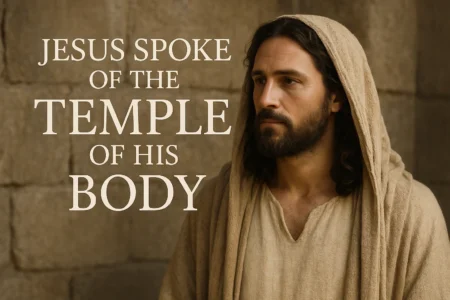
Jesus gives them a cryptic answer: “Destroy this temple, and in three days I will raise it up.”
They thought he was talking about the architecture, the stones and mortar. He was talking about his body. The cleansing of the temple was a prophetic act pointing to his death and resurrection. The physical temple had become corrupt and would eventually be flattened by Rome in 70 A.D. But the true Temple—the body of Christ—would be destroyed by sin and death and then raised in glory.
John 2:15 is the opening act of a drama that ends at the empty tomb. He cleanses the house to prepare it for the new era of worship—worship in Spirit and in truth.
Why Does John Place This Event at the Beginning?
If you read Matthew, Mark, and Luke, they place the temple cleansing at the end of Jesus’ ministry, right before the crucifixion. John puts it right at the start, in Chapter 2.
Scholars have argued about this for centuries. Did it happen twice? Many conservatives, and I’m in this camp, believe yes. It makes sense. He cleansed it at the start to announce his ministry, and he cleansed it at the end because the corruption had crept back in. Evil is persistent like that.
It reminds me of gutting a house. You can spend a month renovating, tearing out the rot, painting the walls. But give it a few years. The clutter returns. The dust settles. The “tables” get set up again.
The spiritual life requires constant maintenance. We can’t just point to a “moment” twenty years ago when we got right with God. We need a fresh cleansing. We need Jesus to walk through the courts of our hearts regularly and check the corners.
For more on the timeline of these events and the layout of the temple, you can check out this detailed breakdown of the Temple Courts.
What Does “Making a Whip” Say About Premeditation?
Let’s go back to the whip. I can’t get past the deliberate nature of it. Impulsive anger grabs the nearest object—a rock, a stick, a fist. Righteous anger plans.
Jesus sat. He braided. He thought. During those minutes, the noise around him continued. The bleating sheep. The clinking coins. The dishonest laughter of men counting their profits. He didn’t tune it out. He let it fuel his resolve.
This challenges me to think about how I handle the things in the world that break God’s heart. Do I just get mad and vent on social media? Or do I sit down, “braid the cords,” and formulate a plan to make a difference?
Real change—whether in our hearts or our society—requires this kind of focused, deliberate energy. It requires us to look at the problem, prepare our tools, and then act with decisive force.
Are We Too Polite in Our Spirituality?
We live in a culture that worships tolerance. We are terrified of offending anyone. Consequently, our Christianity often becomes beige, flavorless, and utterly unthreatening.
Jesus was not polite in John 2:15. He was disruptive. He caused a scene. He made a mess. Sometimes, following Jesus means making a mess. It means overturning the tables of racism, or greed, or hypocrisy in our own circles.
I had a conversation recently with a guy who told me, “I just like to keep my faith private. I don’t want to rock the boat.” I pointed him to this passage. Jesus didn’t just rock the boat; he capsized the economy of the temple. If our faith never offends anything or disrupts anyone, we have to wonder if it’s the same faith that Jesus modeled.
How Should We React to John 2:15 Today?
So, what do we do with this? We close our Bibles, but the image remains. The man with the whip. First, we should tremble a little. God is not a tame lion. He is holy, and he demands holiness. Second, we should invite him in. It’s a scary prayer to pray, but a necessary one: “Lord, come into my temple. If you see tables that shouldn’t be there, flip them over. If you see livestock that is making a mess, drive it out. Do whatever it takes to make me a house of prayer.”
It takes guts to pray that. It takes trust. But the Jesus who cleanses is also the Jesus who heals. He clears out the junk not to leave us empty, but to fill us with something better—Himself.
Conclusion
John 2:15 stands as a towering testament to the passion of Christ. It strips away our caricatures of a passive deity and presents us with a Lord who fights for the purity of worship. He made a whip of cords. He drove them all out. He refused to let the sacred be swallowed by the profane.
As I reflect on this, I realize I don’t want a safe Jesus. A safe Jesus can’t save me from my own darkness. I need the Jesus of the whip. I need the Jesus who loves me enough to disrupt my life, overturn my idols, and restore the temple of my heart to its rightful purpose. The noise of the market has gone on long enough. It is time to let the King clean house.
FAQ – John 2:15
Why did Jesus create a whip and drive out the vendors and animals from the temple in John 2:15?
Jesus created a whip of cords and drove out the vendors and animals to restore the sacredness of the temple, defending it from exploitation and corruption, and emphasizing that the temple’s purpose is worship, not commerce.
What is the significance of Jesus’ actions in the temple for understanding His character?
Jesus’ actions reveal His passionate love for God’s house and His zeal for true worship, showing that He is not passive but actively committed to holiness and purity.
Why does the image of Jesus with a whip shock many people today?
The image shocks because it contradicts the calming, gentle Savior often depicted; it portrays Jesus as fierce and willing to disrupt the status quo to defend sacred truth and justice, which can be unsettling in a culture expecting a bland or tame Jesus.
How does this event in John 2:15 relate to the concepts of grace and judgment?
This event demonstrates that grace and judgment are not mutually exclusive; sometimes grace involves divine intervention to remove obstacles to worship and righteousness, even if it appears violent, because love’s goal is to restore and purify.
What lessons can modern believers learn from Jesus’ cleansing of the temple?
Modern believers can learn to evaluate their own hearts and communities for anything that corrupts worship or grieves God’s Spirit, and to act courageously and deliberately to remove such barriers, trusting in Christ’s authority and love.