
We have done a really good job of domesticating Jesus. If you walk into most Sunday schools or scroll through religious memes on social media, you usually get a version of Christ that feels safe. He’s often portrayed with soft eyes, holding a lamb, looking like he wouldn’t hurt a fly. We like that Jesus. He’s comforting. He fits into our lives without knocking over the furniture.
But then you run headfirst into John chapter 2, and that safe image gets shattered.
You find a man standing in the middle of the religious epicenter of his day, and he isn’t offering platitudes. He is holding a weapon. He is flipping heavy tables. He is shouting down the religious elite. It’s violent, it’s loud, and frankly, it’s terrifying.
When his disciples watched this explosion of force, they didn’t think, “Oh, he’s having a bad day.” Their minds instantly snapped to an ancient text. They remembered Psalm 69:9. They remembered the phrase that defines the driving force of the Messiah: “Zeal for your house will consume me.”
This verse, John 2:17, isn’t just a caption for a dramatic moment. It is the key to understanding what actually makes God angry, what he is passionate about, and what it costs to truly follow him. It forces a mirror in front of my face, and I don’t always like what I see.
More in John Chapter 2 Category
Key Takeaways
- It wasn’t a temper tantrum: Jesus didn’t snap; he acted with calculated, theological precision to defend the marginalized.
- Zeal is dangerous: Biblical zeal isn’t just being “excited” about church; it is a burning, jealous heat that refuses to tolerate a rival.
- The geography matters: Jesus was clearing the Court of the Gentiles—the only place outsiders were allowed to pray—which had been turned into a marketplace.
- The ultimate cost: The “consumption” spoken of here points directly to the cross; his passion for God’s glory is what eventually got him killed.
- Our modern temples: If we are now the temple of the Holy Spirit, we have to ask what tables Jesus would flip over in our own hearts today.
Why in the world was Jesus so angry?
To get why John 2:17 matters, you have to understand the real estate. I think for years I missed this. I just assumed Jesus hated capitalism or didn’t like money changing hands in a church foyer. But it is way deeper than that.
The Jewish temple wasn’t one big room. It was a series of courts, getting more restrictive the closer you got to the center. There was the Holy of Holies, the Court of Priests, the Court of Israel, and the Court of Women. But way out on the perimeter was the Court of the Gentiles.
This was the only spot where a non-Jew—someone from the nations—could come to seek the God of Israel. If you were a seeker from Rome or Ethiopia, this was your designated prayer closet.
And what had the high priests done? They had turned that specific prayer closet into a barn.
They set up the cattle, the sheep, and the money exchange tables right there in the Court of the Gentiles. Imagine trying to pour your heart out to God, trying to find repentance, while a cow is relieving itself ten feet away and two guys are screaming at each other over the exchange rate of the shekel. It was impossible.
Jesus wasn’t just mad about the noise.
He was furious about the exclusion. They had taken the space meant for the nations and clogged it up with profit.
I felt a microscopic fraction of this feeling a few years back. I’m a dad, and when we bought our first house, I became obsessed with the backyard. I spent three weeks building this horizontal slat fence. I dug the post holes, poured the concrete, the whole nine yards. I stained it this rich cedar color. It was my sanctuary.
One Saturday, I looked out the kitchen window and saw three neighborhood teenagers sitting on top of it. Muddy sneakers grinding into the wood I had just sanded.
I didn’t knock on the window. I didn’t politely ask them to get down. I flew out the back door like a maniac. I was yelling before I even cleared the porch. “Get off! What is wrong with you?” My face was hot, my hands were shaking.
Now, my anger was selfish. I was protecting my wood, my money, my hard work. It was about me. But in that moment, the “zeal” for my house made me irrational to everyone else.
Jesus, however, wasn’t protecting his property for his own ego. He was protecting the access point to the Father. His anger was pure because it was entirely for the sake of others and the honor of God. He saw the clutter preventing people from meeting God, and he physically removed it.
What does “Zeal” actually mean in the Bible?
We use the word “zeal” pretty loosely these days. We might say someone is a “zealous” fan of the Philadelphia Eagles, or they are “zealous” about their CrossFit routine. We usually just mean they are high-energy or really committed.
But the Greek word used in John 2:17, zēlos, is heavier. It comes from a root word that means “to boil” or “to be hot.” It’s the same root used for “jealousy.”
In our modern relationships, jealousy is a red flag. It’s toxic. It implies insecurity. But biblical jealousy is different. It’s the protective fury of a husband who sees someone trying to harm his wife. It is the refusal to share the thing you love with an enemy.
When the text says, “Zeal for your house,” it means Jesus was burning with a hot, protective love for the purity of God’s worship. He wasn’t willing to negotiate. He wasn’t willing to say, “Well, the merchants provide a necessary service, so let’s just tolerate the noise.”
Zeal is intolerant of compromise.
I remember a phase in my late twenties where I confused busyness with zeal. I was doing everything at church. I was on the setup team, I led a small group, I was on the finance committee (which was a disaster), and I volunteered at the shelter. I looked zealous. I looked impressive.
But internally? I was cold. I was doing it for the applause. I was doing it because I couldn’t say no.
True zeal isn’t about the volume of your activity; it’s about the temperature of your heart. It’s about what breaks you. Does it bother you when God’s name is dragged through the mud? Does it keep you up at night when the church looks more like a corporation than a family? That is the heat of zēlos.
How does Psalm 69 connect the dots?
The disciples didn’t just pull this phrase out of thin air. They were Jewish men who had been steeped in the Torah and the Psalms since they were boys. When the tables started flying, something clicked.
They recalled Psalm 69:9: “For zeal for your house has consumed me, and the reproaches of those who reproach you have fallen on me.”
This is a lament of David. David was crying out because his faithfulness to God had made him a target. People were mocking him because he took God seriously. By applying this to Jesus, John is telling us something massive: Jesus is the Greater David. He is the ultimate Righteous Sufferer.
This connection is vital because it validates Jesus’ authority. If a random guy walks into a cathedral and starts smashing statues, he gets arrested for vandalism. But if the King walks in and starts smashing idols, it’s cleansing. The scripture proved he had the right to do it.
For a deeper dive into how the Old Testament Psalms prefigure the life of Christ, the Christian Classics Ethereal Library has some incredible, heavy-hitting commentaries from the early church fathers that connect these dots way better than I can.
The disciples realized that Jesus wasn’t just a teacher; he was the embodiment of God’s burning passion for his own glory. He felt the insult to the temple as a personal physical blow.
Was this a calculated move or a loss of control?
This is one of the most common questions I hear, and the answer changes everything about how we view Jesus. Did he snap? Did he just lose his temper?
I used to think so. I pictured him walking in, seeing the mess, and just seeing red. But look closely at the text in John 2:15.
“Making a whip of cords…”
Have you ever tried to braid a rope? It isn’t something you do in two seconds. You can’t do it while you are screaming in a blind rage.
He likely had to find the materials—maybe rushes from the bedding of the animals or dropped cords from the merchants. He had to sit down. He had to weave them together. This process took time. Ten minutes? Twenty?
What was he doing during those twenty minutes?
He was sitting there, watching. He was listening to the sheep bleat. He was watching the poor widow get ripped off by the money changer. He was watching the Gentiles being pushed to the margins. He wasn’t losing his temper; he was focusing it.
This was premeditated righteousness. It was a cold, hard calculation that the situation had become intolerable and required a physical disruption.
This scares me more than a sudden outburst. I can understand a sudden outburst; I have those in traffic all the time. But to sit, think, prepare a weapon, and then execute judgment? That is the authority of a Judge.
It challenges my own “righteous anger.” Usually, when I get mad, it’s reactive. Someone insults me, I snap back. Jesus shows us that true zeal is steady. It is controlled. He didn’t start hitting people (the Greek suggests he drove them out, likely striking the ground or the animals to cause a stampede), but he dismantled the system.
What does it mean to be “consumed”?
The verse says zeal “will consume me.” It’s future tense. It’s a prophecy.
In the immediate sense, it meant that this passion would take over his life. It would define him. But in the ultimate sense, it meant it would kill him.
You can’t go into the seat of power, threaten the financial livelihood of the high priests, and call them a “den of robbers” without putting a target on your back. This act in the temple was the turning point. It was the moment the authorities surely decided, “Okay, this guy has to die.”
His zeal for the Father’s house literally ate him up. It walked him up the hill to Golgotha.
This is where the rubber meets the road for us guys today. We love to talk about passion. We love to talk about being “all in.” But are we willing to be consumed?
I’ll be honest: I have a lot of hobbies that consume my time and money. I can spend hours watching videos on how to smoke the perfect brisket. I research the wood, the rub, the stall temperature. I am zealous about BBQ.
I get consumed by politics, too. I can doom-scroll for an hour, getting worked up about what some politician said, letting it ruin my mood for the whole evening.
But am I consumed by the things of God?
Most of the time, I want a balanced Christian life. I want enough Jesus to save my soul and make me a nice person, but I don’t want the kind of zeal that ruins my reputation. I don’t want the kind of zeal that makes things awkward at dinner parties. I want a “safe” faith.
John 2:17 tells me there is no such thing. If you want the real Jesus, you get the fire. You get the consumption.
How did the “House” change from brick to breath?
The most mind-bending part of this story happens right after the table flipping. The Jewish leaders demand a sign. They ask, “What sign do you show us for doing these things?”
Jesus gives them an answer that must have sounded completely insane: “Destroy this temple, and in three days I will raise it up.”
They thought he was talking about the building. They were like, “Buddy, it took 46 years to build this place. You’re going to rebuild it in a weekend?”
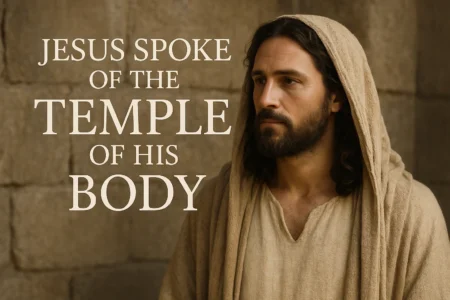
But John tells us, “He was speaking about the temple of his body.”
This is the pivot point of history. For centuries, if you wanted to meet God, you went to a GPS coordinate in Jerusalem. You went to the stone building. Jesus is saying, “No more.” The meeting place is no longer a place; it’s a Person.
And then, the New Testament takes it a step further. Paul tells us in Corinthians that we are the temple of the Holy Spirit. The church—you and me—is now the house where God lives.
So, apply John 2:17 to that.
If I am the temple, and Jesus is zealous for his house, what happens when he walks into the “courtyard” of my heart?
Does he find a house of prayer? or does he find a marketplace?
I have to do a brutal inventory here. Often, I have tables set up in my heart that need flipping. I have the table of Anxiety, where I trade peace for worry. I have the table of Bitterness, where I keep a ledger of everyone who has wronged me. I have the table of Lust or Greed.
If Jesus loves me—if he is truly zealous for me—he won’t leave those tables standing. He will come in with a whip. It might feel painful. It might feel like he is wrecking my life. But he is actually clearing the clutter so I can function as I was designed.
Righteous Anger vs. Just Being a Jerk
I have to include this section because I have seen so many guys use this verse as an excuse to be a jerk.
I’ve seen pastors bully their staff and say, “I’m just zealous for the Lord!” I’ve seen guys scream at their wives or kids and claim they are just leading their household with “passion.”
Stop it.
There is a massive canyon between Jesus’ anger and our temper.
Our anger is usually defensive. We get mad because our ego was bruised, our comfort was disturbed, or we didn’t get our way. Jesus’ anger was offensive—in the strategic sense. He wasn’t defending his ego; he was defending the helpless. He wasn’t mad that he was being inconvenienced; he was mad that God was being robbed of glory.
I recall a church business meeting—which is where the fruit of the Spirit often goes to die—where we were arguing over the budget. The debate got heated. I stood up and made this “passionate” speech about stewardship. I raised my voice. I pointed fingers. I felt like a prophet.
Looking back? I was just embarrassed that my idea was getting voted down. My pride was hurt, so I wrapped my ego in spiritual language and called it “zeal.”
If your “zeal” leaves a trail of damaged people, it’s not from God. Jesus drove out the oppressors to make room for the worshippers. If we drive out the worshippers to make room for our ego, we are the ones who need the whip.
The Danger of Familiarity
The merchants in the temple didn’t start out as evil villains. They probably started as a convenience. “Hey, people are traveling from far away, let’s sell them animals here so they don’t have to carry them.”
It started practical. Then it became profitable. Then it became the norm.
The tragedy is that they lost their awe. They were standing meters away from the Holy of Holies, and they were worried about profit margins. They treated the holy thing as a common thing.
This is the danger for all of us who have been in church for a while. Familiarity breeds contempt.
We hold the Bible—the actual words of the Creator—and we yawn. We take communion—the symbol of the broken body of Christ—and we are mentally checking our fantasy football lineup. We sing songs about the blood of Jesus while checking our watch to see if we can beat the Baptists to the lunch buffet.
John 2:17 is a wake-up call. It screams at us to recover our awe.
I have a buddy who restores old, high-end furniture. I watched him work once. He treats that wood with reverence. He moves slowly. He wears gloves. He doesn’t slam his tools around. He respects the material.
That is a picture of zeal. It is a careful, intense respect for the Master’s house. We need to get that back.
Does this zeal exist in the modern church?
If a non-believer walked into our churches this Sunday, would they describe us as “consumed with zeal”?
Or would they describe us as “mildly interested”?
We often confuse production value with zeal. We think if the music is loud and the lights are cool, we are passionate. But zeal isn’t about volume. You can have a quiet liturgy that burns with white-hot zeal. And you can have a rock concert that is spiritually dead.
True zeal shows up in obedience. It shows up when we refuse to budge on the truth of Scripture, even when the culture calls us backward. It shows up when we are the first to serve the poor, not for a photo op, but because we see Jesus in them.
It shows up when we protect the vulnerable. Remember, Jesus cleared the court for the Gentiles—the outsiders. If our churches are clubs for the elite and the put-together, we are missing the point. If we make it hard for broken people to get to Jesus because we are too fond of our traditions or our politics, we are the money changers.
Conclusion
The meaning of John 2:17 isn’t just a history lesson about a day Jesus got mad. It is a blueprint for the Christian heart.
“Zeal for your house will consume me.”
It’s a promise that following Jesus is dangerous. It’s a promise that he loves us too much to let us stay comfortable in our sin. He is coming for the tables.
He allowed that zeal to drive him to the cross, where he was consumed by the judgment of God in our place. He took the whip we deserved.
So now, the question is, will we let him have the run of the house? Will we hand him the keys to every room—the finances, the relationships, the secret habits? Will we let his zeal ignite our own, until we burn with a passion that makes the world stop and wonder?
It might cost you your reputation. It might cost you your comfort. But it is the only way to truly come alive.
FAQ – John 2:17
Why was Jesus so angry in John 2:17, and what does this reveal about God’s passions?
Jesus’ anger in John 2:17 was fueled by his zeal for God’s house, specifically defending the integrity of worship and the exclusion of outsiders. This reveals that God’s passions include a deep love for purity in worship and a protective fury for His glory.
What is the true meaning of ‘zeal’ in the biblical context, and how does it differ from modern usage?
Biblical ‘zeal,’ derived from the Greek ‘zēlos,’ means a hot, protective love that refuses to tolerate rivals or impurity. Unlike modern usage, which often signifies high energy or enthusiasm, biblical zeal signifies a burning, committed passion rooted in love and righteousness.
How does Psalm 69 connect to Jesus’ actions in clearing the temple, and what does this imply about His identity?
Psalm 69:9, which speaks of zeal consuming the sufferer, is connected to Jesus’ temple cleansing as a prophecy of His unwavering passion for God’s holiness. It implies that Jesus is the Greater David, embodying righteous suffering and authority in defending God’s honor.
Was Jesus’ action in the temple a sudden outburst or a premeditated act of righteousness?
Jesus’ actions were premeditated; he carefully prepared a whip and thoughtfully drove out the merchants, demonstrating calculated righteousness rather than losing control in anger.
What does Jesus’ statement about destroying the temple and raising it in three days signify for believers today?
It signifies that the place of worship has shifted from a physical building to Jesus Himself and believers’ hearts. It challenges Christians to examine if their own hearts and lives are true temples of worship, cleansed of clutter and distraction.