
You can almost hear the silence ripple through the crowd. Just seconds before, the air cracked with the sound of a whip and the chaotic clatter of coins hitting the stone pavement. Animals bellowed, merchants shouted over overturned tables, and the religious elite stood there, jaws on the floor. Jesus had just cleared the temple courts, disrupting the lucrative Passover business with a holy vengeance that nobody saw coming.
When the dust finally settled, the Jewish leaders didn’t arrest Him. Not yet. Instead, they demanded a sign. They wanted credentials. They wanted to know who gave this carpenter from Nazareth the authority to wreck their commerce and interrupt their worship.
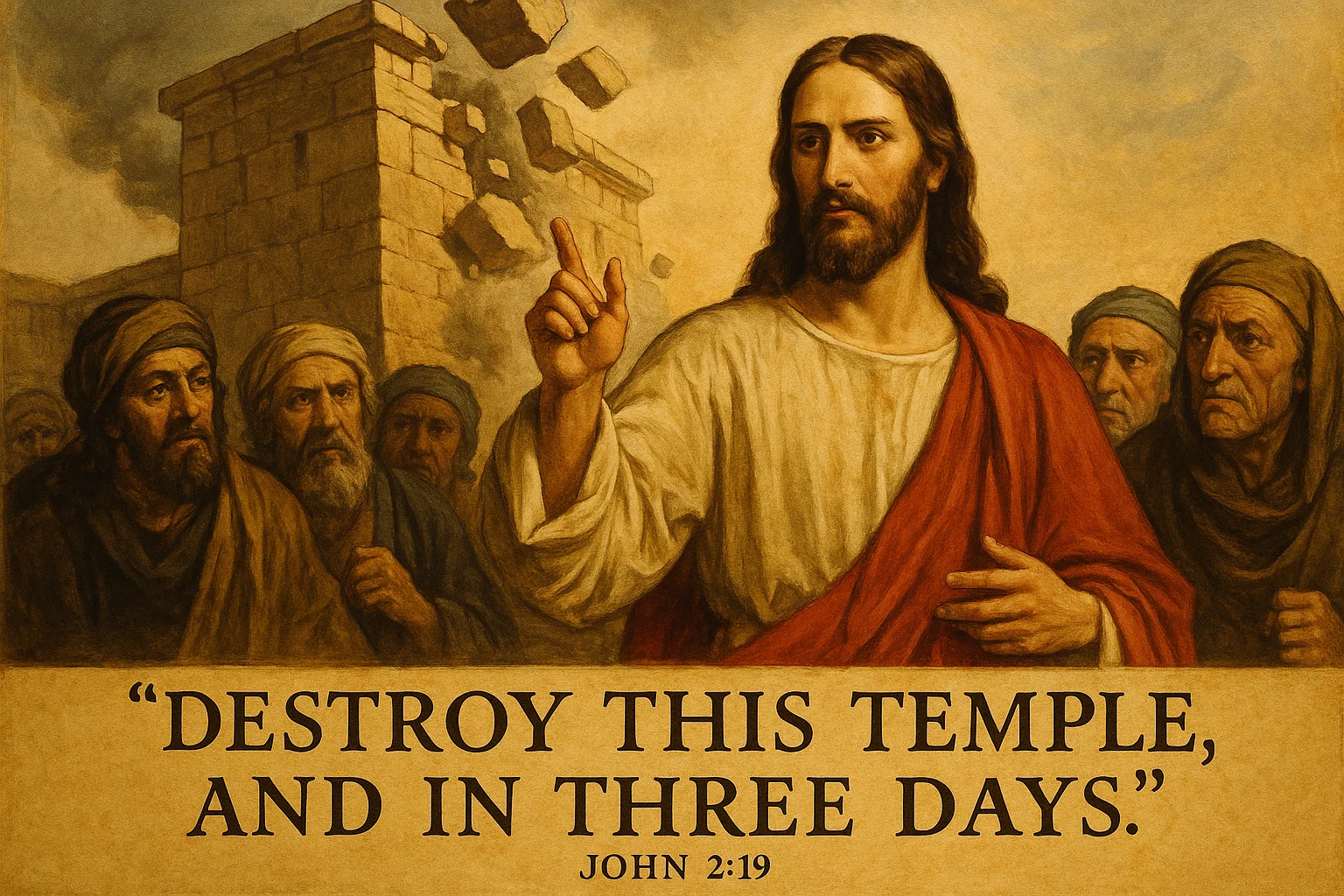
Jesus didn’t pull out a scroll. He didn’t call down fire from the sky. Instead, He looked them dead in the eye and dropped a riddle that would haunt them all the way to His trial: “Destroy this temple, and in three days I will raise it up.”
Understanding the John 2:19 meaning requires us to stop looking at the bricks and mortar. We have to look at the architecture of God’s plan. This wasn’t a threat against a building; it was a prophecy about a body. It creates a definitive line in the sand of history where the dwelling place of God shifted from a location on a map to a Person.
More in John Chapter 2 Category
Key Takeaways
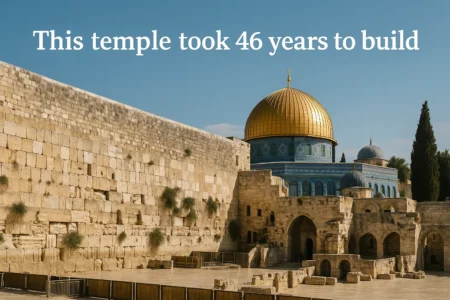
- The Misunderstanding: The religious leaders were obsessed with the physical Second Temple (Herod’s Temple), a massive construction project that had been dragging on for 46 years.
- The True Temple: Jesus wasn’t talking about architecture; He was referring to His own body as the Temple, the actual meeting place between God and man.
- The Sign of Authority: The resurrection (“in three days I will raise it up”) is the ultimate receipt. It proves Jesus has authority over religious systems and death itself.
- A New Era: This moment signals the end of “location-based” worship and the start of “relational” faith.
- Prophetic Fulfillment: Even the disciples were scratching their heads until after the resurrection, which proves that spiritual truth often needs the lens of the cross to make sense.
Why did Jesus cause such a scene in the temple courts?
We have this habit of picturing Jesus as perpetually soft, maybe sitting on a hillside with a lamb. But John 2 paints a totally different portrait. We see a man consumed with zeal. It’s jarring. It’s intense. It’s scary.
I remember getting into a scrap in the schoolyard when I was about ten. I was a scrawny kid, but I saw a bully knock the lunch tray out of my younger brother’s hands. I didn’t think about the size difference. I didn’t calculate the odds. I just reacted. It wasn’t about hate; it was about protection. There is a specific kind of anger that is born strictly from love, and that is exactly what we see exploding in the temple courts.
Jesus walked into the Court of the Gentiles—the one single space where non-Jews were allowed to pray to the God of Israel—and found a flea market. The noise of cattle and the haggling of money changers drowned out the prayers of the nations. They had turned his Father’s house into a mall.
He fashioned a whip of cords. He drove them out. He wasn’t just tidying up; He was reclaiming sacred ground. This action sets the stage for John 2:19. The leaders demanded a “sign” to prove He had the right to clean house. Jesus basically told them: You want a sign? You’re looking at the Temple. Kill it, and watch what happens.
What exactly was the “Sign” the Jewish leaders demanded?
In the first century, you couldn’t just walk into town and claim to be a prophet. You had to prove it. Moses had the burning bush and the plagues. Elijah called down fire. So the Jews asked Jesus, “What sign do you show us for doing these things?”
They wanted a cosmic magic trick. They expected Him to part the sky, turn the stones to bread, or maybe make the sun stand still.
Jesus gave them something far more cryptic. He pointed to the ultimate sign: the Resurrection. But notice how He phrased it. He invited them to do their worst. “Destroy this temple.” He handed them the hammer and nails, metaphorically speaking, right there in the courtyard.
This response does two things. First, it predicts His death at their hands. Second, it stakes His entire claim of deity on His ability to walk out of a grave. If Jesus stays dead, He is a liar. If He rises, He is Lord of the Temple. It’s an all-or-nothing gamble.
Was Herod’s Temple really that magnificent?
To understand why the crowd thought Jesus was crazy, we have to grasp the sheer scale of the building they were standing in. When the Jews retorted, “It has taken forty-six years to build this temple,” they weren’t exaggerating.
Herod the Great began this renovation project to win favor with the Jews, and he spared no expense. We aren’t talking about a small country church with a steeple. We are talking about an architectural marvel of the ancient world. Historians tell us that some of the stones were so massive—40 feet long—that modern engineers still scratch their heads trying to figure out how they moved them without hydraulics.
Gold plates covered the front of the sanctuary. Josephus, the ancient historian, wrote that when the sun hit the temple at sunrise, it was blinding. It looked like a mountain of snow topped with gold.
Imagine walking into the Vatican or the U.S. Capitol building and hearing a dusty traveler say, “Tear this down, and I’ll fix it over the weekend.” You would think he was insane. That is exactly how they looked at Jesus. They saw the marble; Jesus saw the mechanism of salvation. They saw a monument to religion; Jesus saw the vessel of God’s spirit.
For a deeper look at just how massive this structure was, the Yale University course on Roman Architecture gives some incredible context on how Herod transformed the Temple Mount.
How does John 2:19 change our understanding of “Temple”?
This is the pivot point. The Greek word Jesus uses here is naos. This isn’t the word for the whole temple complex. It refers specifically to the inner sanctuary, the Holy of Holies—the place where God’s presence actually dwelt.
In the Old Testament, if you wanted to meet with God, you went to the building. You brought a goat. You followed the protocol. The structure was the mediator.
I recall sitting in a stiff wooden pew as a child, staring at the heavy velvet curtains at the front of our church. My grandmother told me to hush because “this is God’s house.” I was terrified to run in the aisles. I thought God lived in the woodwork. I imagined Him hovering somewhere near the pipe organ, watching to see if I fidgeted. It created a distance. I was here; God was there.
Jesus shattered that distance. By identifying His body as the Temple, He announced that God had moved out of the brick and mortar and into flesh and bone.
This means the meeting place is no longer a zip code in Jerusalem. The meeting place is Jesus Himself. We don’t go to a building to find God; we go to Christ. He is the altar. He is the sacrifice. He is the High Priest. He is the glory.
Why did the disciples miss the point until later?
John is honest enough to admit in verse 22, “When therefore he was raised from the dead, his disciples remembered that he had said this.”
They didn’t get it. Not right then.
I find this incredibly comforting. These guys walked with Him, ate with Him, and slept near the campfire with Him, yet they were just as confused as the Pharisees. They likely looked at the massive stone walls, looked back at Jesus, and shrugged.
The disciples viewed Jesus through the lens of a conquering King who would kick out the Romans, not a Dying Messiah who would be crushed by them. The idea of the “Temple” being destroyed was unfathomable. It wasn’t until they stood in the empty tomb that the tumblers of the lock clicked into place.
Retrospect is a powerful teacher. Sometimes we read Scripture and feel frustrated by our lack of understanding. We want immediate clarity. But often, the Holy Spirit uses time and experience to unlock the truth of the Word. The disciples needed the Resurrection to decode the riddle.
Is there a deeper connection between the Tabernacle and the Resurrection?
The architecture of the Old Testament Tabernacle helps us decode John 2:19 even further.
Think back to the wilderness. God told Moses to build a tent. The design was specific. It had an outer court, a Holy Place, and the Holy of Holies. God’s presence hovered over the Ark of the Covenant in that inner room.
John 1:14 tells us that the Word became flesh and “dwelt” among us. That word “dwelt” literally means “tabernacled.” Jesus pitched His tent among us.
When Jesus says, “Destroy this temple,” He is acknowledging that His body is the veil. Remember what happened the moment Jesus died on the cross? The veil in the physical temple tore from top to bottom. Why? Because the Real Temple had been destroyed, rendering the shadow temple obsolete.
The death of the physical body of Jesus released the presence of God to the world. The “three days” parallels the sign of Jonah, but it also parallels the restoration of humanity. The building brings separation; the Body brings reconciliation.
How does this verse relate to the trial of Jesus?
Fast forward three years. Jesus stands bound before the High Priest. They are desperate for a charge that will stick.
Matthew 26:61 tells us that two false witnesses came forward and said, “This fellow said, ‘I am able to destroy the temple of God and to build it in three days.'”
Notice the twist?
- Jesus said, “Destroy this temple” (imperative—you do it).
- The witnesses heard, “I am able to destroy the temple” (declarative—I will do it).
They accused Him of being a terrorist threatening a national monument. Jesus was actually predicting that they would be the destroyers. They projected their violence onto Him. This distortion is tragic but telling. Religion often protects its structures at the cost of truth. They loved the building more than the Builder. They were willing to kill the Living God to protect the house of God.
What does a “Temple” made without hands look like?
Stephen, the first martyr, preached a sermon that got him stoned. His main point? “The Most High does not dwell in temples made with hands.”
We humans love things we can touch. We love cathedrals with flying buttresses. We love mega-churches with stage lighting. We love shrines. We like to contain the Divine because a contained God is a safe God. A God in a box (or a building) can be visited on Sunday and ignored on Monday.
A Temple made without hands—the resurrected body of Christ—is wild and untamable. It implies that the Spirit is loose in the world.
When Jesus raised “it” up, He didn’t just reanimate a corpse. He inaugurated a new creation. The Resurrection body of Jesus is the first brick in a new spiritual house. He is the cornerstone.
Are we now the Temple of the Living God?
This is where the theology of John 2:19 crashes into our daily lives. If Jesus is the Temple, and we are “in Christ,” what does that make us?
The Apostle Paul connects the dots in 1 Corinthians 6:19: “Or do you not know that your body is a temple of the Holy Spirit within you?”
A few years back, my body betrayed me. I was stuck in a hospital bed, tethered to beeping machines, watching a bag of fluid drip, drip, drip into my arm. You feel helpless. I looked at my shaking hand and felt a sense of anger at my own biology. I had always treated my body as a tool—something to get me to work, to play sports, to do chores.
But lying there in the dark, the reality hit me. This fragility isn’t just a shell; it’s a sanctuary.
If the Spirit of Him who raised Jesus from the dead dwells in us, we are walking, talking, breathing mobile temples. We carry the Holy of Holies into the grocery store. We carry it into our offices. We carry it onto the freeway.
This changes how we treat ourselves and how we treat others. You don’t vandalize a temple. You don’t pollute a sanctuary. The holiness that was once restricted to a stone room in Jerusalem now resides in the chest of every believer.
What did Jesus mean by “I Will Raise It Up”?
We usually attribute the Resurrection to the Father or the Holy Spirit. Scripture supports both. But here, Jesus claims agency: “I will raise it up.”
This speaks to His authority over life and death. He says in John 10:18, “No one takes it from me, but I lay it down of my own accord. I have authority to lay it down, and I have authority to take it up again.”
This is a staggering claim. A dead man cannot resuscitate himself unless that man is also the Author of Life. This highlights the dual nature of Christ. The human body would die; the divine nature would resurrect that body.
For the audience listening that day, this was nonsense. For us looking back, it is the anchor of our hope. If He has the power to raise His own destroyed temple, He certainly has the power to restore the ruined parts of our lives.
How does the “Third Day” motif echo through Scripture?
Why three days? Why not instantly? Why not a week?
The “third day” is a rhythm found throughout the Bible.
- Abraham traveled three days to sacrifice Isaac before God provided the ram (a type of resurrection).
- Jonah spent three days in the belly of the whale.
- Esther fasted for three days before approaching the King to save her people.
The three days represent a period of complete darkness, a genuine death, followed by a deliverance that only God can provide. It proves that death was not a swoon or a coma. It was final. The span of three days validates the reality of the death and the miracle of the return.
When Jesus spoke of three days, He was tapping into a deep Hebrew consciousness of trial and deliverance. He was saying, I will go into the deepest darkness, the place of no return, and I will walk out the other side.
Why does the location of this saying matter?
Jesus didn’t say this in a synagogue in Galilee. He said it in Jerusalem, at Passover.
Passover celebrates the blood of the lamb saving the people from death. By standing in the Temple during Passover and speaking of His death and resurrection, Jesus replaces the Passover lamb. He replaces the Temple rituals.
He is redefining the center of gravity for the Jewish faith. It is no longer about a place; it is about a Person. It is no longer about animal blood; it is about His blood.
The irony is thick. The priests were busy preparing lambs for slaughter, unaware that the Lamb of God was standing right in front of them, telling them exactly how the ultimate sacrifice would go down.
Conclusion
The challenge of John 2:19 remains as potent today as it was two thousand years ago. We are naturally religious people. We like our structures. We like our rituals. We like to point to a building and say, “God is there.”
But Jesus looks at our structures—whether they are actual buildings or the religious frameworks we build in our minds—and says, “I am the point.”
The meaning of “Destroy this temple, and in three days I will raise it up” is the gospel in a nutshell. It is the promise that human efforts to destroy God’s plan will only serve to fulfill it. The cross looked like a defeat. It looked like the Temple was destroyed. But the empty tomb proved that the true Temple is indestructible.
We don’t need to travel to Jerusalem to find the presence of God. We don’t need a priest to offer a sacrifice for us. We have a Living Temple who has walked out of the grave. And wonderfully, terrifyingly, He has invited us to be living stones in that same spiritual building.
So, the next time you walk into a church, remember: the building is just a shell. The church is you. The Temple has left the building, and He is alive and active in the world through His people.
FAQ – John 2:19
Why did Jesus cause a disturbance in the temple courts, and what was His motivation?
Jesus caused the disturbance out of zeal to reclaim sacred space for worship, driven by love for God’s house, which had been turned into a marketplace, and to confront the corruption and distortion of true worship.
What did the Jewish leaders expect as a sign from Jesus, and how did He respond?
The Jewish leaders expected a miraculous sign to verify Jesus’ authority, but Jesus responded cryptically by referring to His resurrection, indicating that His death and rising again would serve as the ultimate sign of His divine authority.
How does the concept of the temple evolve in understanding through John 2:19?
John 2:19 shifts the understanding from a physical temple to Jesus’ body as the true temple, signifying that God’s presence and meeting with Him are now centered in Christ, not in man-made structures.
What does the statement ‘Destroy this temple, and in three days I will raise it up’ imply for believers today?
It implies that Jesus is the indestructible spiritual Temple, and believers, being in Christ, are also temples of the Holy Spirit, emphasizing the shift from reliance on buildings to a personal relationship with Jesus.