
I’m going to be honest with you. For a long time, I treated verses like John 2:12 as the “commute” scenes in a movie. You know the ones. The hero gets in the car, drives for five seconds of screen time, and arrives at the villain’s lair. You don’t pay attention to the drive. You check your phone. You grab more popcorn. You wait for the action to start again.
That’s how I read the Bible. I wanted the highlights. Give me the Wedding at Cana with the miraculous wine. Give me the whip of cords in the Temple courts. Skip the travel log.
But then I got older. I started realizing that life isn’t mostly highlights. Life is mostly travel days. It’s mostly packing bags, waiting for family members to get their shoes on, and staring out the window on a long drive. When I slowed down and actually looked at John 2:12, I realized John wasn’t just filling space. He was showing us the humanity of Jesus in a way the big miracles sometimes obscure.
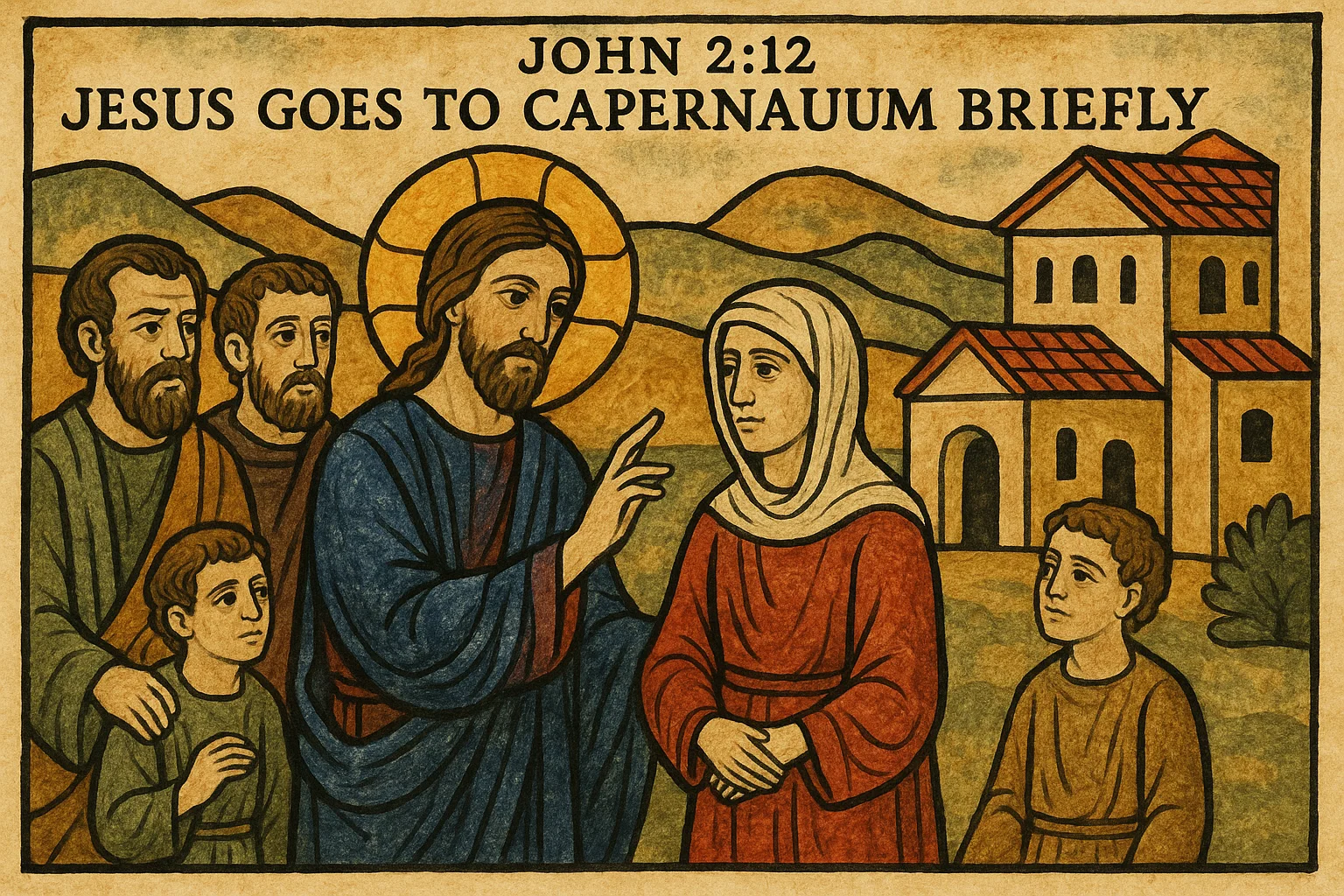
John 2:12 says: “After this he went down to Capernaum, he, and his mother, and his brethren, and his disciples: and they continued there not many days.”
It’s short. It’s simple. But man, is it loaded. This isn’t just a travel itinerary; it’s a pivot point. It’s the moment the private son becomes the public prophet, and it’s messy, real, and strategic all at once.
More in John Chapter 2 Category
Key Takeaways
- The Strategic Shift: This move signals the end of the “hidden years” in Nazareth and establishes Capernaum as the new base of operations for the Galilean ministry.
- Real Family Tension: Traveling with biological family (who didn’t believe yet) and new disciples created a unique, high-pressure dynamic.
- Topographical Reality: The phrase “went down” is a precise geographical marker, proving the eyewitness nature of the text.
- The Necessary Pause: Jesus prioritized rest and regrouping before heading into the spiritual war zone of Jerusalem.
Why does a seemingly “filler” verse matter so much?
We have this tendency to spiritualize everything Jesus did to the point where He floats six inches off the ground. We forget He had feet. We forget He had to pack. We forget He probably had to wait for His brother James to find his sandals before they could leave Cana.
This verse matters because it grounds the Gospel in grit. It reminds us that the Incarnation wasn’t just God appearing as a man; it was God living the schedule of a man. He had transitional days. He had days where the main goal was just “get to the next town.”
I think about my own life. The moments that shaped me weren’t always the graduation ceremonies or the wedding days. It was the drive to the new city. It was the quiet Tuesday morning before the big meeting. If we skip John 2:12, we miss the fact that God sanctified the “in-between” moments. He made the mundane holy just by participating in it.
What happened right before Jesus went to Capernaum?
Context is everything. You can’t understand the “after this” without feeling the weight of the “this.”
Jesus had just saved a wedding in Cana. He turned water into wine—and not just cheap swill, but the best vintage the guests had ever tasted. But keep in mind, this was a “stealth” miracle. The master of the banquet didn’t know. Most of the guests didn’t know. Only the servants, Mary, and the disciples saw the gears turn.
It was a high point. His disciples “believed in him” (John 2:11). The team was solidifying. Morale was high.
I remember the weekend I got engaged. It was this massive emotional peak. High fives, champagne, calling everyone in my contacts list. But Monday morning hit like a freight train. The adrenaline wore off, and I realized, “Oh, now I actually have to plan a wedding. Now I have to figure out where we are going to live.” The high of the event gave way to the logistics of the reality.
That’s where Jesus is. He is moving from the celebration to the logistics. He is gathering his entourage—which is a weird mix of people at this stage—and moving them to the staging ground. The party is over. The work is beginning.
Why do the Scriptures say He “went down” when Capernaum is north?
If you pull up Google Maps right now and look at Israel, Capernaum is northeast of Cana. In our Western, map-oriented brains, “north” is “up.” You go “up” to Chicago. You go “up” to New York. So why does John, who supposedly witnessed this, say they went “down”?
Because John didn’t live on a paper map. He lived on the ground.
Cana is in the hill country. It’s elevated. Capernaum sits on the shoreline of the Sea of Galilee. The Sea of Galilee is an anomaly; it’s nearly 700 feet below sea level. It is a deep, humid bowl in the earth.
To get from Cana to Capernaum, you are walking downhill almost the entire time. You are descending from the rocky, breezy highlands into the tropical heat of the Jordan Rift.
This is the kind of detail a forger misses. If I were making up a story about a country I’d never visited, I’d say “He went over to Capernaum” or “He traveled north.” But John says “down” because he remembers the burn in his shins from braking on the descent. He remembers the air getting thicker and hotter as they dropped below sea level. It’s a stamp of authenticity.
Who actually tagged along for this trip to Capernaum?
Here is the cast of characters listed in verse 12:
- Jesus
- His Mother (Mary)
- His Brethren (James, Joses, Judas, Simon)
- His Disciples (Peter, Andrew, Nathanael, Philip, etc.)
Stop and look at that group for a second. Really look at it. This is a recipe for awkwardness.
You have the new “work friends” (the disciples) who think Jesus is the Messiah. They are wide-eyed, eager, and probably a little intense.
Then you have the “siblings.” We know from John 7:5 that “neither did his brethren believe in him.” They grew up with Him. To them, He isn’t the Messiah yet; He’s just their big brother who is suddenly acting very different and attracting a crowd.
I come from a family of boys. I have brothers.
We love each other, but let me tell you, the dynamic between brothers is… specific. There is a skepticism there. If one of my brothers suddenly started claiming to be a prophet, I wouldn’t be the first to sign up. I’d be the one in the back rolling my eyes, saying, “Dude, I remember when you crashed dad’s car.”
Now, imagine a road trip with both groups. The disciples are probably asking Jesus deep spiritual questions, hanging on His every word. The brothers are probably walking a few paces back, whispering, “Where are we even going? Why are we following Him? Is Mom okay with this?”
And Mary? She is right in the middle. She knows who He is. She triggered the miracle at Cana. But she is also the mother of the skeptics.
Jesus held this group together. He didn’t tell his brothers, “Get lost, you don’t have enough faith.” He let them come. He let them see. He walked “down” to Capernaum with the believers and the doubters side-by-side. That shows a patience I frankly do not possess.
Why Capernaum? What made this fishing village special?
Why not stay in Nazareth? Why not set up shop in Cana?
Nazareth was nowhere. It was a tiny agricultural village nestled in the hills. It was insular. Everyone knew everyone, which means everyone knew Jesus as “the carpenter’s son.” It’s hard to launch a global revolution from a place where people still pinch your cheeks because they knew you as a toddler.
Capernaum was different.
Capernaum was the hustle. It sat on the Via Maris (The Way of the Sea), the major international highway connecting the empires of the north (Syria, Babylon) to the empires of the south (Egypt). It wasn’t just Jewish peasants; it was Roman soldiers, Greek merchants, Syrian traders. It was a border town with a customs house (where Matthew worked).
By moving “down” to Capernaum, Jesus was making a strategic play. He was placing His light on a lampstand. If you said something in Nazareth, it stayed in Nazareth. If you did a miracle in Capernaum, a caravan driver might see it and talk about it in Damascus three days later.
Is Capernaum just a random stopover or a strategic headquarters?
While John 2:12 makes it sound brief (“not many days”), the other Gospels (Matthew 4:13) tell us that leaving Nazareth and dwelling in Capernaum was a fulfillment of prophecy. Capernaum became “His own city” (Matthew 9:1).
Think of John 2:12 as the “soft launch” or the “move-in weekend.”
When I moved my family across the country for a new job, we didn’t just teleport. We went down a month early. We stayed in a hotel. We drove around the neighborhoods. We found the grocery store. We got a feel for the rhythm of the place.
That’s what this feels like. Jesus is bringing the family down to get settled. He is establishing a base. He knows He is about to head to Jerusalem to pick a fight with the religious establishment, and He needs a safe harbor to return to. Capernaum—with its open-minded, mixed population and easy access to the lake for quick getaways—was the perfect tactical headquarters.
What does “not many days” tell us about Jesus’ schedule?
The text is specific: “they continued there not many days.”
Why the rush? Why not stay for a month and enjoy the lake?
Because the calendar was ticking. Verse 13 tells us, “And the Jews’ passover was at hand.”
Jesus was an observant Jew. He lived under the Law. The Law of Moses required all able-bodied males to appear before the Lord in Jerusalem for the three major feasts. Passover was the big one.
This creates a sense of urgency in the text. Jesus couldn’t get comfortable. He had a divine appointment. It reminds me that Jesus lived a life of immense discipline. He didn’t just float around Galilee doing whatever felt good. He had a schedule. He had obligations.
But here is the kicker: He still stopped.
He could have gone straight from Cana to Jerusalem. It would have been more efficient. But He took the detour to Capernaum first. Why? Maybe Mary needed to rest. Maybe He needed to check on the fishing boat business with Peter. Maybe He just needed to look at the water for a few days before walking into the snake pit of the Temple.
It teaches us that even when “the Passover is at hand”—when the deadline is looming—it is okay to take a few days to breathe.
How does John 2:12 connect family duty with divine mission?
This touches a nerve for me.
Jesus is the Son of God. He has the weight of the cosmos on His shoulders. He is about to redeem humanity. But in John 2:12, He is also acting as the eldest son of a widow.
Most scholars agree that by this time, Joseph has passed away. He disappears from the narrative after Jesus is twelve. In that culture, the responsibility for the mother and the unwed siblings fell to the oldest son.
Jesus didn’t abandon His post. He didn’t say, “Sorry Mom, I’m the Messiah now, good luck with the rent.” He brought them with Him. He relocated them to Capernaum, likely to keep them close and safe while He was traveling.
I remember when my dad got sick a few years back. I was in the middle of the busiest season of my career. I was trying to build a business, trying to be “important.” But suddenly, none of that mattered. I had to drive to the hospital. I had to sit in waiting rooms. I had to be a son first.
It was exhausting, trying to balance the mission of my work with the duty to my family. I felt pulled in two directions.
Seeing Jesus do this—seeing Him manage the logistics of moving His mother and brothers while simultaneously preparing to cleanse the Temple—is profoundly comforting. He gets it. He knows the burden of family responsibility. He didn’t shun it; He integrated it into His mission.
Are we seeing the shift from private son to public Messiah?
This is the pivot. The “Hinge of the Gospel,” if you will.
In Cana (John 2:1-11), Jesus is operating in the private sphere. He is at a wedding. He is dealing with wine and jars. It’s domestic.
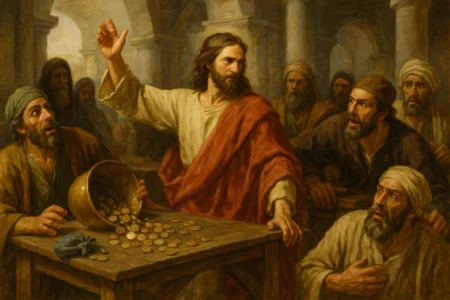
In Jerusalem (John 2:13 and on), He is operating in the public sphere. He is dealing with money changers, priests, and national worship.
John 2:12 is the bridge. It is the moment He walks out of the private life of a Nazareth carpenter and steps onto the stage of history.
Bringing the family to Capernaum might have been a way of protecting them from the fallout. He knew that once He flipped those tables in Jerusalem, His name would be mud among the elite. He would be a marked man. Nazareth was too small to hide from the gossip. Capernaum was big enough to get lost in. He was positioning His loved ones before He pulled the pin on the grenade.
What archaeological evidence supports John’s account?
I love this stuff because it silences the critics who say the Bible is a collection of fairy tales.
If you go to Capernaum today, you can see the ruins. You can see the black basalt foundations of the first-century homes. They were simple, cramped, grouped together in “insula” (family compounds).
Specifically, there is one house that stands out. Archaeologists call it “Peter’s House.” Since the very early first century, this specific house was treated differently. The internal walls were plastered (unusual for a poor fisherman’s house), and it was turned into a house church. They found Christian graffiti scratched into the walls from the earliest centuries.
It sits right across from the Synagogue.
So when John says they went “down to Capernaum,” he isn’t inventing a setting. He is describing a real house, likely Peter’s, where Jesus, Mary, and the brothers probably crashed on the floor or in the courtyard. It brings the story into 3D. You can almost smell the fish drying in the courtyard and feel the rough basalt stones.
How should we apply this transitional moment to our own lives?
We hate the “in-between,” don’t we?
We love the mountaintop experiences (Cana). We feel useful in the battles (Jerusalem). But the travel days? The days where we are just moving boxes or waiting for the next thing to start? We hate those. We feel like we are wasting time.
But look at Jesus. He didn’t rush.
Maybe you are in a John 2:12 season right now. You’ve had a win, but the next big door hasn’t opened yet. You are just… waiting. You are in Capernaum for “not many days.”
Don’t waste the pause.
Use this time to solidify your team. Look who is walking with you. Are you ignoring your family because you are too focused on your “mission”? Are you ignoring your disciples because you are too focused on your family?
Jesus used this transit time to bind His group together. He let them share the road. He let them eat together. Those quiet days in Capernaum likely built the trust that the disciples needed when things got scary in Jerusalem a week later.
Did the brothers know what was coming?
This is the question that keeps me up. Did James, Joses, Simon, and Judas have a clue?
They were going up to Jerusalem for Passover. To them, this was tradition. It was turkey at Thanksgiving. They expected to roast a lamb, drink some wine, sing the Psalms, and go home.
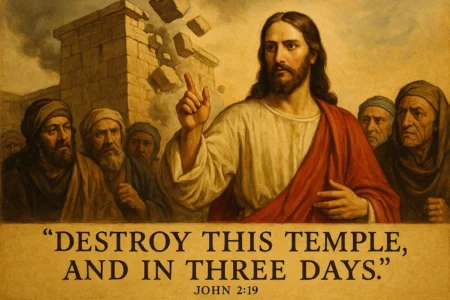
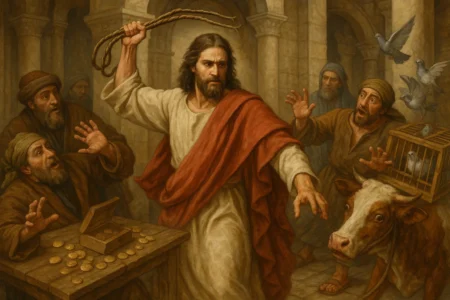
They had zero idea that their brother was about to walk into the Court of the Gentiles, make a whip out of cords, and single-handedly shut down the temple sacrifice system.
If they had known, would they have gone? Or would they have tried to stop Him? “Jesus, don’t make a scene. You’re going to get us all arrested.”
This teaches me that God rarely gives us the full script. He gives us the next scene. “Go to Capernaum.” Okay. “Go to Jerusalem.” Okay.
If God showed us the battles we were about to fight, we’d probably run the other way. He gives us the grace of ignorance. He leads us one step at a time, just like Jesus led his unsuspecting brothers down the road to the sea.
The Contrast: The Quiet Lake vs. The Noisy Temple
You can’t appreciate the silence of verse 12 until you hear the noise of verse 14.
- Verse 12: Capernaum. The sound of waves. Family dinner. A few days of rest.
- Verse 14: Jerusalem. The bleating of sheep. The lowing of oxen. The clinking of coins. The shouting of angry merchants.
The contrast is violent. Jesus moves from the serenity of the lakeside to the cacophony of the religious market.
I believe He needed Capernaum to prepare for the Temple. As a man, He needed to fill His tank with the beauty of creation and the warmth of fellowship before He faced the cold, hard greed of the religious system.
We need that too. Men, especially. You cannot fight dragons every day. If you don’t have a Capernaum—a place to just sit, breathe, and be with your people—you will burn out before you ever get the chance to flip the tables that need flipping.
Final Thoughts on the “Go Down”
John 2:12 is small. You could miss it if you blink.
But don’t.
It’s the verse that tells us God cares about geography. He cares about family road trips. He cares about rest. It tells us that the Savior of the world didn’t just teleport from miracle to miracle; He walked the dusty miles in between.
He dealt with the awkwardness of skeptical brothers. He dealt with the logistics of moving His mom. He dealt with the heat of the Jordan Valley.
So the next time you feel stuck in a transition—somewhere between your last victory and your next battle—remember John 2:12. Jesus was there too. He didn’t waste the journey, and neither should you.
FAQ – John 2:12
What is the significance of John 2:12 in understanding Jesus’ life and ministry?
John 2:12 highlights the transition of Jesus from private life to public ministry, illustrating that He lived through mundane, transitional days just like any other person, emphasizing His humanity and strategic movements in His mission.
Why does the verse John 2:12, which seems simple, carry such importance in the Gospel narrative?
This verse grounds the Gospel in the reality of everyday life, showing that Jesus experienced mundane journeys and family responsibilities, sanctifying ordinary moments and reminding us that living in the in-between times is part of divine purpose.
How does the geographical detail in John 2:12 support its authenticity?
The phrase ‘went down’ reflects the actual topography of the area, with Cana situated in the hill country and Capernaum on the Sea of Galilee below sea level, confirming the eyewitness nature of the account and adding historical credibility.
Who traveled with Jesus in John 2:12, and what does this group tell us about His family and followers?
Jesus was accompanied by His mother Mary, His brothers (James, Joses, Judas, Simon), and His disciples, indicating a diverse group including skeptics and believers, demonstrating Jesus’ patience and inclusiveness even amid potential tension.
What lessons can we draw from Jesus’ time in Capernaum before His public ministry?
Jesus’ time in Capernaum teaches us the importance of resting, preparing, and building relationships during transitional periods, reminding us not to rush through the in-between moments but to use them for growth and solidifying our teams.