
I still remember the moment I realized authority isn’t about the badge. It was years ago on a job site. I was twenty-two, fresh out of college, green as summer grass, and technically in charge of a concrete crew. These guys had been pouring foundations since before I was born.
I walked up to the foreman, a guy named Mike with hands like catcher’s mitts, and told him he was doing the rebar wrong.
He didn’t yell. He didn’t argue. He just leaned on his shovel, looked me dead in the eye, and asked, “Who put you in charge, kid?”
He wasn’t asking for my job description. He didn’t care about my degree. He wanted to know if I had the grit, the weight, the right to tell him his business.
That exact tension—that gut-level, defensive demand for credentials—is what smacks you in the face when you read John 2:18.
It’s not a polite Sunday School question. It’s a confrontation. Jesus just flipped the tables (literally), wrecked the market, and cost powerful people a lot of money. They are furious. They want to see a badge. They want a warrant. To really get the John 2:18 meaning, you have to smell the dust and feel the hostility in the air.
More in John Chapter 2 Category
Key Takeaways
- It’s Not About Curiosity: The Jews weren’t asking for information; they were challenging Jesus to a fight over authority.
- Missing the Forest for the Trees: They were so obsessed with their building project they couldn’t see God standing three feet away.
- The Real Proof: Jesus refused to do a magic trick and pointed to the Resurrection—the ultimate mic drop.
- Our Mirror: We do the exact same thing when we demand God fix our problems our way before we trust Him.
Why Did the Temple Clearing Start Such a Massive Fight?
You have to get the picture right. It’s Passover. Jerusalem isn’t quiet; it’s a zoo. The city swells from 50,000 to over 100,000 people. The Temple courts are packed.
Imagine a stock exchange floor mixed with a barnyard. Sheep bleating, cattle lowing, money changers shouting exchange rates, pilgrims haggling over the price of a dove. It’s loud. It smells. It’s chaotic.
Then Jesus walks in.
He doesn’t file a complaint. He doesn’t ask for a manager. He makes a whip. He starts flipping heavy stone tables. Coins go flying everywhere. He drives the animals out. He shuts the whole operation down.
This hits the religious leaders in their wallets and their pride. The Temple police and the Sanhedrin representatives scramble to the scene. They see their system in shambles and this Galilean carpenter standing in the middle of it.
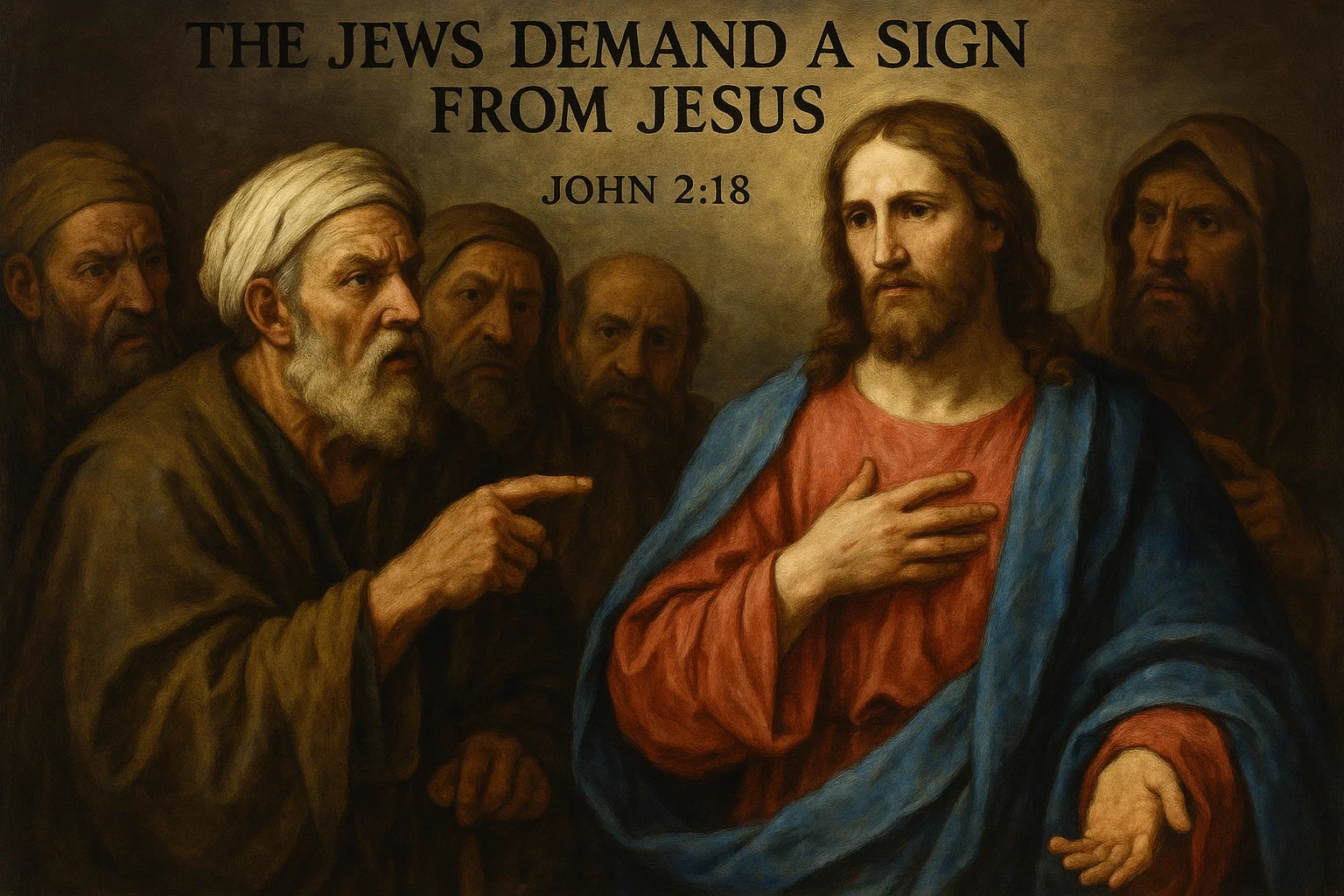
When they get in His face in verse 18, they aren’t asking for a miracle because they are spiritually hungry. They are asking for a permit. In their heads, only a prophet sent directly by God has the right to regulate the Temple. If Jesus wants to act like Elijah, they demand He proves He has Elijah’s power.
What Does John 2:18 Actually Say vs. What It Means?
The text hits hard: “The Jews then responded to him, ‘What sign can you show us to prove your authority to do all this?'”
Notice they don’t ask, “Is this the right thing to do?” They don’t ask, “Did we lose our way?”
They ask for a sign (semeion).
In John’s Gospel, this word is heavy. John rarely calls miracles “wonders.” He calls them signs. A sign points to something else. A stop sign isn’t the law; it tells you about the law. The leaders wanted a supernatural firework show. They wanted Him to split a rock or call down lightning. They wanted a divine ID card.
Why Didn’t They Just Arrest Him on the Spot?
Great question. Why talk? Why not just tackle Him?
Because the crowd was watching. And because Jewish history is full of guys who looked crazy but turned out to be from God. Moses. Jeremiah. Ezekiel.
The leaders were trapping Him. It was a calculated move.
- Option A: He refuses a sign. They call Him a fraud and a lunatic.
- Option B: He tries a miracle and fails. They stone Him for being a false prophet.
They wanted a parlor trick to expose Him. Instead, He gave them a prophecy about His own death that went right over their heads.
Is Asking for Proof Wrong or Are We Just Blind?
Asking for ID makes sense in the real world. If a guy walks into my house and starts rearranging the furniture, I’m going to ask who he thinks he is.
But here’s the kicker: the “sign” was already happening.
Jesus cleaning out the corruption was the proof. The prophet Malachi said the Lord would suddenly come to His temple and purify it. Jesus was literally fulfilling ancient prophecy in real-time, right in front of their noses.
But they missed it. Why? Because they were spiritually blind. They were so worried about the disruption of their market they missed the purification of God’s house. They wanted a magic trick, but they got a moral revolution.
Does My Own “Show Me, God” Attitude Look Like This?
I’ve been the Pharisee. I think most men have, even if we lie about it.
Five years back, my career hit a brick wall. I got laid off on a Tuesday. By Friday, I was staring at a bank account that wouldn’t cover the mortgage. I remember sitting on my back porch at 2:00 AM, nursing a cold coffee, angry at the sky.
I didn’t want “peace.” I didn’t want a Bible verse.
I told God, “I need a sign. I need the phone to ring right now with a job offer, or I’m done with this.”
I was doing exactly what those guys did in John 2:18. I was demanding God submit to my performance review. I wanted Him to validate His authority by fixing my problem exactly how I wanted it fixed.
Spoiler alert: The phone didn’t ring that night. God didn’t write “It’s okay” in the stars. instead, He dragged me through six months of grinding, rebuilding my character, and learning to trust Him when the bank account was empty. The “sign” was that I didn’t quit. But at the moment? I missed it because I was demanding a miracle on my terms.
Why Is “Authority” Such a Big Deal in the Temple Context?
You have to understand the turf war here. The Temple wasn’t just a church. It was the intersection of Heaven and Earth. It was the only place on the planet where God promised to dwell. The High Priest was the guardian of that house.
When Jesus took a whip to that court, He claimed ownership. He called it “My Father’s house.” He didn’t act like a visitor; He acted like the Son.
The Jews got the message loud and clear. If Jesus has the authority, then their authority is fake. It’s a zero-sum game. People rarely demand proof of truth; they demand proof of authority because they are terrified of losing control.
How Did Jesus Answer and Why Did It Confuse Everyone?
Jesus throws them a curveball in verse 19: “Destroy this temple, and I will raise it again in three days.”
You can hear the crowd laugh. The Jews look at the massive stone columns—Herod had used stones that weighed tons. It was a construction marvel. They sneer, “It has taken forty-six years to build this temple, and you are going to raise it in three days?”
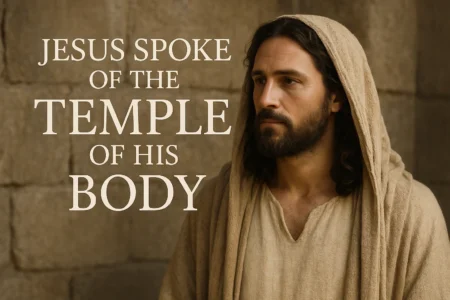
They took Him literally. They were thinking about brick and mortar. But John, looking back years later, tells us the secret in verse 21: “But the temple he had spoken of was his body.”
Were They Too Materialistic to See the Truth?
Absolutely. They were materialists in robes. They loved the system. They loved the gold. They assumed God lived in the architecture.
Jesus was signaling a massive shift. The true meeting place between God and man wasn’t going to be a building in Jerusalem anymore. It was going to be a Person.
This is the John 2:18 meaning in a nutshell. They wanted a sign inside the old system; Jesus told them He was replacing the system.
What Can We Learn from Their Skepticism?
It’s easy to hate on the religious leaders. We paint them as the villains. But take a look in the mirror.
The skepticism in John 2:18 comes from a desire to control God. If God performs the sign I ask for, then I am the judge. I set the bar. God jumps.
Faith is the opposite. Faith means I surrender the right to judge God’s methods. The leaders couldn’t do that. They had their theology figured out, their hierarchy set, and their cash flow secure. Jesus threatened all of it.
Remember That Time I Missed God Because I Was Being a Critic?
Let me tell you about a Sunday that humbled me.
I was visiting a new church. I walked in with my arms crossed, looking for problems. I critiqued the music (too loud). I hated the coffee (too watery). I judged the pastor’s skinny jeans. I was hunting for errors. I was demanding a “sign” that this place was good enough for me.
While I was busy playing critic, a guy two rows down was weeping. Shoulders shaking, total breakdown. I found out later he had just lost his wife. The “too loud” music was the first thing that broke through his grief.
I missed God moving because I was inspecting the paint job. I was acting just like the guys in John 2. I demanded the environment suit my tastes, while God was busy healing broken hearts three feet away.
How Does This Verse Fit With the Rest of John’s Gospel?
Scholars call John the “Book of Signs.” Jesus turns water to wine, heals the sick, feeds the 5,000, walks on water.
But here, the pattern breaks. Usually, Jesus does a sign, then teaches. Here, they demand one, and He refuses. He points straight to the resurrection.
Why? Because faith based on seeing cool stuff is weak. John 2:23-25 says many believed because of the signs, but Jesus “would not entrust himself to them.” He knew their hearts were shallow.
He doesn’t want fans who clap for magic. He wants followers who stick around when the temple crumbles, believing He can raise it up again.
Why Is This Verse Essential for Understanding Who Jesus Is?
Strip away the history. Forget the architecture for a second. John 2:18 forces us to decide who Jesus is.
Only God has the right to say how He is worshipped. By clearing the Temple, Jesus claims God’s authority. By predicting His own resurrection (“I will raise it again”), He claims power over death.
The Jews saw the blasphemy. Later, at His trial, they bring this specific comment up to try and execute Him. They knew He was claiming to be equal with God.
So, What Now?
The John 2:18 meaning is a warning and an invite. It warns us to stop demanding God prove Himself to our satisfaction. It warns us to stop loving our religious structures more than the God who built them.
But it invites us to look at the real Sign. The Jews wanted a show; Jesus gave them a Savior. They wanted a building; Jesus gave his body.
When life hits the fan, our knee-jerk reaction is to yell, “Show me a sign!” “Prove you’re there!”
Jesus points back to the empty tomb and says, “I already did.”
The authority of Jesus isn’t found in Him doing what I want, when I want it. It’s found in the fact that He beat death. If He can do that, He can handle the mess on my construction site or in my bank account.
So, next time you want to see God’s credentials, remember the foreman and the angry priests. Drop the demand for a badge. Look at the Resurrection. That’s the only proof that matters.
For more on the history of the Temple, check out Britannica’s Temple of Jerusalem page.
FAQ – John 2:18
What is the main message of John 2:18 in relation to authority and signs?
John 2:18 highlights that the religious leaders demanded a sign to prove Jesus’ authority, seeking a supernatural display to validate His actions, but Jesus pointed to the ultimate sign—the Resurrection—as proof of His authority.
Why did the Jewish leaders ask Jesus for a sign after He cleared the temple?
The Jewish leaders asked Jesus for a sign to authenticate His authority to act in the temple, seeking a divine endorsement or miracle to confirm that He had the right to challenge their system and claim ownership of God’s house.
How did Jesus respond to the demand for a sign in John 2:18, and what does it mean?
Jesus responded by saying, ‘Destroy this temple, and I will raise it again in three days,’ referring to His body rather than the physical structure, meaning His resurrection is the ultimate sign of His divine authority.
What does the temple cleaning event teach us about spiritual blindness and the demand for signs?
The event illustrates that people often miss God’s work because they focus on appearances or expect spectacular signs, ignoring the spiritual significance of God’s presence and work, such as Jesus’ moral revolution and His resurrection.
How can we apply the lesson from John 2:18 about demanding signs and trusting God’s authority?
We should stop demanding signs on our terms and trust Jesus’ authority demonstrated through His resurrection, recognizing that true proof lies in God’s power over death and His fulfillment of prophecy, rather than miraculous displays.