
I’ll never forget walking into that cathedral in Europe. I was twenty-two, backpacking, and looking for something spiritual. I didn’t know what, exactly. Just… something. I expected silence. I expected the kind of atmosphere that makes you instinctively take your hat off and lower your voice.
Instead, I walked into a wall of noise.
Tour guides were shouting over each other in three different languages. People were shoving past me to get the perfect angle for a selfie with a statue. And in the corner? A gift shop. A literal gift shop with a cash register dinging every thirty seconds selling overpriced rosaries and plastic icons.
It didn’t feel holy. It felt like a tourist trap. It felt like a mall.
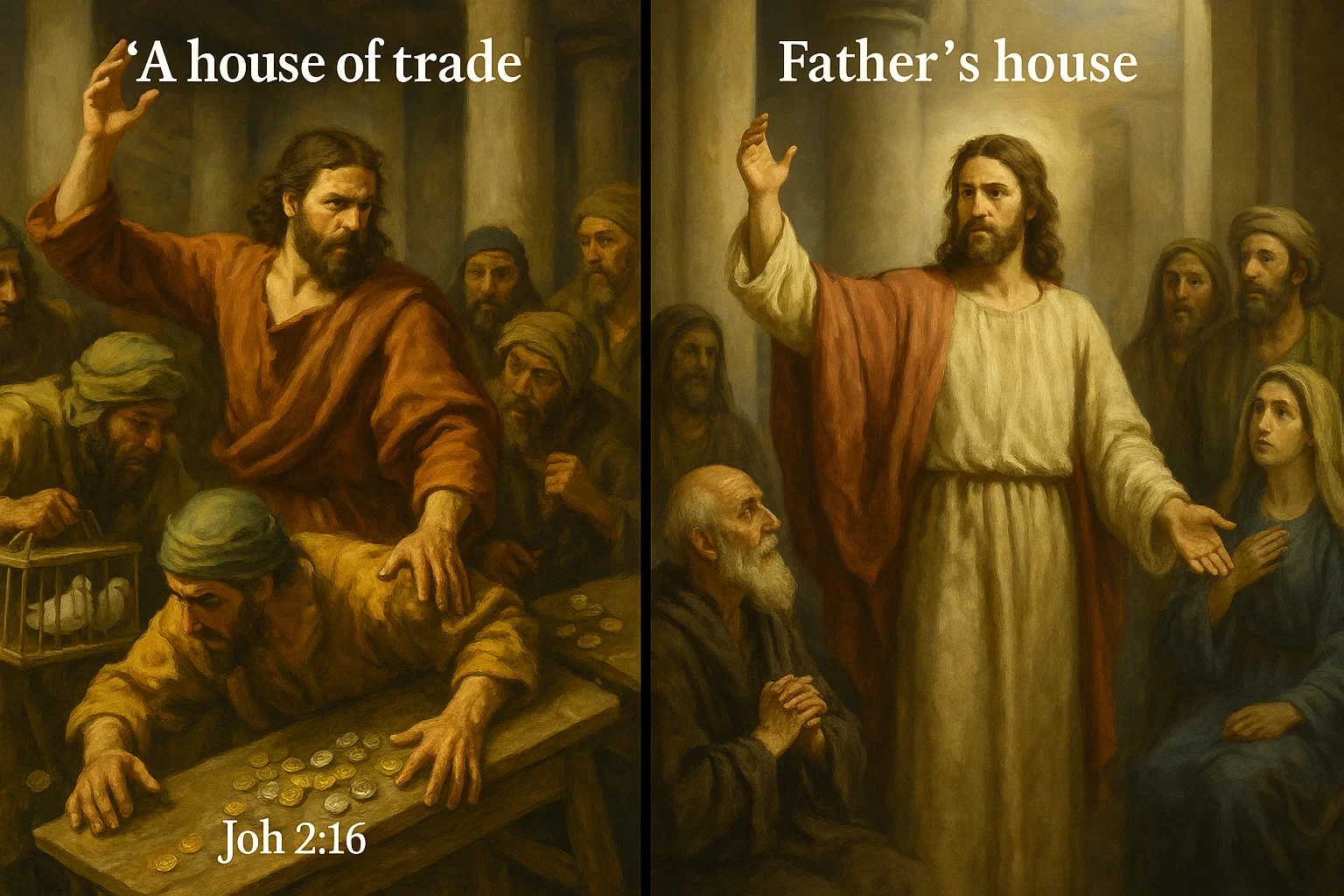
That distinct feeling of disappointment—that gut-check moment where you realize the sacred has been sold out—is exactly where John 2:16 lands. We like the painting of Jesus holding a lamb. We aren’t so comfortable with the Jesus who holds a whip. But here He is. He isn’t whispering. He isn’t teaching a parable. He is flipping heavy wooden tables and driving grown men out of the room.
And amidst the crashing coins and the bleating sheep, He yells the sentence that changes everything: “Take these things away; do not make my Father’s house a house of trade.”
This isn’t just a history lesson about an ancient building. It’s a mirror. It forces us to ask the uncomfortable question: Do we treat God like a Father, or do we treat Him like a business partner?
More in John Chapter 2 Category
Key Takeaways
- Family vs. Factory: Jesus distinguishes between a transactional relationship (a market) and a familial one (a house).
- Premeditated Action: Jesus didn’t snap; He took the time to braid a whip, showing His anger was deliberate and righteous.
- The Outsider’s Plight: The trade was happening in the one spot Gentiles were allowed to pray, effectively shutting them out.
- You Are The Temple: Today, this verse applies to the “courts” of our own hearts and minds.
- Divine Authority: By using the phrase “My Father’s House,” Jesus was making a massive claim to divinity and ownership.
What in the world was happening in that Temple?
You have to understand the scene to get the anger. It was Passover. Jerusalem wasn’t just busy; it was a madhouse. Historians tell us the population exploded during the festival. Pilgrims were streaming in from everywhere—Rome, Egypt, Asia Minor.
Now, put yourself in their sandals. You’ve traveled for weeks. You can’t drag a sacrificial ox all that way. It’s impossible. So, the religious leaders, in a stroke of “convenience,” set up a market right inside the temple courts. Specifically, the Court of the Gentiles.
And then there was the money issue. The Temple tax couldn’t be paid with Roman coins because they had Caesar’s face on them—a graven image. So, you had to exchange your cash for the Tyrian shekel.
Enter the money changers. They sat at tables, taking your Roman currency and giving you Temple currency, charging a nice little surcharge for the service.
On the surface, it looks helpful. Logical, even. They were facilitating worship, right? But Jesus didn’t see a service. He saw a barrier. He saw the hustle. He saw the noise of commerce drowning out the prayers of the nations.
Why did Jesus call it a “House of Trade”?
The Greek word John uses is emporion. It sounds like “emporium” because that’s exactly what it is. A trading post. A market.
Think about the vibe of a stock exchange floor or a frantic flea market. It’s calculated. Everyone has an angle. I want what you have, and I want to pay as little as possible for it. You want my money, and you want as much as possible.
The moment the transaction is done, the relationship is over. We go our separate ways.
Here is the kicker: I’ve treated God like an emporion more times than I want to admit. My prayer life often sounds like a contract negotiation. “Okay, God, here is the deal. I will stop swearing this week, and I will give extra in the offering plate. In exchange, You make sure I get that promotion.”
That isn’t worship. That’s business.
When Jesus yells, “Do not make my Father’s house a house of trade,” He is obliterating the transactional view of religion. The priests turned grace into a commodity. They put a price tag on access to the Almighty. Jesus wasn’t having it.
What does “Father’s House” actually mean?
The contrast here is everything. Market vs. House.
I grew up with a dad who had an open-door policy. I didn’t need to make an appointment to talk to him. I didn’t need to pay five bucks to sit at the dinner table. I belonged there. I had a key.
When Jesus calls the Temple “My Father’s House,” He is doing two massive things.
First, He’s claiming Sonship. The prophets would say, “Thus says the Lord.” They were messengers. Jesus says, “My Father.” He’s speaking as the Son who has authority over the house.
Second, He is reminding us what the Temple was supposed to be. It wasn’t a bank. It was a home. It was the meeting place between heaven and earth.
In a house, the dynamic is relational. You don’t negotiate for love in a healthy family; you receive it because you are a son or a daughter. Jesus wanted to clear out the clutter that turned a family reunion into a swap meet.
Was this just a loss of temper?
I’ve heard guys use this passage to excuse their own rage issues. “Well, Jesus flipped tables, so I can scream at the referee during my kid’s soccer game.”
No. Stop it.
Look at the text. Verse 15 says He made a whip of cords.
Have you ever braided a rope? I haven’t done it since Boy Scouts, but I remember it takes a minute. You have to find the materials. You have to sit down. You have to weave the strands together.
This implies Jesus sat there, in the middle of the noise, watching the exploitation. He watched the poor widow getting ripped off on the exchange rate. He watched the Gentile seeker getting shoved aside by a merchant selling sheep. And while He watched, He braided.
This wasn’t a tantrum. It was premeditated, calculated, righteous indignation. He didn’t lose control; He took command.
Why does the location make it worse?
This is the detail that breaks my heart. The tables were set up in the Court of the Gentiles.
The Temple had layers. The Holy of Holies was for the High Priest. The inner courts were for Jewish men. But the outer court? That was the only place a non-Jew could come to pray to the God of Israel. It was the designated missionary zone.
And the religious leaders turned it into a barn.
Imagine you are a guy from Greece. You’ve heard about Yahweh. You travel hundreds of miles, hungry for truth. You finally get to the Temple, walk into the only area you are allowed in, and… it smells like manure. You can’t hear yourself think because of the shouting. You get elbowed by a guy selling pigeons.
You would walk away thinking, “This God doesn’t care about me. There is no room for me here.”
Jesus wasn’t just clearing furniture. He was clearing a path for the outsider. He was defending the space for the people who had no one else to defend them.
Are we building walls or welcome mats?
This hits close to home. I remember a few years back, I finally convinced a buddy of mine to come to church. He was rough around the edges. Tattoos, biker vibe, definitely not the “Sunday best” type.
I was so excited he was coming. We walked into the lobby, and before we even got to the auditorium, an usher stopped him. The usher didn’t say “Welcome.” He didn’t say “Glad you’re here.”
He pointed at my friend’s head and said, “You need to take that hat off. Show some respect.”
My friend took the hat off, but his face went red. He sat through the service, stone-faced. Afterward, he told me, “Man, if God is that worried about a baseball cap, I don’t think we’re gonna get along.”
I wanted to scream. We had cluttered the court. We put a cultural hurdle in front of a spiritual seeker. We made the Father’s house feel like a strict country club with a dress code.
We have to ask ourselves: What barriers are we setting up? Is our church culture so consumed with our own “business”—our jargon, our politics, our preferences—that there is no room left for the person who just needs Jesus?
Why did John put this story first?
If you read Matthew, Mark, and Luke, they put this event at the end of Jesus’ life, right before the cross. John puts it in chapter 2.
Scholars argue about this all day. Did it happen twice? Maybe. I tend to think so. One to open His ministry, one to close it.
But look at the theology John is throwing at us. He just showed us Jesus turning water into wine—bringing the new wine of the Kingdom. Now, immediately, he shows Jesus disrupting the old religious system.
John is shouting: Jesus is the replacement.
The old Temple was corrupt. It was broken. It was temporary. A few verses later, Jesus says, “Destroy this temple, and in three days I will raise it up.” He wasn’t talking about bricks and mortar. He was talking about His body.
He didn’t just come to clean the building; He came to be the building. He is the meeting place. He is the sacrifice. The “House of Trade” is obsolete because the Son has arrived.
Does “Zeal” actually consume us?
The disciples watched this wild scene and a verse from the Psalms popped into their heads: “Zeal for your house will consume me.”
Zeal is a fierce word. It’s not just enthusiasm. It’s a protective jealousy. It’s the feeling a husband gets if someone insults his wife.
Do we have that?
I’ll be honest—I have plenty of zeal for my house. I get fired up if someone scratches my car. I get angry if I’m disrespected at work. But do I feel that burning heat when God’s name is dragged through the mud?
We’ve become passive. We’re polite. We let the world creep into the church because we don’t want to cause a scene. We let our worship services turn into performances because, hey, it draws a crowd.
We need a little more of that whip-braiding zeal. The kind that says, “No. This space is holy. We aren’t doing this here.”
Bringing it inward: The internal temple
Here is where it gets personal. The New Testament changes the geography. We don’t go to Jerusalem to find God anymore. Paul tells us in 1 Corinthians that we are the temple.
If I am the temple, then John 2:16 isn’t just about a building in 30 A.D. It’s about me, right now.
If Jesus walked into the courtyard of my mind today, what would He find? Would He find a quiet sanctuary of prayer? Or would He find a noisy marketplace?
- The Table of Anxiety: I’m constantly trading peace for worry, calculating every possible outcome like a terrified accountant.
- The Table of Approval: I’m selling my authenticity to buy likes or approval from people who don’t even know me.
- The Table of Distraction: My mind is so cluttered with noise, podcasts, news, and entertainment that God couldn’t get a word in edgewise if He tried.
I have to ask Jesus to come in with the whip. And frankly, that’s a scary prayer. Lord, flip the tables.
It hurts when He does it. It hurts when He overturns my ambitions. It hurts when He drives out the habits I’ve grown comfortable with. But He loves me too much to let my soul remain a marketplace.
Is the modern church selling out?
We need to tread lightly here, but we also need to be honest. The “House of Trade” warning is flashing neon red for the modern Western church.
We live in a consumer culture. It’s the water we swim in. And we have unknowingly dragged that consumerism into the sanctuary.
We market Jesus like a product. Try Jesus! He’s better than the leading brand! We promise that if you buy in, your life will be smoother, your marriage will be hotter, and your bank account will be fatter.
We treat people like customers. We create “experiences” tailored to their preferences. And if the customer isn’t happy? If the music is too loud or the sermon is too long? They take their business down the street to the church with the better coffee shop.
When the church becomes a vendor of religious goods, we have lost the plot. We are no longer the Father’s house. We are a spiritual service provider.
Jesus calls us back to the dinner table. The church is a body, not a business. It’s a family, not a franchise.
Religion vs. The Gospel
At the end of the day, John 2:16 draws the battle lines between religion and the Gospel.
Religion says: “Bring your coin. Bring your animal. Pay the fee. Do the work. If you pay enough, God will accept you.” It is a transaction.
The Gospel says: “Put your money away. The price has been paid. The table is flipped. The barrier is down.”
The merchants represented the idea that you had to add something to get to God. You needed their approved currency. Jesus clears them out to show that He is the only access we need.
When we try to “buy” God’s favor with our good behavior, or our church attendance, or our moral superiority, we are setting up a money changer’s table in our hearts. We are telling Jesus, “Thanks, but I can afford this myself.”
That is an insult to the cross.
How do we keep the noise out?
So, how do we live this out? How do we stop the drift toward the marketplace?
1. Check your entrance. Don’t just rush into worship (or prayer). I’ve started sitting in my car for two minutes before I walk into church. I take a breath. I remind myself: “I am not here to get something. I am not a consumer. I am here to meet my Father.”
2. Audit your prayers. Listen to yourself pray. Is it just a list of demands? Gimme this, fix that, change him. Or are there moments where you just sit in the Father’s house? Try praying for ten minutes without asking for a single thing. Just say thank you. Just enjoy the silence. It’s harder than you think, but it clears the tables fast.
3. Look for the outsider. If you are in church, stop looking for your friends. Look for the guy who looks uncomfortable. Look for the person standing alone. Be the one who clears the path for them, rather than being part of the wall of noise.
Conclusion
John 2:16 is a splash of cold water. It wakes us up.
Jesus stands in the center of our busy, noisy, calculated lives and demands a cleanup. He refuses to let us turn the sacred into the commercial.
It challenges me every single day. Am I trying to cut a deal with God, or am I trusting Him? Am I building a market, or am I building a family?
Let’s let Him flip the tables. Let’s let Him drive out the noise. Let’s reclaim the sanctuary. Because at the end of the day, we don’t need another place to do business. We need a Father.
For further reading on the context of the Temple and the layout of the courts, you can check out resources at Bible Gateway.
FAQ – John 2:16
Why did Jesus flip tables in the temple according to John 2:16?
Jesus flipped tables in the temple because He saw the space, meant for prayer and worship, turned into a marketplace where merchants exploited worshippers, especially the outsiders, turning God’s house into a house of trade.
What is the significance of calling the temple ‘My Father’s House’ in John 2:16?
By calling it ‘My Father’s House,’ Jesus claims Sonship and divinity, emphasizing that the temple is a familial and sacred space meant for relationship, not commerce, and He is asserting His authority over it as the Son.
Was Jesus just angry and losing control when He overturned the tables?
No, Jesus’s actions were deliberate and righteous;He sat and braided a whip, indicating His anger was premeditated and controlled, not a loss of temper, to demonstrate His divine authority and protect the sacred space.
How does the temple incident relate to personal faith today?
The incident challenges believers to examine their own hearts, asking whether they have turned their inner spiritual lives into marketplaces driven by anxiety, approval, or distraction, instead of seeking genuine relationship with God.
What does the Bible teach about the difference between religion and the Gospel as seen in John 2:16?
The Bible contrasts religion, which is transactional and demands work to earn God’s acceptance, with the Gospel, which proclaims that Christ’s sacrifice has removed barriers and paid the price, offering free access to God.