
I had one job. Just one.
It was my brother’s wedding rehearsal dinner, and I was tasked with bringing the ice. Simple, right? But between a traffic jam on the I-95 and me forgetting my wallet on the kitchen counter, I showed up 45 minutes late. I walked in carrying three bags of what was essentially lukewarm slush. I’ll never forget the look on my mother’s face. It wasn’t rage. It was that quiet, devastating disappointment that hurts way more than yelling.
The logistical fabric of the party was fraying, and I was the guy pulling the thread.
We’ve all felt that sinking sensation. It’s the pit in your stomach when resources run dry, the plan crumbles, and you realize you have absolutely nothing left to bring to the table. You stand there, empty-handed, waiting for the fallout.
That is exactly where we land when we crack open the second chapter of John’s Gospel. We aren’t in a holy temple; we are smack in the middle of a potential social disaster in a dusty town called Cana. But right there, amidst the shame and the shortage, Jesus steps in.
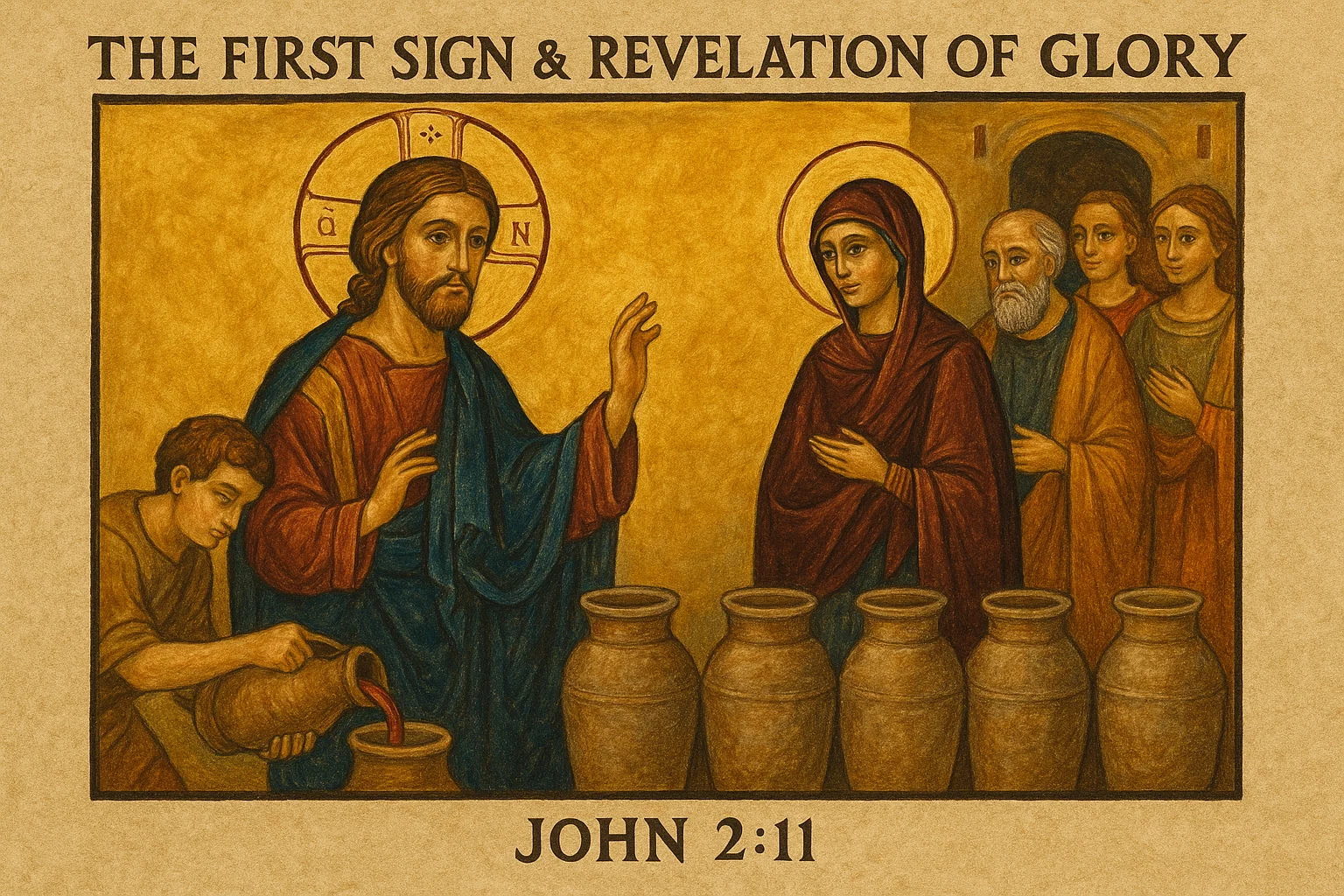
John 2:11 captures the climax of this rescue mission: “This beginning of signs Jesus did in Cana of Galilee, and manifested His glory; and His disciples believed in Him.”
This isn’t just a footnote about a party trick. It’s the explosive launch of Jesus’ public ministry. It’s the blueprint for how God interrupts our lack with His overwhelming abundance.
More in John Chapter 2 Category
Key Takeaways
- Miracles are Road Signs: John uses the specific word semeion (sign) to tell us the miracle isn’t the point; the destination is Jesus’ divinity.
- Glory Unveiled: This wasn’t about saving a party; it was about pulling back the curtain to show the Creator in human skin.
- The Great Exchange: Jesus swaps the stagnant water of ritual purification for the vibrant wine of grace.
- Faith moves from Head to Heart: The disciples stopped just following a teacher and started believing in a Messiah.
- God of the Grit: Jesus picked a no-name town and a wedding reception to reveal his glory, proving He cares about our ordinary lives.
Why Did Jesus Choose a Backwater Wedding for His Debut?
If I were handling the PR rollout for the Messiah, I would have fired his booking agent.
Seriously, think about it. If you are God in the flesh and you want to announce your arrival, you go to Jerusalem. You book the Temple courts during Passover. You perform a dazzling display of raw power in front of the Pharisees, the Sadducees, and the Roman elite. You go where the influencers are. You want to make a splash? You go to the capital.
Jesus went to a wedding in Cana.
Cana wasn’t a hub of commerce. It wasn’t a religious center. It was a blip on the map. A dusty village that nobody really cared about. By choosing this setting, Jesus completely shattered our expectations of where God likes to show up. He didn’t wait for a holy convocation. He didn’t wait for the choir to start singing.
He stepped into a family gathering. He stepped into the noise, the laughter, the awkward relatives, and the wine-stained reality of human life.
I think back to a time I was helping a buddy move into a third-floor walk-up apartment in July. The AC was broken. We were sweating through our shirts, tired, and frankly, miserable. We weren’t praying. We weren’t quoting scripture. We were just trying to pivot a massive sleeper sofa around a tight corner without crushing our fingers.
We took a break on the stairs, gasping for air, and suddenly my friend looked at me and broke down. He talked about how lonely he’d felt since his divorce, and how this—just two guys moving furniture—was the first time he felt like he had a team in years. God showed up on that staircase. It smelled like sweat and old carpet, but God was there.
God loves the ordinary. John 2:11 anchors the revelation of glory in the soil of everyday life. He sanctifies our celebrations. He cares about the social faux pas of a family running out of wine. This tells us that no part of our life is too trivial for His glory to manifest.
Is It Just About the Wine, or Something Deeper?
Let’s be honest for a second. Turning water into wine is a cool trick. If you do that at a frat party, you are a legend forever. But if we stop at the “magic,” we miss the entire point John is trying to make.
John 2:11 calls this the “beginning of signs.” That phrasing matters. He doesn’t call it a “miracle” (dynamis) or a “wonder” (teras). He uses the Greek word semeion.
A sign isn’t the destination; a sign points to the destination.
If I’m driving through Arizona and I see a sign that says “Grand Canyon: 50 Miles,” I don’t pull the car over and start taking selfies with the sign. I don’t set up a picnic blanket next to the metal post. I keep driving. Why? Because the sign is telling me that something massive, something breathtaking, is just down the road.
Jesus turning water into wine was a sign pointing to His identity as the Creator. It pointed to the New Covenant.
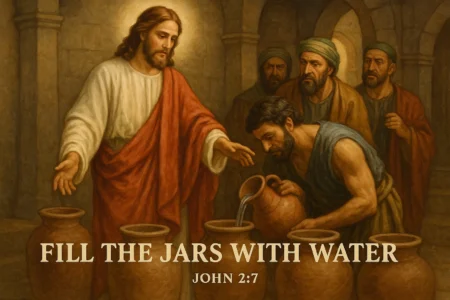
Look at what he used. He didn’t zap thin air into Merlot. He used six stone water jars set aside for “Jewish rites of purification.” These weren’t drinking pitchers. These were heavy, ceremonial vessels used for washing. They represented the Law. They represented the constant, exhausting need to scrub yourself clean on the outside to be acceptable to God. They held the water of obligation.
Jesus took that symbol of religious drudgery and transformed it into the wine of celebration.
He was essentially saying, “The old way is water. It cleans you, but it doesn’t change you. I am bringing the new wine of the Kingdom.” John 2:11 marks the moment where religion turned into relationship. It wasn’t just a refill; it was a renovation.
What Does It Actually Mean to Manifest Glory?
“Manifested his glory.” We hear phrases like this in church so often that they lose their teeth. We nod along, thinking, “Yes, quite glorious, very shiny.” But what does that actually look like in the real world?
The word “glory” (doxa in Greek) carries the weight of reputation, splendor, and the very essence of a thing. In the Old Testament, God’s glory was a terrifying cloud or a consuming fire that would kill you if you got too close. Moses couldn’t even look at it directly without his face glowing for days.
Here, the glory looks like a vintage Cabernet.
I recall watching my dad fix an old, broken-down Ford tractor on our property. It had been sitting in the weeds for years, rusting away. For most of my life, I just saw him as “Dad”—the guy who drove the truck and told me to mow the lawn. But that day, I watched him diagnose the engine. I watched him strip the carburetor, clean the plugs, and bypass the solenoid.
When he turned the key and that engine roared to life, spitting black smoke and then settling into a rhythmic hum, I saw a master at work. His skill “manifested.” In that moment, he wasn’t just Dad; he was a mechanic who understood the soul of that machine. I realized, Whoa, he understands how things work in a way I don’t.
In John 2:11, the disciples had a similar realization. They knew Jesus was a teacher. They knew he was charismatic. But when the molecular structure of water obeyed his silent will, the veil lifted. They saw the Creator looking back at them.
Manifesting glory means making the invisible attributes of God visible in physical space. Jesus showed that He has authority over creation. He showed that He creates the best, not the cheap stuff. He showed that He is a God of abundance, providing 120 to 180 gallons of wine for a small village wedding. That is an outrageous amount of wine. That is the glory of His generosity.
Why Does the Text Emphasize “This Beginning”?
John is being very specific here. “This beginning of signs.” He’s keeping score. This marks a definitive shift in human history.
Before this moment, Jesus lived in total obscurity. He was the carpenter from Nazareth. He hammered nails, sawed wood, paid his taxes, and lived a quiet life. He probably had calluses on his hands and sawdust in his hair. John 2:11 is the crossing of the Rubicon. Once this sign occurs, the clock starts ticking toward the cross. There is no going back to the woodshop after this.
It’s interesting because Jesus initially told his mother, “My hour has not yet come.” He knew that revealing His power would set a series of events in motion that would end on Calvary. He knew the cost of this wine.
Yet, he acted. Why? Because compassion for a humiliated couple and the faith of his mother accelerated his revelation.
“This beginning” also suggests a progression. If this is the start, there is more to come. It kicks off a highlight reel of divinity:
- The healing of the official’s son.
- The healing at the pool of Bethesda.
- Feeding the 5,000.
- Walking on water.
- Healing the man born blind.
- Raising Lazarus.
Each sign ramps up the intensity. Each sign reveals a new facet of His glory. But John 2:11 is the foundational stone. It proves He can change the very substance of reality. If He can change water to wine, He can change death to life.
How Did This Moment Change the Disciples Forever?
The verse ends with a crucial reaction: “and His disciples believed in Him.”
Wait a minute. Didn’t they already believe? They were following him, weren’t they? Andrew, Peter, Philip, and Nathanael had already signed up. They called him “Rabbi” and “Messiah” in chapter 1. They had left their nets and their tax booths.
So, what changed?
There is a massive canyon between intellectual assent and experiential trust. I can believe a parachute works because I understand physics and aerodynamics. I can read the manual. That is intellectual belief. But jumping out of a plane at 10,000 feet and feeling that chute catch my weight? That is experiential belief. That changes you.
The disciples had intellectual hope. After John 2:11, they had experiential proof.
I remember when I first truly believed my wife loved me. We had been dating for a year, and I “knew” she cared. But then I got laid off. It was brutal. I lost my income, my confidence, and my direction all in one afternoon. I sat on the couch feeling like a total failure. I expected her to pull back. I expected her to say, “Well, this isn’t what I signed up for.”
Instead, she doubled down. She became my rock. She looked at my empty bank account and my broken ego and said, “We’ve got this.” That crisis didn’t create her love; it revealed it. And my belief in “us” shifted from a nice concept to an unshakable conviction.
The disciples saw Jesus save the day. They saw Him save a family from social suicide. They realized He wasn’t just a political leader or a moral teacher. He was the Lord of matter and time. Their faith thickened. It developed roots.
What Can We Learn from Mary’s Nudge?
You can’t really analyze John 2:11 without looking at the catalyst: Mary.
Her interaction with Jesus is fascinating. She presents the problem: “They have no wine.” Jesus offers a gentle pushback. She doesn’t argue. She doesn’t panic. She doesn’t try to manipulate him. She simply turns to the servants and says, “Whatever He says to you, do it.”
This is the ultimate posture of faith that leads to the revelation of glory.
- She identified the lack: She didn’t pretend everything was fine. She faced the brutal reality.
- She brought it to the right source: She went straight to Jesus. Not the headwaiter, not the groom.
- She submitted to His method: She left the “how” entirely up to Him.
As men, we struggle with this. We want to fix it. If I were at that wedding, I would have been calculating how fast I could run to the nearest vineyard. I would have been checking my pockets to see if I could bribe a merchant. I would have tried to water down the existing wine to make it stretch. I would have tried to solve the problem with my own sweat and effort.
Mary teaches us that the pathway to John 2:11—to seeing glory—is surrender. It is admitting, “I have no wine. I have no resources. I can’t fix this.”
When we stop trying to manufacture a solution and simply obey His command (“Fill the waterpots”), we position ourselves for a miracle. The servants did the heavy lifting, carrying those heavy jars, but Jesus did the transforming.
Can John 2:11 Still Transform Our Reality Today?
Is this verse just a history lesson? Just a nice story to read at weddings? Absolutely not. The principle of John 2:11 is active right now.
Every one of us faces “Cana moments.”
- The moment your marriage feels like it has run out of wine and the joy is gone, leaving only the water of duty.
- The moment your career hits a wall and the passion has dried up.
- The moment your health fails and you feel empty.
The “Old Wine” always runs out. Human resources always run dry. The party eventually ends if it depends on us. We all hit a limit.
But Jesus saves the best for last. The master of the feast tasted the water-made-wine and remarked that usually, people serve the good stuff first, then the cheap stuff when people are too drunk to notice. But Jesus reversed the order.
This gives us profound hope. With Jesus, your best days are not behind you. The world says you peak in your 20s or 30s and then it’s a slow decline into irrelevance. The Kingdom says the glory of the latter house shall be greater than the former.
I cling to this. I’ve gone through seasons where I felt washed up, where I felt like just an empty stone jar standing in a corner gathering dust. But John 2:11 reminds me that if I offer my emptiness to Him, He can fill it with something richer, deeper, and more vibrant than what I had before.
How Does This Sign Point to the Ultimate Sacrifice?
We have to connect the wine to the blood. John writes his Gospel with the end in mind. He knows where this story is going.
At the Last Supper, Jesus takes the cup of wine and says, “This is my blood of the covenant.” In Cana, He provides wine to save a wedding party from temporary embarrassment. On the cross, He pours out His blood to save the Bride (the Church) from eternal shame.
John 2:11 is the first drop of a flow that culminates at Golgotha. The glory manifested at Cana was a glory of power over creation. The glory manifested at the Cross was a glory of sacrificial love. Both are necessary. Both are Jesus.
When we read “manifested his glory,” we should see a Savior who is willing to do whatever it takes to restore joy to His people. He changes the composition of reality to save us.
Conclusion: Your Invitation to the Feast
John 2:11 is not a distant fable. It’s an invitation. It invites you to bring your empty jars to Jesus. It invites you to trust Him when the resources run out. It invites you to look past the “sign” and see the Savior standing there.
I think back to that rehearsal dinner disaster with the ice. Eventually, we sorted it out (a frantic run to a gas station saved the day). But that feeling of helplessness stayed with me. It reminds me that I am not the provider; I am just a guest at the table.
Jesus is the Host. He is the true Bridegroom who ensures the party never really ends. He turned water into wine to show us that He brings life where there was only ritual, and joy where there was only duty.
His disciples believed in Him. The question John leaves hanging in the air for us is simple: Do you?
When you hit the wall, when the wine runs out, do you believe He has saved the best for last? That is the challenge and the promise of John 2:11. It is the first sign, but for those who believe, it is only the beginning of the glory He intends to reveal in your life.
Link to Yale Divinity School Bible Study on John
FAQ – John 2:11
What is the significance of the miracle at Cana in John 2:11?
The miracle at Cana signifies the beginning of Jesus’ public signs, revealing His divine glory and establishing His identity as the Creator. It points to the new covenant where religion transforms into relationship and demonstrates God’s abundant grace.
Why did Jesus choose a wedding in Cana for His first sign, and what does this teach us about God’s nature?
Jesus chose a humble wedding in Cana to show that God’s presence is in everyday life and ordinary settings. It teaches us that God cares about our personal and social lives and that His glory can be manifested in any environment, no matter how insignificant it seems.
How does turning water into wine serve as a sign pointing to Jesus’ divine identity?
Turning water into wine was a sign that pointed to Jesus’ authority over creation and His role as the Creator. It symbolized the transition from the old covenant of obligation to the new covenant of grace, demonstrating His power to transform and renew.
What does it mean to manifest God’s glory, and how can it be seen today?
Manifesting God’s glory involves making His divine attributes visible in the physical realm through acts of power, provision, or transformation. Today, it can be seen in acts of kindness, miracles, and lives changed by His power, reflecting His splendor and authority.
How does John 2:11 connect to the larger story of Jesus’ sacrifice?
John 2:11 connects to Jesus’ sacrifice by illustrating that His power and glory are ultimately revealed through His sacrificial love on the cross. The miracle at Cana is the first sign that leads to the ultimate sacrifice, where His blood offers salvation and eternal joy.