
You know that feeling when you walk out of a movie theater, blinking in the sunlight, and your brain is spinning? You drive halfway home, radio off, staring at the bumper in front of you, and suddenly you slam your hand on the steering wheel. “Oh! Now I get it!”
That plot twist in the final scene didn’t just end the movie; it rewrote the entire two hours you just sat through. Lines of dialogue that felt like throwaway filler suddenly carry the weight of the world. It’s a universal human experience: we live life moving forward, but we only really understand it looking backward.
I felt this hit me like a freight train with my own dad. We didn’t always see eye to eye. Growing up, he had this maddening habit of dragging me out to the garage on Saturday mornings. He’d be under the hood of his rusted-out ‘78 Ford, and my job was to hold the flashlight. Just hold the light. Sounds easy, right? But I was sixteen, and I wanted to be anywhere else.
He would mutter things from the dark underbelly of that engine block. “Don’t force the bolt, son. You gotta feel the threads catch. If you force it, you strip it.”
I rolled my eyes so hard it hurt. I thought he was just being a perfectionist. I thought he liked hearing his own voice.
Twenty years later, I’m standing on the shoulder of I-95 in the pouring rain. My radiator is blown. Steam is hissing. I’m cold, I’m wet, and I’m frantic. I grab a wrench, and I go to crank on a bolt that won’t budge. My knuckles are white. I’m about to put all my weight into it and snap the thing off.
Then, clear as a bell, I hear it. “You gotta feel the threads catch.”
I froze. I didn’t just remember the words; I finally understood the mechanic’s touch he was trying to drill into my thick skull. The frustration of those Saturday mornings made sense.
That exact moment—that collision of memory and understanding—is the heartbeat of John 2:22.
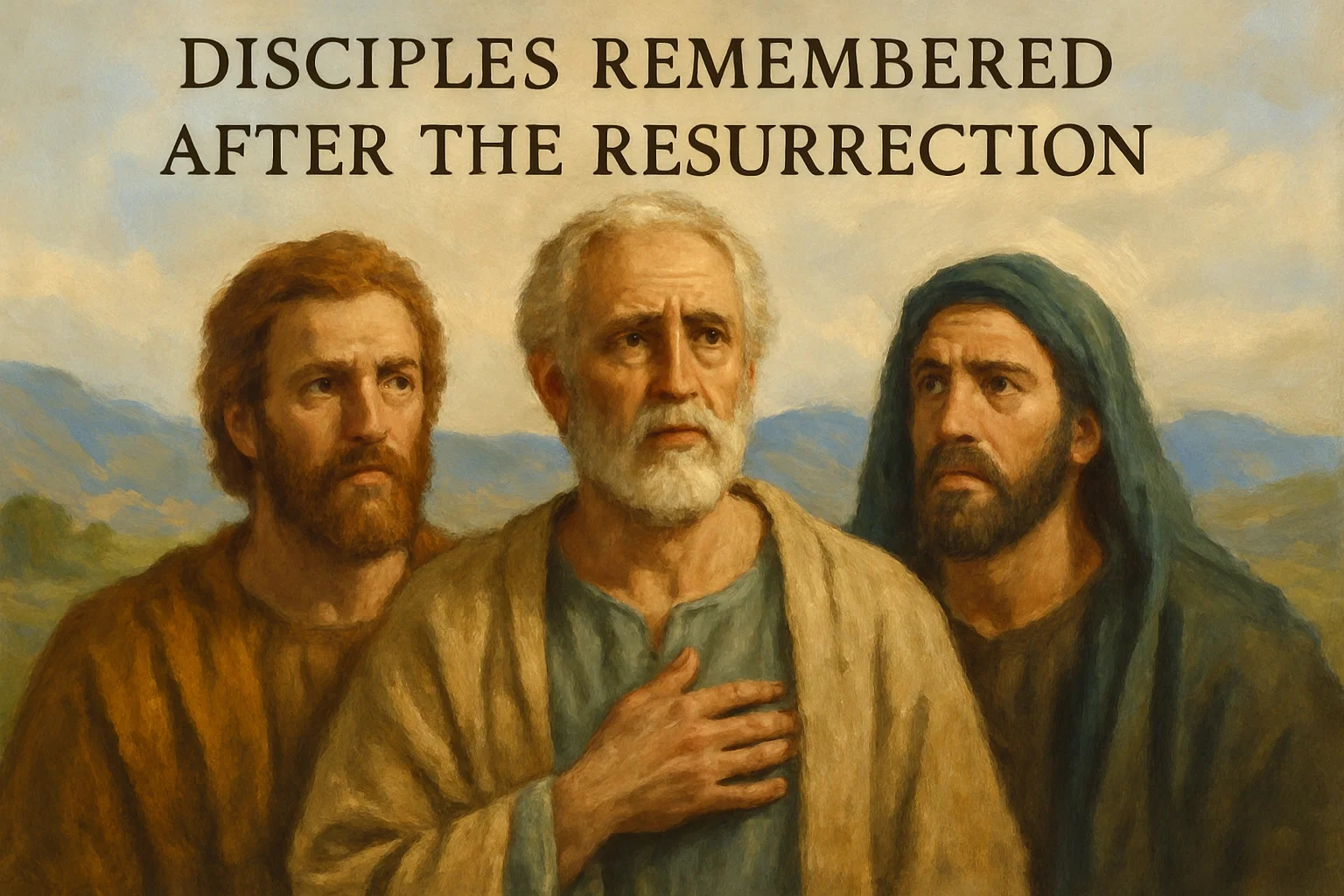
It says: “When therefore he was raised from the dead, his disciples remembered that he had said this, and they believed the Scripture and the word that Jesus had spoken.”
This verse isn’t just some editorial footnote John threw in to fill space. It is the key to the whole operation. It’s the bridge between total confusion and rock-solid clarity. We give the disciples a hard time for being slow on the uptake, for missing the obvious. But if we are honest? We do the exact same thing.
More in John Chapter 2 Category
John 2:12 Explained and John 2:19 Meaning
Key Takeaways
- Hindsight is Essential: You can’t see the whole picture while you are inside the frame; the disciples needed the Resurrection to decode Jesus’ mission.
- Scripture Meets Street Smarts: Real belief happens when the dusty theology in your head crashes into the gritty reality of your life experience.
- The Temple Shift: Jesus moved the headquarters of God from a pile of limestone to His own living, breathing body.
- Active Faith: Remembering isn’t just sitting around reminiscing; it’s an active, deliberate move toward trusting God.
- The Waiting Game: It is perfectly normal to be confused by God’s plan; clarity is often a delayed package.
Why Do We Always Miss the Point in the Moment?
Humans are linear. We are obsessed with timelines. Past, present, future. Step one, step two, step three. But God? He moves in circles. He plants seeds in 1995 that don’t sprout until 2025.
The disciples were standing shoulder-to-shoulder with the God of the Universe. They saw the sweat on His brow. They smelled the dust on His robes. Yet, they missed the magnitude of what He was saying.
Why?
Because their box was too small. They had a “political revolutionary” box. They expected a Messiah who would kick down the doors of the Roman governor’s palace, toss out the legionnaires, and put Israel back on top of the geopolitical food chain.
So when Jesus starts talking about destroying temples and raising them up in three days, they tried to jam that square peg into their round hole of political conquest. It didn’t fit. Not even close.
I recall sitting in a lecture hall during my sophomore year of college. The professor was droning on about “existential dread” and the fragility of societal structures. I was twenty. I had a full head of hair, a decent car, and a wallet full of my parents’ money. I thought this guy was inventing problems just to hear himself talk.
Fast forward a decade. I’d lost a job I loved. My bank account was flashing red. A health scare had me sleeping with one eye open. Suddenly, that lecture came back to me. I didn’t just recall the data; I felt the gut-punch of the truth.
The disciples needed the trauma of Good Friday and the shock of Easter Sunday to shatter their old paradigms. Only then could the words of John 2:22 settle in.
What Was the Scene Really Like in the Temple?
To really get why this memory stuck, you have to smell the air in the temple courts that day.
Jesus walks into Jerusalem. It’s Passover. The city is bursting at the seams. Historians tell us the population would swell by hundreds of thousands.
The temple courts weren’t a quiet cathedral with pipe organ music playing softly. It was a zoo. Literally. You have thousands of sheep bleating in terror. You have pigeons cooing in cages. You have money changers shouting exchange rates over the din. It smelled like manure, sweat, and unwashed bodies. It was a marketplace masquerading as a house of prayer.
Jesus enters the fray. He doesn’t politely ask them to keep it down. He constructs a whip of cords.
He goes kinetic.
He flips heavy stone tables. Coins—denarii, drachmas, shekels—go skittering across the pavement. He drives out the livestock. It is a scene of absolute, controlled chaos. The Jewish leaders are furious. Their profit margins are running away on four legs. They demand a sign. “Who do you think you are? Show us your credentials!”
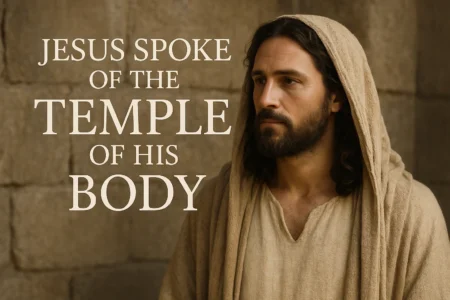
Jesus looks them dead in the eye and drops a bomb: “Destroy this temple, and in three days I will raise it up.”
Was This Just a Temper Tantrum?
It’s tempting to read this and think Jesus just had a bad day. Maybe He was tired. Maybe the noise got to Him.
But that’s lazy reading.
He wasn’t having a meltdown; He was making a takeover bid. He was claiming authority over the single most important square mile on planet Earth.
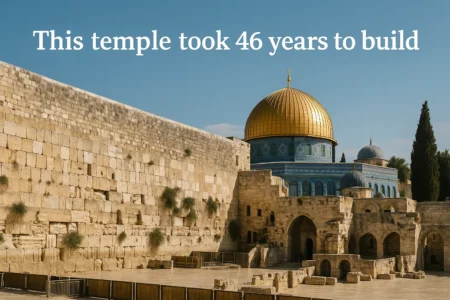
The Jews scoffed. “It has taken forty-six years to build this temple, and will You raise it up in three days?”
They looked at the granite; Jesus looked at the grace. They looked at the architecture; Jesus looked at the atonement. They were talking about masonry; He was talking about His marrow. They were obsessed with the building; He was focused on the body.
How Does John 2:22 Rewrite the Gospel Narrative?
This single verse is John breaking the fourth wall. He stops the story, looks at the camera, and says, “Hey, just so you guys know, we were completely clueless when this went down.”
This proves the honesty of the Bible. Think about it. If you were making up a religion, wouldn’t you write yourself into the story as the hero? Wouldn’t you paint the founding leaders as spiritual geniuses who nodded sagely at every word the Master spoke?
John doesn’t do that. He paints himself and his friends as thick-headed. They filed this information away in the dusty attic of their brains, ignoring it until Easter morning.
This verse validates the resurrection because it highlights the psychological shift. Something massive had to happen to turn these confused, scared men into lions of the faith. That “something” was the empty tomb.
Why Couldn’t They Grasp “Destroy This Temple”?
Imagine standing in front of the Pentagon. Someone walks up and says, “Tear this down, and I’ll put it back up by Tuesday.”
You’d call the cops. Or a psychiatrist.
Herod’s Temple was a marvel of the ancient world. It was massive. Gold overlay. intricate courtyards. It represented the very presence of God among His people. The idea of the “Temple” shifting from a stone structure to a human being was inconceivable. It broke their theology.
Jesus was saying, “I am the meeting place. I am where heaven hits earth. I am the Holy of Holies.” You can’t understand that until you see the curtain rip in two.
Also read: John 2:7 and John 2:8 Explained
Can We Actually Trust Memory After Trauma?
Skeptics love to argue that the disciples hallucinated the resurrection. They say grief made them invent a happy ending. But John 2:22 describes a specific, logical cognitive process.
They “remembered.”
This wasn’t some warm, fuzzy feeling. This was the cold, hard clicking of tumblers in a lock.
- Tumbler 1: Jesus predicted He would be destroyed and raised.
- Tumbler 2: Jesus was executed publicly.
- Tumbler 3: Jesus is currently eating broiled fish in front of us and letting us touch His scars.
- Unlock: He is exactly who He said He is.
I have a buddy, Mike, who served in the Marines. Fallujah, 2004. Real heavy stuff. He told me once that in the heat of a firefight, you don’t think. You revert to your training. Muscle memory takes over. You move, you shoot, you communicate.
But afterward? In the quiet, when the adrenaline dumps? That’s when you process. You remember the drills. You remember the screaming of the drill instructor from boot camp. And suddenly, you realize why they made you scrub the floor with a toothbrush. You realize the training wasn’t punishment; it was survival.
The resurrection forced the disciples to process three years of “spiritual boot camp” that hadn’t made a lick of sense in the moment.
The Old Testament Connection
Look at the phrasing again: “They believed the Scripture and the word that Jesus had spoken.”
John puts Jesus’ words on the same shelf as “the Scripture” (the Old Testament). That is a massive claim to divinity. But which Scripture did they believe?
They likely recalled Psalm 16:10: “For you will not abandon my soul to Sheol, or let your holy one see corruption.”
Or maybe Psalm 69:9: “For zeal for your house has consumed me.”
For a deeper dive into how the Old Testament prefigures the temple and the resurrection, check out the resources at BiblicalTraining.org. They have some fantastic stuff on how to read the Bible without missing these connections.
The Resurrection became the decoder ring for the entire Hebrew Bible. Suddenly, the suffering servant of Isaiah 53 wasn’t a tragedy; it was the game plan. The story of Jonah sitting in the belly of a fish wasn’t a fable; it was a signpost pointing to the tomb.
Is Prophecy a Blueprint or a Map You Read Backwards?
We love to treat biblical prophecy like a crystal ball. We want the dates, the times, the exact sequence of events. We want a blueprint.
But John 2:22 suggests prophecy often functions like a map you only pull out after you’ve already arrived.
Jesus didn’t give them the prophecy (“I will raise it up”) so they would stop the Roman soldiers from nailing Him to the cross. He gave it to them so that after the resurrection, their faith would have an anchor. Prophecy isn’t there to satisfy our curiosity about the future; it’s there to build our trust in God’s sovereignty when we look back at the past.
The Resurrection: The Ultimate Light Switch
Without the Resurrection, let’s be honest: Jesus is just a guy who got himself killed for causing a riot. He becomes a tragic figure. A failed revolutionary. A footnote in Josephus’s history books. His words about raising the temple would have been proven false by the rot of His body in a borrowed grave.
But the moment He took that first breath in the cold dark of the tomb?
Everything changed.
Every crazy thing He ever said became absolute, concrete truth.
- “I am the bread of life.”
- “I am the light of the world.”
- “Before Abraham was, I am.”
The Resurrection flips the switch. It floods the dark room of human confusion with blinding light. When the disciples remembered, they didn’t just recall sound waves; they grasped the reality of God Incarnate standing in their midst.
Applying This to the Mess of Our Lives
We all hit walls. The plan falls apart. The company downsizes and you’re out. The marriage you fought for crumbles. The doctor walks in with a clipboard and won’t make eye contact. You look at the “temple” of your life—the thing you spent forty-six years building—and it looks like a pile of rubble.
We stand in the debris, dusting off our clothes, thinking, “Well, God, this is a disaster.”
John 2:22 tells us to wait. It tells us that the story isn’t over. It tells us that a “remembering” is coming.
When God Goes Silent
I went through a season about five years back that nearly broke me. I was doing everything “right.” I was working my tail off, trying to be a decent husband, serving at church, tithing. And everything—I mean everything—kept blowing up in my face.
We were bleeding money. My truck broke down. My wife and I were passing each other like ships in the night, too tired to talk. I felt hollowed out. I remember sitting on my back porch at 2:00 AM, staring at the stars, angry. I pointed to my Bible and whispered, “You promised. Where are You?”
It felt like Jesus was speaking in riddles. Or worse, not speaking at all.
Two years later? An opportunity opened up that I never, ever could have taken if my previous plans had succeeded. If I hadn’t been broken down, I wouldn’t have been ready for what came next. I looked back at that season of silence and realized God wasn’t ignoring me; He was retooling me. He was stripping the threads so He could re-tap the bolt.
I “remembered” His promises, and suddenly, they carried a weight they never had before.
If you are in the confusion phase right now, hold the line. You are in the “three days.” You are in the gap between the destruction and the raising. The understanding is coming.
- Trust the Character: Even when the plan is hidden in the dark.
- Hold the Word: Even when it contradicts your current reality.
- Wait for Life: God is in the business of resurrection. That’s His specialty.
What Does True Belief Look Like?
The verse ends with three simple words: “and they believed.”
Didn’t they believe before? Sure. They left their nets. They walked away from their careers. They followed Him for three years. But that belief was fragile. It was untested. It was based on partial data.
Post-resurrection belief? That is a different animal.
That kind of belief is unbreakable. It is battle-hardened. It has looked death in the face and watched death blink first.
When the disciples “remembered,” their faith transitioned from a hope to a certainty. This is why they could face martyrdom without flinching. You don’t get crucified upside down like Peter for a metaphor. You don’t let them boil you in oil for a riddle. You die for a Risen Lord who proved that the grave is not the exit.
The Danger of Forgetting
The enemy of faith isn’t doubt; it’s amnesia. The opposite of John 2:22 is forgetting.
Throughout the Bible, God is constantly shouting, “Remember!”
- Remember you were slaves.
- Remember the Red Sea.
- Do this in remembrance of Me.
Why? Because we leak. We are leaky vessels. When the pressure is on, we forget what Jesus said in the light. We forget the track record of God. We have to fight, actively, to remember.
I started keeping a journal a few years ago. Not a “dear diary” filled with feelings, but a tactical log. A log of battles. I write down the problem. I write down the prayer. And when the answer comes—maybe a week later, maybe a year later—I write down the result.
When I hit a new wall, I flip back. I read about a problem that seemed like a mountain in 2019, and I see how God flattened it. I “remember,” and it puts steel in my spine for the fight I’m in today.
Conclusion: Living Looking Backward
John 2:22 teaches us that faith is often a retrospective act. We move forward by looking back at the empty tomb.
Maybe you’re wrestling with a text in Scripture that makes no sense. Maybe your life feels like a jigsaw puzzle with half the pieces missing. Take heart. You are in good company. Peter, John, the whole crew—they didn’t get it either. Not at first.
But keep walking. Keep listening. Store those words up in your gut. Because a day is coming—a resurrection day, a day of deliverance, or just a Tuesday where the fog lifts—and the light will click on.
You’ll look back at the winding, confusing road you just traveled. You’ll remember what He said. And you’ll believe with a depth that scares the darkness away.
The temple of your understanding might need to be torn down today so He can rebuild it into something that lasts forever.
FAQs – John 2:22
How does the resurrection change the disciples’ perception of Jesus’ words?
The resurrection transforms the disciples’ understanding from partial hope to full belief, solidifying that Jesus’ words and predictions about his death and resurrection were trustworthy and divinely inspired.
Why did the disciples initially miss the meaning of Jesus’ statement about destroying and raising the temple?
The disciples missed the deeper meaning because their worldview was limited to the physical temple, not understanding that Jesus was referring to His own body as the new temple representing God’s presence.
What role does memory play in developing faith according to this article?
Memory is crucial in affirming faith, especially after trauma or confusion, as recalling God’s promises and past actions helps believers trust in His plan even when facing uncertainty.
How can modern believers apply the lesson of looking backward in their spiritual lives?
Believers are encouraged to remember God’s faithfulness and past deliverances to strengthen their trust in Him during difficult times, recognizing that understanding often comes in hindsight.