
I still wake up in a cold sweat thinking about my best friend’s wedding. I was the best man, standing there with a plastic smile, when the head caterer grabbed my arm. His grip was tight. His face was the color of ash. He whispered the one thing you never want to hear at a reception: “We’re out of food.”
Not low on food. Out.
That specific pit in my stomach—that mix of humiliation and panic—is exactly why the Wedding at Cana hits me so hard. I know that feeling. The wine ran out. The party was crashing. The family’s reputation was about to be shredded in front of the whole village.
In the middle of that social train wreck, Jesus steps up. But He doesn’t wave a magic wand. He doesn’t summon lightning. He gives a command that, on the surface, sounds completely insane.
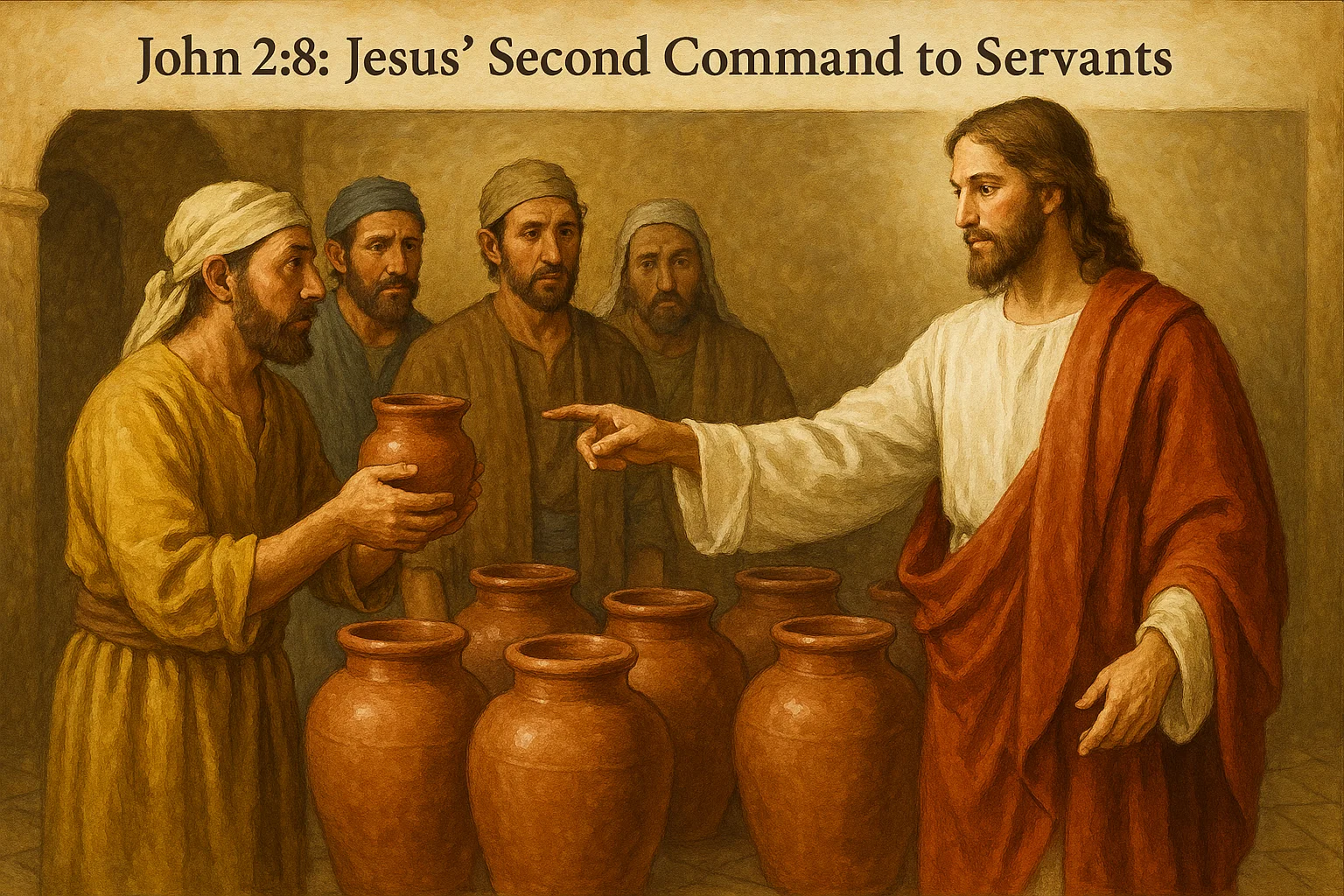
We love the part where the water turns to wine. We quote it. We put it on bumper stickers. But we almost always skip the bridge that got us there. That bridge is John 2:8. It is the moment where common sense died and radical obedience took over. Jesus looks at these exhausted servants—guys who just hauled hundreds of gallons of water—and drops this bomb: “Draw out now, and bear unto the governor of the feast.”
This isn’t just a Bible verse. It’s a blueprint for how to act when your life falls apart. Let’s dig into the grit of this moment.
More in John Chapter 2 Category
Key Takeaways
- Miracles are a team sport: Jesus did the heavy lifting, but He made the servants do the walking.
- Common sense is often the enemy: Taking water to a wine critic sounds like a great way to lose your job.
- “Now” is the scary part: You don’t get time to analyze the plan; you just get a split second to move.
- Risk is the price of admission: The servants risked public shame to follow a stranger’s orders.
- Motion creates the miracle: The water didn’t change while it was sitting still; it changed when they moved it.
Why Is John 2:8 the Scariest Verse in the Chapter?
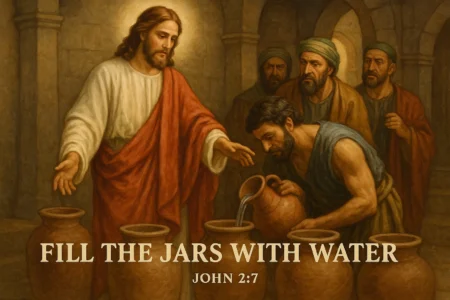
You have to look at the timeline here. In verse 7, Jesus told them to fill the jars. Okay, fine. That’s hard work, but it’s safe. It’s just water. You fill a jar, you wipe your hands, you go home. No one gets fired for filling a bucket.
But John 2:8? That’s where the safety net snaps.
Jesus shifts gears. He tells them to take that water—which, let’s be honest, still looks, smells, and sloshes exactly like water—and march it straight to the head honcho. This moment is the “faith gap.” It’s that terrifying space between what God told you to do and what your eyes are actually seeing.
Think about it. If the servants stop at verse 7, the pots are full, but the guests are still thirsty. The wedding is still a disaster. The miracle dies inside the stone jar. John 2:8 is the trigger. It’s the moment human grit collides with divine power. Without this second command, the water stays water.
What Exactly Did Jesus Command in John 2:8?
He didn’t give a speech. He gave orders. “Draw out now,” He said. “Bear unto the governor.”
The Greek word here for “draw out” is antleo. It’s usually used for pulling water out of a deep well, not just dipping a cup into a jar. It implies work. It implies digging deep.
Notice what He didn’t say. He didn’t say, “Hey guys, watch this cool trick.” He didn’t say, “Don’t worry, it’s going to turn into Merlot halfway across the room.” He gave them zero reassurance. He just gave them a job.
I worked construction for a summer in my early twenties. My foreman was this grueling, old-school guy. One morning, we were staring at a perfectly good wall. He handed me a sledgehammer and said, “Knock it down.” I hesitated. I started asking questions. “Why? It looks fine. Are you sure?”
He just stared at me. “Do you trust me, or do you trust the wall?”
I swung the hammer. Turned out, a pipe was rusted through behind the drywall, leaking rot into the frame. I couldn’t see it. He could.
Jesus treats the servants the same way. He doesn’t explain the chemistry. He demands the swing.
Why Was This a Career-Ending Risk for the Servants?
Have you ever had to present a project to your boss that you knew wasn’t done? That sick feeling in your throat? Multiply that by a thousand.
These servants weren’t apostles. They weren’t spiritual giants. They were hired help or slaves. Their job security—and in that culture, maybe even their physical safety—depended on not screwing up. Serving lukewarm tap water to the master of the banquet as “wine” would look like a sick joke. It would look like a mockery.
If the master tastes water, he doesn’t blame the bridegroom. He blames the waiter.
The risk here is professional suicide. By obeying John 2:8, they put their own necks on the chopping block for Jesus’ reputation. They had to decide right then and there: Is this stranger’s word worth more than my safety?
We all want safe miracles. We want the money in the bank before we write the check. We want the doctor to say “you’re cured” before we stop worrying. We want the water to turn purple in the jar so we know it’s safe to pour.
Jesus doesn’t play that game. He asks you to pour while it still looks clear.
Who Was the “Governor of the Feast” and Why Should We Care?
We need to talk about this guy. The King James calls him the “governor of the feast,” but think of him as the Master of Ceremonies or the ultimate food critic.
In the first century, the architriklinos ran the show. He controlled the flow of the meal. He tested the quality of the meat. And he definitely knew his wine. He knew the vintage stuff, and he knew when a cheap host switched to the watery vinegar to save a few bucks.
You couldn’t fool this guy.
So when Jesus says, “Take it to him,” He isn’t sending the servants to a drunk uncle in the corner who wouldn’t know the difference. He sends them to the expert. He sends them to the critic.
This teaches me something massive about God. He isn’t afraid of scrutiny. He stands up to the test. When God does something in your life, He doesn’t hide it in the shadows. He sends it straight to the governor.
Did the Water Turn Before or After They Moved?
Here is the million-dollar question. When did the miracle actually happen?
- Did it turn when it hit the bottom of the jar?
- Did it turn when the ladle dipped in?
- Did it turn while they were walking across the room?
- Did it turn the second it hit the governor’s lips?
The Bible doesn’t give us a timestamp. But a lot of scholars think the miracle happened in the going. As they obeyed the command of John 2:8, the supernatural invaded the natural.
If the water was already wine when they dipped it out, that’s easy. “Oh, wow, smells like grapes. Cool, I’ll take it.” That’s not faith. That’s just delivery service.
But if it was still water when they drew it out? That takes guts. That takes nerves of steel.
I like to believe it was still water in the cup. I picture them walking across that noisy, crowded room, holding a ladle of clear liquid, sweating bullets, trusting the strange guest who gave the order. That is where real faith lives. It lives in the transit. It lives in the gap between the promise and the proof.
How Does Radical Obedience Unlock the Impossible?
We live in a world that demands an explanation before we lift a finger. We want the business plan. We want the safety data sheets.
The servants at Cana flip that script. They operated on raw, blind obedience.
- They didn’t argue. You don’t hear them asking, “Can we try this with just one cup first?”
- They didn’t negotiate. No backup plans.
- They just went. “And they bare it.”
Those four words—”And they bare it”—are the unspoken heroes of this story. They define the success of the miracle.
If you’re waiting for God to fix your marriage, your bank account, or your health, look at the last thing He told you to do. Did you do it?
Sometimes the miracle isn’t stuck because God is weak. It’s stuck because we are stationary. We’re standing next to the stone jars waiting for a lightning bolt, and He’s waiting for us to pick up the ladle.
Could You Have Walked That Water to the Governor?
Let’s get real for a second.
I remember a few years back, I felt God nudging me to give away my car. It was a beat-up sedan, but it was my beat-up sedan. Logic screamed at me. “You need to get to work. This is stupid. You’re going to be stranded.”
The math didn’t add up. The logic was full of holes. But the internal command was loud. “Give it to that family.”
I argued with God for three days. These servants didn’t even argue for three minutes.
Eventually, my hands shaking, I gave the keys away. It was terrifying. I felt exposed. I felt reckless. Two days later, a guy at my church—who knew absolutely zero about what I’d done—tossed me keys to a truck he didn’t need. It ran better than my old car ever did.
That walk across the parking lot to hand over my keys felt exactly like the walk the servants took in John 2:8. You feel foolish.
But that is the only way to taste the new wine. You have to risk the water.
Why Does the Silence of the Servants Matter?
Notice something weird? The servants never say a word.
Mary talks. Jesus talks. The governor talks. The bridegroom gets talked to. But the servants? They are silent.
They are the unsung heroes of John’s Gospel. They don’t need the credit. They don’t need to explain themselves. They just do the work.
There is a quiet dignity in that. We talk too much about our faith these days. We post about it. We tweet about it. We argue in comment sections. These guys just carried it. They let the results do the talking.
Maybe we need less commentary and more carrying.
How Does John 2:8 Hit Us on a Tuesday Morning?
You might not be at a wedding feast. You might be in a grim hospital waiting room. You might be staring at a pile of unpaid bills.
The principle of John 2:8 holds the line. Jesus gives commands that seem totally disconnected from the problem.
- The Problem: You’re lonely and depressed.
- The Command: Go serve someone else.
- The Logic: “I can’t. I’m empty.”
- The Problem: You’re broke.
- The Command: Be generous.
- The Logic: “I need to save every penny, not give it away.”
- The Problem: You’re full of anxiety.
- The Command: Pray with gratitude.
- The Logic: “I’ll be grateful when the panic attack stops.”
In every single case, the command asks you to “draw out” something that looks inadequate and present it to the situation. You draw out gratitude when you feel pain. You draw out service when you feel drained.
You present it to the Governor—the reality of life—and you watch God change the substance.
Is Faith Really Just Acting Without Proof?
Yes. That is exactly what it is.
If you have proof, you don’t need faith. You need eyesight.
The book of Hebrews defines faith as the evidence of things not seen. John 2:8 is the practical application of that. The servants held the evidence of things not seen in a ladle.
This flies in the face of modern skepticism. You can’t lab-test a miracle before it happens. You have to engage with it to trigger it.
If you want to go deeper into how John frames these signs, the Yale Bible Study on the Gospel of John has some fantastic material on the cultural background here.
Why Does Jesus Say “Now”?
Jesus says, “Draw out now.”
He puts a timestamp on it. Delayed obedience is really just disobedience with a pause button.
If the servants had huddled up for ten minutes to discuss the pros and cons, the moment might have passed. The governor might have walked out. The panic might have overtaken the room.
There is a rhythm to grace. When the impulse comes, you have to move.
I’ve missed out on things because I hesitated. I analyzed the water until I talked myself out of the miracle. “Now” is a scary word because it removes the buffer. It forces your hand.
Are you sitting on a “now” word from God?
What’s the Deal With the “New Wine”?
The wine Jesus made wasn’t just grape juice. The governor tastes it and basically says, “Whoa, you saved the best for last.”
This tells me that what Jesus produces through our obedience is always better than what we can manufacture on our own. We can pump water. We can scrub jars. But we cannot make the best wine.
John 2:8 is the exchange rate. We give Him our water—our best effort, our grind, our limited resources—and He exchanges it for His wine. His power. His abundance.
But He never touches the water until we move it.
Are You Still Staring at the Jars?
It’s easy to stand by the jar. It’s safe there. You can talk about the potential. You can dream about what God could do.
But nothing tastes different at the jar.
You have to dip. You have to draw out. You have to turn your back on the safety of the kitchen and walk straight toward the judgment of the dining hall.
John 2:8 is an invitation to stop staring and start walking.
Conclusion: The Legacy of the Second Command
The Wedding at Cana kicked off Jesus’ public ministry. It showed His glory. It saved a family from total shame.
But none of it happens without the anonymous servants who obeyed John 2:8.
They are the bridge. They remind us that God doesn’t need our ability; He needs our availability. He needs people crazy enough to carry water to a wine tasting just because He said so.
I think back to my friend’s wedding. We ended up ordering pizza. It wasn’t a miracle, but it fixed the hunger. We did what we could with what we had.
Jesus asks for the same thing. Do what you can. Fill the jar. Draw it out. Take the walk.
Let Him handle the molecular structure of the water. You just handle the ladle.
When you wake up tomorrow and look at a situation that seems hopeless—a relationship that’s dead, a bank account that’s empty, a diagnosis that’s cold—remember the command. Don’t look for the wine. Look for the instruction.
Draw out now.
FAQ – John 2:8
What is the significance of John 2:8 in the Wedding at Cana story?
John 2:8 is crucial because it marks the moment where common sense is set aside, and radical obedience takes over as the servants are commanded to draw water and take it to the governor of the feast, which leads to the miracle happening.
Why is John 2:8 considered the scariest verse in the chapter?
John 2:8 is considered the scariest because it involves trusting God’s command without visible reassurance, demanding the servants to take water that still looks like water to the governor, which is a leap of faith and a risk of public humiliation.
What exactly did Jesus command in John 2:8, and what does the Greek word ‘antleo’ imply?
Jesus commanded, ‘Draw out now, and bear unto the governor of the feast.’ The Greek word ‘antleo’ implies pulling water out of a deep well, meaning it requires effort and work, not just dipping lightly into the jar.
Why was obeying John 2:8 a career-ending risk for the servants?
Obeying John 2:8 was risky because they had to trust a stranger’s command to take water to the governor, knowing it could lead to their professional shame or even danger if the water was recognized as not wine, making it an act of radical obedience and sacrifice.
How does John 2:8 teach us about faith and obedience?
John 2:8 teaches that faith involves acting without proof, trusting God’s command even when the outcome is uncertain, and that obedience often requires taking risks and moving forward in the face of doubt, which is where faith truly lives.