
I still wake up in a cold sweat thinking about my first week of advanced calculus in college. I’m not exaggerating. I walked into that lecture hall feeling like I owned the place. I was the smart kid. I’d done the prep work. I’d aced every prerequisite. I was the guy people copied homework from in high school.
Then the professor—a guy with wild hair and chalk dust on his nose—turned to the whiteboard and started scribbling symbols that looked less like mathematics and more like the frantic scrawlings of a madman. Greek letters mixed with imaginary numbers.
I sat there, pen hovering over my notebook, completely paralyzed. My brain didn’t just stall; it crashed. Blue screen of death. I raised my hand, armpit sweating, not to solve the equation but to ask the only question my stunned mind could form: “How does that even work?”
That feeling right there—that specific cocktail of intellectual defeat, embarrassment, and desperate confusion—is exactly where we find Nicodemus in the third chapter of John.
We give Nicodemus a hard time in church circles. We call him “Nick at Nite.” We paint him as a coward for sneaking around in the dark to see Jesus. But we rarely give him credit for the sheer, crushing weight of his confusion. When we dig into John 3:9 explained, we aren’t just looking at a Bible verse. We are watching a brilliant, educated, successful man hit a spiritual brick wall at a hundred miles an hour.
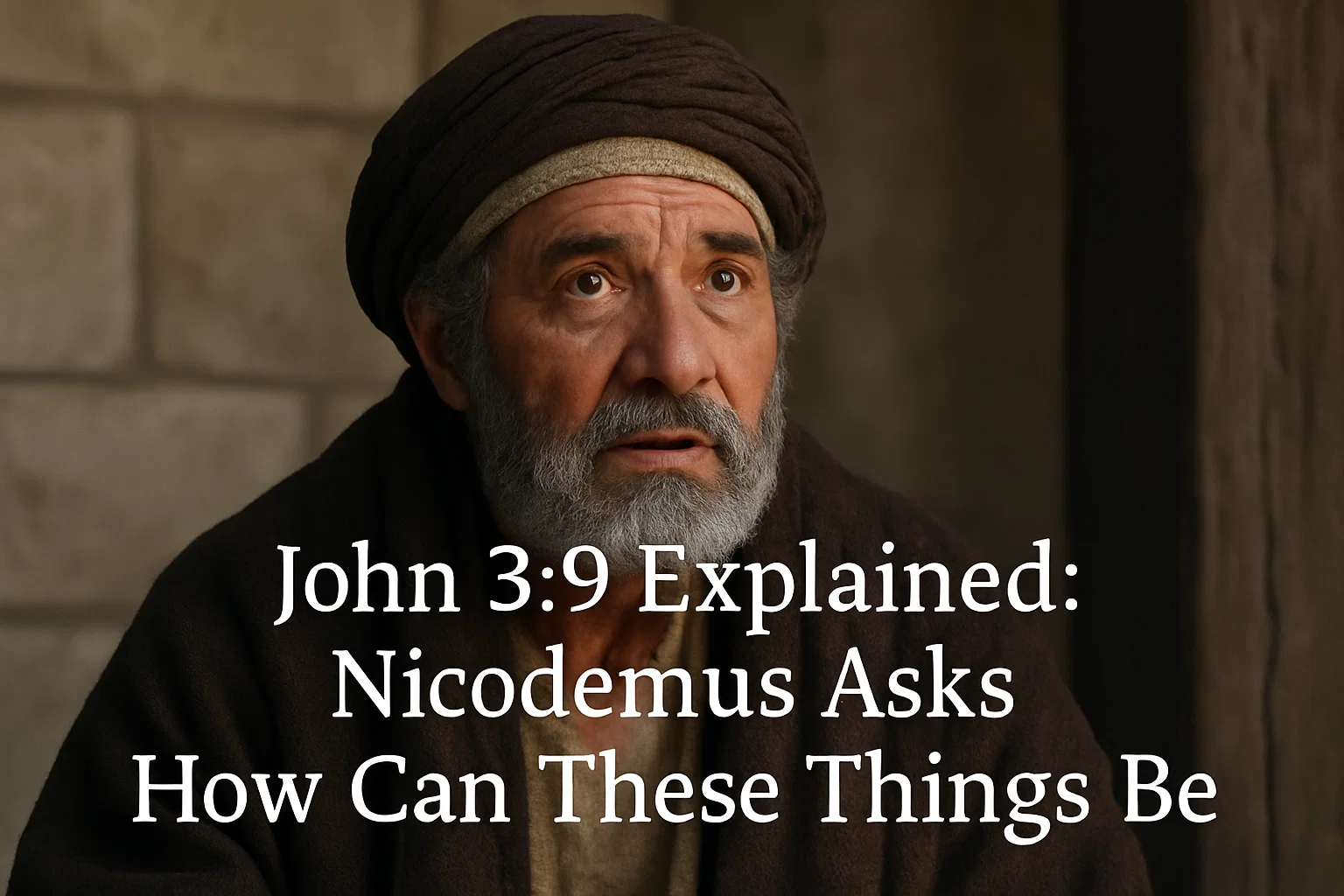
“Nicodemus answered and said unto him, How can these things be?”
That isn’t just a polite inquiry. That is the sound of a worldview shattering. It’s the collision between human logic and divine reality, and the wreckage is total.
More in John Chapter 3 Category
John 3:2 Commentary and John 3:1 Explained
Key Takeaways
- Logic Has a Hard Ceiling: You can be the smartest guy in the room—the CEO, the PhD, the expert—and still be spiritually blind. Intellect cannot climb the ladder to heaven.
- The Shift in Authority: Nicodemus had to stop trusting his résumé and start trusting the Rabbi from Nazareth.
- Grace is Not a Machine: The “how” isn’t a mechanical lever we pull or a button we push; it’s a sovereign move of the Spirit, wild and unpredictable like a nor’easter.
- Honest Confusion is Okay: Jesus didn’t kick Nicodemus out for asking questions; He used the confusion to till the soil for truth.
Who Was This Man Hiding in the Shadows?
You have to understand who is asking the question to feel the weight of it. Context is everything here. If a five-year-old asks, “How does a car engine work?” it’s cute. You explain gas and spark plugs. But if the chief engineer at Ford Motors asks, “How does a car engine work?” you have a crisis on your hands.
Nicodemus was the chief engineer.
He wasn’t some random seeker wandering in off the street. He was a Pharisee. He was a “Ruler of the Jews,” a member of the Sanhedrin. Think Supreme Court Justice meets Vatican Cardinal. This guy had the Torah memorized. He counted his steps on the Sabbath to ensure he didn’t walk too far. He tithed on his spice rack—mint, dill, and cumin.
His entire life, his reputation, his salary, and his self-worth were built on one single, rock-solid premise: I know how God works, and I follow the rules.
Imagine the most intimidating professor you’ve ever had. The one who wrote the textbook everyone uses. Now, imagine him standing in a dark alley, shivering, talking to a carpenter from a backwater town like Nazareth, completely flummoxed. That is the tension of John 3.
Nicodemus came to Jesus attempting to be polite. He started with a compliment: “Rabbi, we know that thou art a teacher come from God.” He thought they were going to have a peer-to-peer discussion. Maybe debate some nuances of Leviticus. Maybe talk about the political mess with Rome.
But Jesus didn’t care about the pleasantries. He didn’t care about Nicodemus’s PhD or his nice robes. Jesus dropped a nuclear bomb on the conversation: “You must be born again.”
This wasn’t just confusing to Nicodemus; it was insulting. It stripped him naked. Think about a baby. A baby brings nothing to the table. A baby doesn’t have a résumé. A baby doesn’t have “good works.” It just receives life. It screams and cries and needs everything done for it.
For a man who spent fifty years earning his status, being told he had to start over like a helpless infant was offensive. It meant his entire trophy case counted for zero.
Why Did the New Birth Crash Nicodemus’s Hard Drive?
I’ve found that the smarter we think we are, the harder it is to accept simple things. We want complexity because complexity makes us feel in control. If it’s complex, I can master it. If it’s simple, I just have to receive it.
Nicodemus suffered from what I call the “Curse of the Expert.” He viewed the world through a very specific lens: Physical descent (I am a son of Abraham) and Moral performance (I keep the Law). In his mind, the equation for salvation was simple arithmetic: Jewish Blood + Good Behavior = Kingdom of God.
Jesus took a red marker to that equation and wrote one word: SPIRIT.
When we look at John 3:9 explained, we see a man trying to run new software on an old operating system. It’s just giving him error messages. In verse 4, Nicodemus asks, “Can a man enter a second time into his mother’s womb?”
People laugh at that line. They think he’s being sarcastic. I don’t think so. I think he was panicked. He was grasping for something literal because the spiritual reality was slipping through his fingers like sand. He knew Jesus spoke in metaphors—rabbis did that all the time—but this specific metaphor was impenetrable to him.
He was facing cognitive dissonance. He saw the miracles. He knew God was with Jesus—you can’t fake raising the dead or healing the blind. But the theology Jesus was teaching didn’t match the grid Nicodemus had built his life on.
Have you ever tried to assemble IKEA furniture without the instructions? You have the boards. You have the screws. You have that little Allen wrench. But nothing fits. You start sweating. You start getting angry. That was Nicodemus. He had the Old Testament scriptures (the parts), but without the Holy Spirit (the instructions), he couldn’t see the picture Jesus was building.
What Does John 3:9 Actually Expose About Our Brains?
Let’s look at the language for a second—don’t worry, I won’t get too academic on you. The phrase is Pōs dunatai tauta genesthai? It literally translates to: “How is it possible for these things to happen?”
Focus on that first word: How.
“How” is the favorite word of the rationalist. It’s the favorite word of the modern Western mind. We are obsessed with mechanics. If my car breaks, I want to know how to fix the alternator. If I want to lose weight, I want to know how the metabolism works. If I want to get rich, I want to know how the stock market moves.
We love “how” because “how” implies a manual. And if I have the manual, I have control. If I know how the machine works, I can pull the levers and get the result I want.
Jesus refuses to give Nicodemus the manual. He explains the “What” (you must be born again) and the “Who” (the Spirit and the Son of Man), but He refuses to explain the mechanics of the “How.”
Why? Because you cannot engineer a miracle. You cannot build a stairway to heaven out of logic.
This verse exposes the ultimate limitation of human reasoning. Your intellect can get you to the moon. It can split the atom. It can map the human genome. But your intellect cannot transport you from spiritual death to spiritual life. Only the Spirit does that. Nicodemus hit the ceiling of his own brain in verse 9. He realized that his impressive intellect was useless in the face of the New Birth.
Is Doubt Always the Enemy of Faith?
I need to make a distinction here because a lot of us carry baggage about “questioning God.” I grew up in a church culture where you just nodded your head. If the preacher said it, you believed it. Asking “how” was seen as rebellion.
But look at the text closely. Jesus doesn’t kick Nicodemus out. He doesn’t say, “Get out of here, you heretic.”
There is a massive difference between the skeptical mockery of a cynic and the honest confusion of a seeker. Pontius Pilate asked, “What is truth?” and then walked out of the room before Jesus could answer. He didn’t care about the answer. He was just being clever. Nicodemus asked, “How can these things be?” and he stayed. He stood there in the dark and listened.
I went through a really dry season in my mid-20s. My faith felt like chewing on cardboard. I read the Bible, and it felt like a history textbook. I prayed, and I felt like I was talking to the drywall. I remember pacing my apartment floor at 2 AM asking, “God, how does this actually work? Are you even there? Is this all just psychological projection?”
I felt guilty for asking. I felt like a bad Christian. But looking back, that wasn’t a lack of faith; it was the growing pains of faith. I had to deconstruct the childish version of God I had in my head to make room for the real One.
Nicodemus is standing in that gap. He represents every single one of us who wants to believe but finds the claims of Christianity intellectually staggering. Jesus challenges him, yes. He pushes him. But He stays with him. He engages him.
The Sting of the Teacher Being Schooled
Jesus’ response to Nicodemus in verse 10 is sharp. It stings. “Art thou a master of Israel, and knowest not these things?”
Ouch. In modern terms, Jesus is saying, “You’re the Dean of Theology at Harvard, and you don’t know the basics of your own Bible?”
This is crucial. Jesus isn’t introducing a brand new religion here. He is pointing Nicodemus back to the Old Testament prophets he claimed to know so well. Ezekiel 36:26: “A new heart also will I give you, and a new spirit will I put within you.” Ezekiel 37: The valley of dry bones coming to life not by effort, but by the breath (Spirit) of God. Jeremiah 31: The promise of a New Covenant written on the heart, not on stone tablets.
Nicodemus knew the text. He could recite the Hebrew. But he missed the music. He missed the theology. He thought the prophets were talking about a national restoration of Israel—kicking out the Romans and setting up a political kingdom. Jesus tells him, “No, they were talking about a restoration of the human heart.”
Jesus shifts the ground from debate to testimony. He says, “We speak that we do know, and testify that we have seen.” He stops arguing logic and starts asserting authority. He essentially tells Nicodemus, “You have to trust Me because I’ve been to heaven, and you haven’t.”
Dancing with the Wind
Right before Nicodemus asks his famous question, Jesus drops an analogy that probably frustrated the poor guy even more. He compares the Spirit to the wind.
“The wind bloweth where it listeth…” (John 3:8).
I used to sail a small boat on a lake near my house. One thing you learn about wind: You don’t control it.
- Invisible Origin: You don’t know where it starts. It just shows up.
- Undeniable Effect: You can’t see the wind itself, but you can see the sails snap full and the boat surge forward. You can feel it on your face.
- Uncontrollable: You can’t tell the wind to stop. You can’t bottle it. You can’t optimize it. You just have to set your sails and catch it.
Nicodemus was a Pharisee. Pharisees were all about control. They controlled what they ate, who they spoke to, how far they walked, and how they washed their hands. Their religion was a grid. A system. Jesus offered him the wind.
When we ask for John 3:9 explained, we have to accept that the Christian life is not a grid. It’s a relationship with the Wind. We want a checklist; God gives us a mystery. We want to know exactly how God will fix our marriage, or how He will pay that bill, or how He will save our wayward kid. Often, the answer is just: “Trust the Wind.”
I learned this the hard way when I was hunting for a job years ago. I had a plan. I had a spreadsheet. I applied to three specific firms. I had the “How” all figured out. God shut every single one of those doors. Slammed them shut. I was angry. I was confused. “How can this be?” A month later, a guy I hadn’t seen in five years—a guy I met randomly at a coffee shop once—called me out of the blue with an offer that was better than anything on my spreadsheet. I couldn’t have planned that. I couldn’t trace the “whence it cometh.” But I sure enjoyed the result.
Why ‘How’ is the Wrong Question for Miracles
The problem with asking “How?” is that it demands a natural explanation for a supernatural event. It’s a category error.
If you ask, “How did Jesus walk on water?” physics has nothing for you. Surface tension doesn’t work like that. Gravity doesn’t work like that. If you ask, “How did five loaves feed five thousand?” biology is silent. Bread doesn’t undergo mitosis. If you ask, “How can a sinner become a saint?” psychology hits a wall. Behavior modification can change habits, but it can’t change nature.
Nicodemus tried to fit the infinite God into his finite brain. It’s like trying to download the entire internet onto a floppy disk. It won’t fit, and you’re going to break the disk trying.
The better question is not “How,” but “Who.”
Once Nicodemus realizes Who he is talking to, the How stops mattering. If Jesus is the Son of Man who came down from heaven (John 3:13), then He has the authority to declare reality. The validity of the New Birth doesn’t rest on Nicodemus’s ability to understand it; it rests on Jesus’ authority to grant it.
The Serpent in the Wilderness
Jesus answers the “How” in a way Nicodemus never expected. He doesn’t give a theological dissertation. He doesn’t draw a diagram. He gives a picture from history.
“And as Moses lifted up the serpent in the wilderness, even so must the Son of man be lifted up.” (John 3:14).
This refers to Numbers 21. The Israelites were dying from snake bites. God told Moses to make a bronze serpent and put it on a pole. The instruction was bizarrely simple: Look at the bronze snake, and you will live. Not “make an antidote.” Not “suck out the poison.” Not “fight the snakes.” Just… look.
It made no logical sense. How does looking at a piece of bronze cure a biological poison? It didn’t make sense then, and the Cross doesn’t make sense to the logical mind now. How does the death of a Jewish man 2,000 years ago fix my sin today? How does blood shed on a Roman cross rewrite my future?
Jesus is telling Nicodemus: “You want to know how? It happens through a look of faith.” The “how” is the sacrifice of the Son. The “how” is God doing for us what we could never do for ourselves. It’s offensive to our pride because we want to do something. We want to earn it. We want to help. God says, “No. Just look and live.”
What Happened to the Skeptic?
I love the arc of Nicodemus. He doesn’t stay in the dark. John 3:9 wasn’t the end of his story. The seed Jesus planted that night—the confusion, the challenge, the mystery—it took root. It grew slowly, underground, but it grew.
We see him again in John 7, defending Jesus in front of the other Pharisees. He’s risking his neck. He asks, “Does our law judge a man before it hears him?” He’s using his legal knowledge to buy Jesus time. He’s stepping out of the line.
And then we see him in John 19. This is the moment that gets me. Jesus is dead. The disciples—the ones who bragged about their faith, the ones who said they would die for Him—have fled. Peter is hiding. But Nicodemus? Nicodemus steps out of the shadows. He goes to Pilate. He brings a mixture of myrrh and aloes, about a hundred pounds weight.
Do you know how much a hundred pounds of myrrh and aloes cost back then? That is a king’s burial. That is a fortune. That is Nicodemus saying, “I don’t care who sees me anymore.”
He publicly identifies himself with the dead body of the Rabbi who baffled him. He moved from asking “How can these things be?” to declaring “This Man is worthy of everything I have.”
He moved from confusion to courage. He realized that he didn’t need to understand the mechanics of the wind to set his sail in it. He didn’t need to solve the equation to trust the Teacher.
How Do We Apply This to Our Google-Obsessed Lives?
We live in the Information Age. We have the world in our pockets. We fact-check everything in real-time. We demand data. We worship at the altar of Science and Reason. In many ways, we are all Nicodemus. We approach God with our Western, analytical, scientific minds, and we fold our arms and say, “Explain yourself. Show me the data. Prove it.”
- “How can a loving God allow cancer?”
- “How can prayer actually change outcomes?”
- “How can the Bible be ancient and relevant?”
These are our versions of John 3:9.
We have to learn to let the mystery exist. True faith isn’t the absence of questions; it’s the presence of trust right in the middle of the questions.
I have a buddy who is an engineer—brilliant guy, builds bridges for a living. Everything in his life has a tolerance level, a specification. He struggles with Christianity because it’s not efficient. Grace isn’t efficient. It’s messy. It’s wasteful. I told him once, over a beer, “Man, you’re trying to measure love with a ruler. You’re using the wrong tool.”
You cannot measure the spiritual rebirth with the tool of human logic. You measure it by the fruit it produces in a life. You measure it by the alcoholic who puts down the bottle. You measure it by the marriage that is restored from the dead. You measure it by the peace that passes understanding.
For those who want to dig deeper into the historical context of the Pharisees and the Gospel of John, Yale Divinity School provides excellent resources that bridge the gap between ancient text and modern understanding.
Stop Trying to Figure It Out
There comes a point where you have to stop trying to figure God out and just let Him be God. Maybe you are there right now. You’ve read the books. You’ve listened to the podcasts. You’ve debated the philosophy. But you still feel empty. You’re still stuck on “How?”
The invitation of John 3 is to stop looking at the mechanism and start looking at the Messiah.
“For God so loved the world…” That’s the answer. How can these things be? How can a rebel be made a son? How can a dead heart beat again? Because God loved the world.
That’s the only explanation that matters. It’s not logic; it’s love. Nicodemus eventually stopped asking how and started carrying the cross. That’s the path. You don’t have to understand the meteorology of the wind to let it fill your lungs. You just have to breathe.
FAQs – John 3:9
Why is Nicodemus’ question in John 3:9 considered a reflection of a worldview collision?
Nicodemus’ question, ‘How can these things be?’, signifies a collision between human logic and divine reality, illustrating how even the most educated can be stunned and confused by spiritual truths that surpass logical understanding.
What does John 3:9 reveal about the limitations of human intellect in spiritual matters?
John 3:9 exposes that human reasoning has a ceiling when it comes to spiritual truths; intellect alone cannot achieve spiritual rebirth, which is a move of the Spirit beyond human control and understanding.
How does Jesus’ response in John 3:9 challenge Nicodemus’ worldview?
Jesus’ response highlights that the ‘how’ is beyond human comprehension and emphasizes trusting in Who He is—the Son of Man—rather than relying solely on human logic or understanding of the process.
Why is it important to distinguish between honest questioning and cynicism in faith, as demonstrated in the story of Nicodemus?
Honest questioning, like Nicodemus’, engages with spiritual truth respectfully and allows growth, while cynicism dismisses the truth altogether; Jesus’ approach shows that seeking understanding is appreciated, even when the questions challenge our beliefs.