
It’s 2 AM. The house is quiet. The emails have stopped pinging. The kids are asleep. You’re staring at the ceiling, and there’s this gnawing feeling in your gut that something isn’t right. On paper, you’re crushing it. You have the title, the salary, the respect of your peers. But inside? It’s a ghost town.
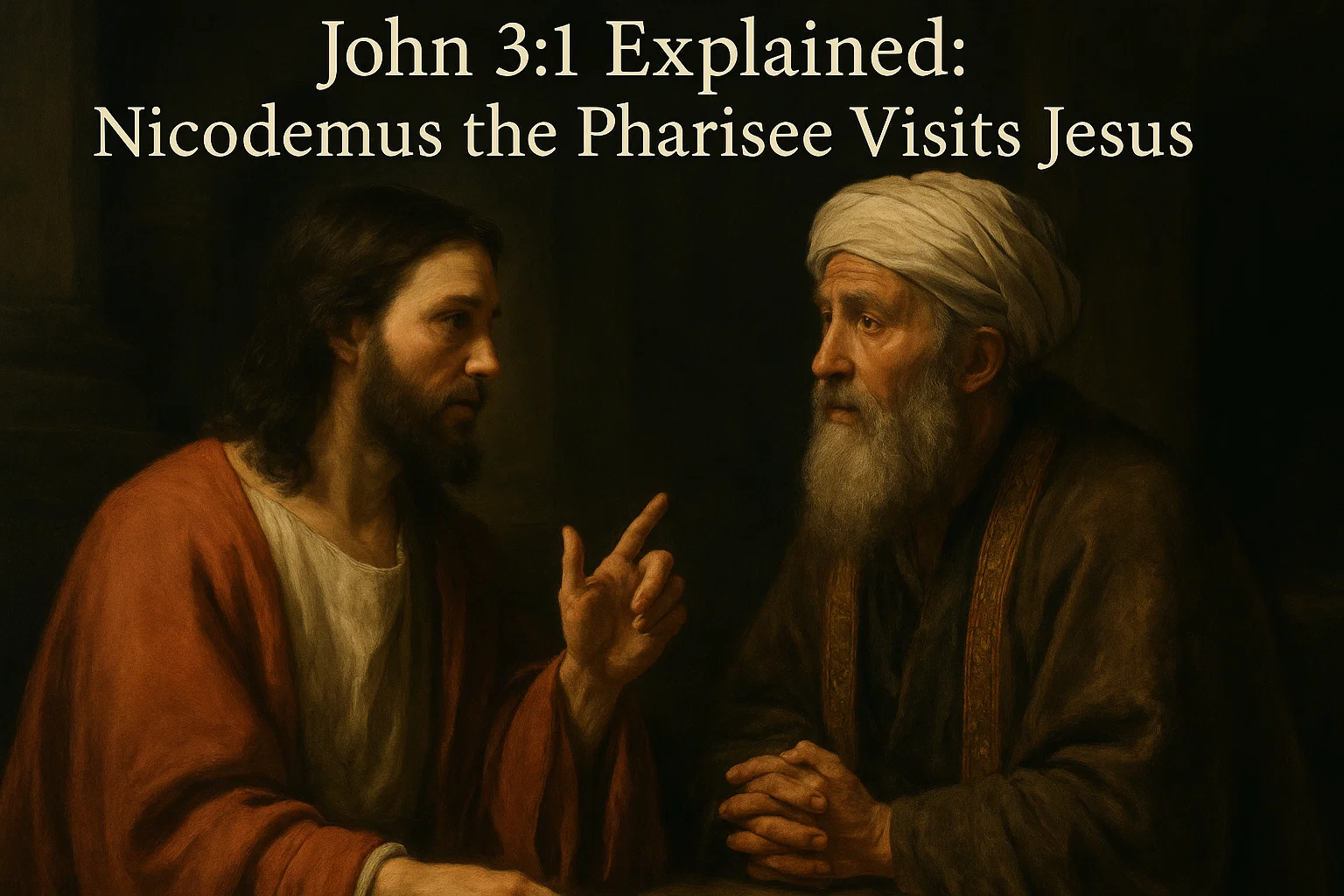
That is exactly where we meet a man named Nicodemus.
We aren’t just dusting off an old history book here. John 3:1 Explained is a mirror. It’s a look into the soul of every person who has ever climbed the ladder of success only to realize it was leaning against the wrong wall. We are going to dissect this opening verse not like academics, but like detectives trying to figure out why a man who had everything would risk it all for a midnight chat with a controversial carpenter.
John 2:21 Meaning and John 2:20 Meaning
Key Takeaways
- Success is a Lousy God: Nicodemus proves that you can reach the absolute pinnacle of your career and religion and still be spiritually starving.
- The “Pharisee” Wasn’t a Cartoon Villain: These guys were the Navy SEALs of Judaism. Nicodemus was disciplined, serious, and deeply committed—not just some hypocrite in a robe.
- The Cost of Curiosity: Making this visit could have cost Nicodemus his seat on the Supreme Court of Israel. The stakes were incredibly high.
- Religion vs. Rebirth: You can know the Bible backward and forward (like Nicodemus did) and still miss the point entirely.
- The Danger of Labels: We love to categorize people. Jesus loves to smash those categories.
Who Was This Guy Lurking in the Shadows?
“Now there was a man of the Pharisees named Nicodemus, a ruler of the Jews.”
John doesn’t mess around. He drops the facts like a hammer. But you have to slow down to actually feel the weight of what he’s saying. When we dig into John 3:1 Explained, we are looking at three massive identifiers that define this guy’s entire existence: a man, a Pharisee, and a ruler.
I remember sitting in a high-rise conference room in downtown Chicago a decade ago. It was late, maybe 9 PM. The cleaning crew was vacuuming the hallway. I was loosening my tie, staring at a quarterly report that said we had just had our best year ever. My team had been high-fiving earlier. I played the part—smiling, shaking hands, acting like the boss. But the second I got into the elevator and those doors slid shut, the mask dropped. I felt like a fraud. I had the corner office, but I was spiritually bankrupt. I was tired of the game.
That is the Nicodemus vibe.
He wasn’t just “some guy.” He was a “ruler of the Jews.” That means he sat on the Sanhedrin. Imagine the Supreme Court combined with the Vatican’s College of Cardinals. He was one of the seventy-one most powerful men in the nation. When he walked into a room, people stood up. When he spoke, people took notes.
John names him. That’s huge. He isn’t “a certain ruler.” He is Nicodemus. This makes it personal. It anchors the story in reality. This actually happened. A real guy with a real reputation to lose decided to step out of his comfort zone.
What Did It Really Mean to Be a Pharisee?
We give Pharisees a bad rap these days. In Sunday School, they are always the bad guys with the angry eyebrows, plotting against Jesus. But if we want to be honest about John 3:1 Explained, we have to drop our modern arrogance.
In the first century, the Pharisees were the heroes. They were the guys who didn’t sell out. When the Greek culture came washing in like a tidal wave, trying to turn Jerusalem into a pagan city, the Pharisees held the line. They were obsessed with purity. They were the Bible-thumpers, the guys who memorized entire books of the Torah. They were the conservatives who believed in angels, the resurrection, and the judgment of God.
Think of the most disciplined person you know. Maybe it’s that buddy who wakes up at 3:30 AM to run ten miles, eats only raw vegetables, and reads a book a week. That was Nicodemus, but for God’s Law. He didn’t just follow the rules; he lived and breathed them. He wasn’t looking for loopholes; he was looking for holiness.
But here is the kicker.
Discipline can be a mask. I spent years in a religious environment where I thought if I just didn’t smoke, didn’t drink, and showed up every time the church doors were open, I was good with God. I became a professional at behavior modification. I could spot a sinner from a mile away while my own heart was full of pride and judgment. Nicodemus was the best of the best, but verse 1 sets him up for a crash. He had the rulebook, but he didn’t have the relationship.
Why Was His Title a Trap?
Being a “ruler of the Jews” sounds great, but it’s a cage.
The Sanhedrin was the ultimate authority. The pressure must have been suffocating. When you are at the top, you can’t ask for help. Who does the boss complain to? If Nicodemus admits he is confused, he looks weak. If he admits he is intrigued by this uneducated preacher from Nazareth, he looks like a traitor.
Have you ever kept your mouth shut in a meeting because you didn’t want to look stupid? Now multiply that fear by a million. If Nicodemus is seen nodding along to Jesus, he risks his tenure. He risks his pension. He risks being kicked out of the synagogue, which was basically social death.
This verse highlights the stakes. By tagging him as a ruler, John is telling us: This guy is gambling everything just by knocking on the door.
Is It Possible to Be Religious and Empty?
This is the question that haunts this entire passage. Nicodemus is the poster boy for organized religion. If anyone had a VIP pass to heaven, it was him. He had the pedigree. He had the education. He had the robes. He had the tithe record.
And yet, he is seeking out Jesus.
Why?
If religion worked, he would be asleep. You don’t go hunting for an itinerant rabbi in the middle of the night if your soul is satisfied. Verse 1 proves that religion alone—rules, rituals, heavy theology—doesn’t fill the void.
I recall a season where I was leading a men’s group. I was dishing out advice, quoting scripture like a machine, praying these long, eloquent prayers that made people nod. But privately? I was dry as a bone. I felt like I was acting in a play. I knew the lines, but I didn’t feel the emotions. I bet Nicodemus felt that same dusty feeling in his chest. He knew the Torah, but he didn’t know the Author.
The Truth About Nicodemus
- He wasn’t a villain: We label him “bad” because of his group, but his visit proves he was open-minded enough to investigate the truth for himself.
- He wasn’t a coward: Yeah, he came at night. But he came. Most of his buddies stayed home and plotted Jesus’ execution. He showed up.
- He evolved: Later in John’s Gospel (chapter 7 and 19), this same man defends Jesus publicly and helps bury His body. This verse is just the starting line of a long journey.
Why Does His Name Matter?
Names are huge in the Bible. “Nicodemus” is a Greek name. It means “victory of the people.”
The irony is thick enough to cut with a knife. He is named “Victory,” but he walks into this scene defeated. He has conquered the social ladder. He has won the approval of his peers. He is a success story. But he hasn’t conquered the nagging doubt in his own head.
John is a specific writer. He doesn’t throw in details for fluff. By giving us the name and the title in John 3:1, he forces us to look at our own labels.
What’s on your business card?
- Senior Vice President?
- Head Deacon?
- PhD Candidate?
- Mother of the Year?
Jesus is about to strip all that away. But it starts here, with a man gripping his identity tight, not knowing he is about to be told to start over from scratch.
Was He Representing All Pharisees?
It is easy to generalize. We say, “The Pharisees hated Jesus.” But Nicodemus shows us there were cracks in the establishment.
There was a hunger inside the religious elite. While the loud majority wanted to crush Jesus because He threatened their power, a quiet minority was whispering, “What if? What if this is real?”
Nicodemus represents the seeker inside the system. Maybe you are part of a system right now—a rigid corporate culture, a strict family, a cynical university department—that mocks faith. It is hard to break rank. It is lonely.
I had a buddy in college, a brilliant guy, totally atheistic circle of friends. They mocked everything spiritual. But one night, after a few too many beers at a dive bar, he looked at me and said, “I wish I could believe what you believe. It must be nice to have hope.” In that moment, he wasn’t “The Skeptic.” He was just a guy, like Nicodemus, standing on the edge of the light, wanting to step in but afraid of the burn. John 3:1 Explained resonates because it validates that secret search.
How Does This Set Up the “Born Again” Bomb?
You can’t appreciate the shock of “You must be born again” (John 3:3) without understanding the credentials in John 3:1.
Jesus tells a man who has spent his entire life building a resume that his resume is trash.
If you tell a criminal he needs a fresh start, he gets it. He knows his life is a wreck. But tell a Pharisee he needs a fresh start? Tell a ruler he needs to be reborn? That is an insult. That is radical.
Verse 1 builds the pedestal so Jesus can kick it out from under him. It establishes how high Nicodemus is so we can see how far he has to fall to get into the Kingdom. Without the context of his high status, Jesus’ command loses its punch. Jesus is basically saying, “Nicodemus, your birthright, your degree, your obedience, your heritage—it buys you nothing. You need a new origin.”
“Now There Was a Man…” Why That Phrasing?
It seems simple. “Now there was a man…” But look back one verse.
John 2:25 says Jesus “knew what was in man.” John 3:1 starts, “Now there was a man…”
See the connection? Jesus knows the dark, messy stuff inside humanity. And immediately, John pushes Nicodemus onto the stage as Exhibit A.
He is the prime example of the “man” Jesus knows. Jesus looks right past the fancy robes, the theological degrees, and the phylacteries, and He sees the naked human soul underneath.
We spend so much cash and energy building our avatars. We filter our Instagram photos. We polish our LinkedIn bios until they shine. We rehearse our elevator pitches. But God sees the “man” underneath the “Pharisee.” He sees the person, not the persona.
Why Do We Resonate with Nicodemus?
I think Nicodemus is the patron saint of the modern intellectual. He wants to believe, but he needs it to make sense. He isn’t satisfied with emotional hype, smoke machines, or catchy worship songs. He sees the evidence (“No one can do these signs that you do,” v.2), but he needs to understand the mechanics of it all.
We live in the information age. We want data. We want the white paper. Like Nicodemus, we approach God with our logic fully engaged.
And here is the beautiful thing: Jesus welcomes him. Notice that? Jesus doesn’t slam the door. He doesn’t mock him for coming in the shadows. He engages him. He challenges him, sure, but he talks to him. He respects the question.
I went through a phase where I deconstructed everything. I tore apart my faith, questioned the Bible, questioned if God was even good. I felt guilty, like I was betraying my grandma’s prayers. But looking back, that was my “Nicodemus moment.” I was coming to Jesus in the dark, asking the hard stuff. And just like in this text, Jesus didn’t push me away. He invited me to look deeper.
What’s the Real History Behind the Pharisees?
To really get John 3:1 Explained, let’s dig into the dirt and dust of history. The Pharisees popped up during the time between the Old and New Testaments. They started as a separatist movement—people who wanted to pull away from the mess of the world and be pure for God.
They were the conservatives of their day. They believed in:
- The Resurrection of the Dead (The aristocratic Sadducees didn’t believe in the afterlife).
- Angels and Demons (They believed in the supernatural realm).
- The Oral Torah (Traditions passed down from the elders to protect the Law).
- Strict Tithing (They gave ten percent of everything, even their garden spices).
Nicodemus wasn’t a liberal theologian trying to water down the scripture to make it palatable. He was a fundamentalist. He took God seriously. This makes his visit even more intense. He wasn’t looking for an easier path; he was looking for the absolute truth.
How Does This Verse Smack Our Prejudices?
We judge people by their tribes. It’s human nature. “He’s a Democrat? He must be crazy.” “She’s a Republican? She must be heartless.” “He’s a Pharisee? He must be a hypocrite.”
John 3:1 shatters that tribalism. It introduces an individual who breaks the mold of his group. It forces us to stop looking at labels and start looking at souls.
I have a neighbor who is deeply involved in a religion that I totally disagree with. We are worlds apart theologically. But we started talking over the fence one day, while he was watering his roses, and I realized he is just terrified of dying. He is doing all this stuff—the rituals, the meetings—because he is scared. He isn’t an “opponent.” He is a man. Just like Nicodemus.
What About “The Jews”?
When John writes “the Jews” in this context, he is usually talking about the religious leaders in Jerusalem, the establishment, not the whole Jewish population. Nicodemus was a “ruler of the Jews.”
This puts him in the danger zone. John’s Gospel is basically a courtroom drama—a trial about who Jesus is. Nicodemus is a member of the jury who decides to sneak out during recess and interview the defendant personally.
He is doing his homework. He is investigating. This is a model for honest skepticism. Don’t just listen to the gossip in the hallway; go to the source. Read the book yourself. Talk to God yourself. Don’t take CNN’s word for it, and don’t take your pastor’s word for it either. Go to the text.
Why Start the “Gospel in Miniature” Here?
Martin Luther called John 3:16 “the Gospel in miniature.” It’s the most famous verse in the world. But you don’t get verse 16 without verse 1.
The story starts with a specific guy in a specific zip code. It grounds the cosmic love of God in a personal, awkward, late-night conversation. God didn’t just skywrite “I LOVE YOU” across the clouds. He sent His Son to talk to a confused old man who was afraid of the dark.
John 3:1 Explained shows us that Jesus is accessible. Whether you are a blue-collar fisherman like Peter with dirt under your fingernails, or an ivory-tower scholar like Nicodemus with soft hands, the door is unlocked. The requirement is the same: drop the ego and step into the light.
Why the “Night”?
Verse 2 mentions he came by night, but verse 1 sets up the reason for the night. Because of who he was (Verse 1), he had to come at night (Verse 2).
The night represents his fear, yes. But it also represents his spiritual condition. He is in the dark. He is stumbling. He has the law, which is a lamp, but he doesn’t have the sun.
But give the man credit. He stepped into the dark to find the Light.
So, What Now?
Maybe you aren’t a Pharisee. Maybe you aren’t a ruler. But I guarantee you have an identity that you protect. You have a reputation that you polish. You have a group of friends you don’t want to alienate.
Are you willing to risk it? Are you willing to ask the question that is burning a hole in your gut?
Nicodemus teaches us that it is okay to start in the dark. It is okay to be scared. It is okay to not have it all figured out. The win is that you make the move. You step out of the safety of your “group” and you seek the person of Jesus.
Nicodemus started in John 3:1 with fear and shadows. He ended in John 19 with courage, helping bury the body of the man he once visited in secret, handling the corpse of a condemned criminal—an act that would have made him ritually unclean and likely cost him his job. He eventually stepped out of the shadows.
But it all started with that one sentence. That one choice to walk out the door.
So, next time you see a “religious” person who looks like they have it all together, remember Nicodemus. Remember that under the suit and the smile, there might be a heart starving for something real.
And if that heart is yours? Don’t let your title keep you from the Truth. Make the visit. Ask the question. He’s up. He’s listening.
FAQs – John 3:1
Why is Nicodemus considered a significant figure in John 3:1?
Nicodemus is significant because he is a Pharisee, a member of the Jewish ruling council, and his visit to Jesus highlights a seeker within the religious establishment who is exploring faith genuinely.
What does Nicodemus’s background as a Pharisee tell us about his character?
His background as a Pharisee reveals that he was disciplined, serious, deeply committed, and took God’s law seriously, pursuing holiness with rigorous discipline.
Why did Nicodemus approach Jesus at night, and what does that signify?
Nicodemus approached Jesus at night out of fear and caution, signifying his apprehension and the need to seek Jesus discreetly because of the potential repercussions within his powerful position.
How does Nicodemus’s story challenge common stereotypes about religious leaders?
Nicodemus’s story challenges stereotypes by showing that he was open-minded, curious, and willing to investigate the truth despite the pressures of his position, illustrating that religious leaders can seek genuine understanding.
What lessons can we learn from Nicodemus’s journey in John 3:1?
Nicodemus’s journey teaches us that it’s okay to seek Jesus in fear and darkness from the shadows, and that spiritual growth often begins with a willingness to ask hard questions and step out of our comfort zones.