
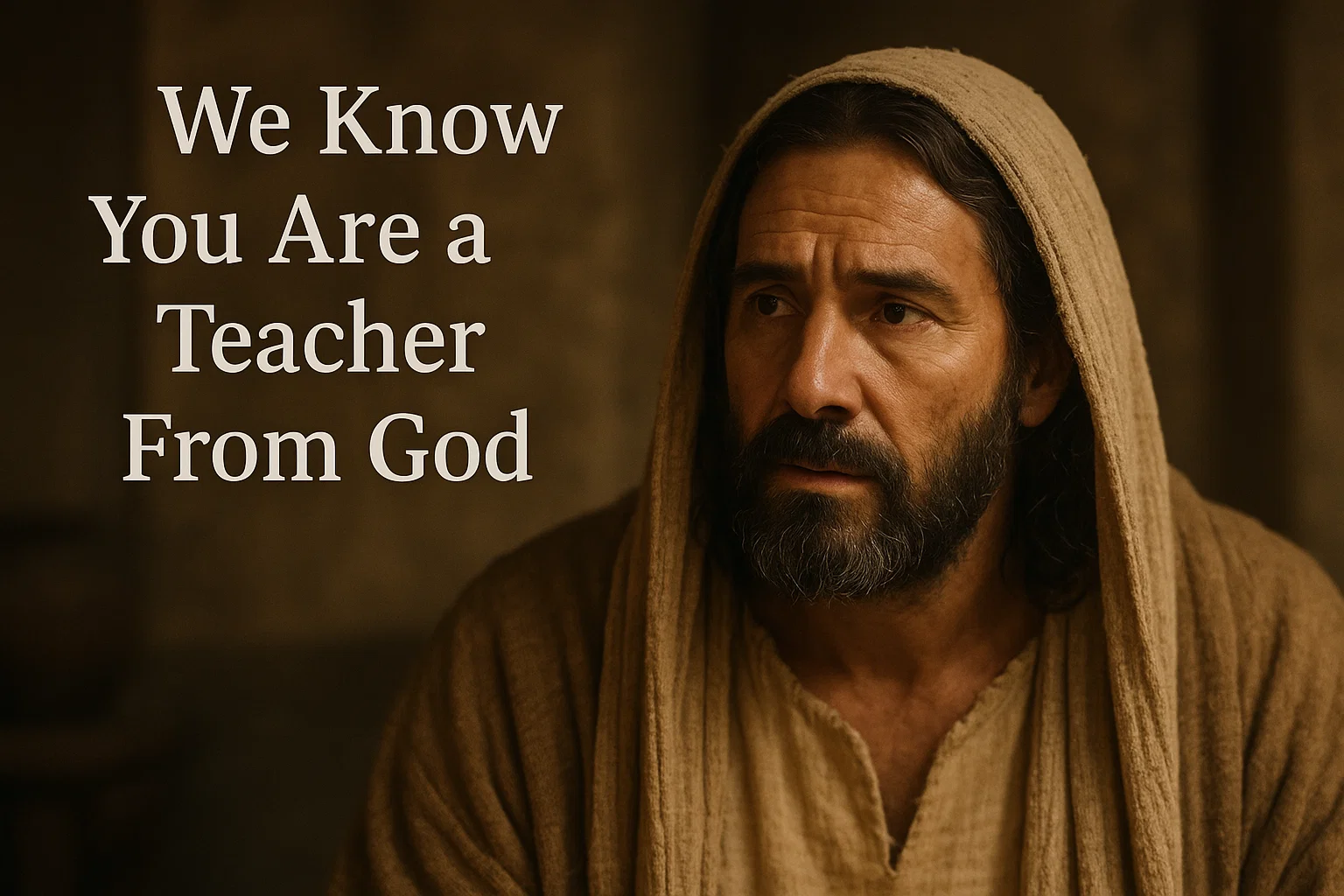
You can almost hear the gravel crunching under his sandals.
Jerusalem at night isn’t silent; it’s watchful. The markets are closed, the shouting merchants are gone, but the city breathes with a heavy, political tension. In the middle of this, a man is hugging the shadows. He isn’t a thief. He isn’t a beggar. He’s a guy who wears robes that cost more than most people make in a year.
He is Nicodemus. A heavy-hitter. A ruler. And he is terrified of being seen.
He finds the door, knocks, and steps into a conversation that tears the roof off his entire worldview.
This is the raw, unpolished reality of John 3:2 Commentary. We often treat this verse like a polite greeting card. It isn’t. It’s a collision. Nicodemus walks in with his chest puffed out, ready to talk shop with the new guy from Nazareth. He thinks he’s offering a compliment. He thinks he’s validating Jesus.
“This man came to Jesus by night and said to him, ‘Rabbi, we know that you are a teacher come from God, for no one can do these signs that you do unless God is with him.'” (ESV)
It sounds nice. “Teacher.” “Come from God.” But underneath those words is a massive misunderstanding. I’ve read this text a thousand times, and every time, it hits me: I am Nicodemus. I love logic. I love safety. I want Jesus to make sense on my spreadsheet. But Jesus doesn’t do spreadsheets.
More in John Chapter 2 Category
John 2:21 Meaning and John 2:20 Meaning
Key Takeaways
- The Cover of Darkness: Nighttime isn’t just a setting; it’s a confession of fear and social preservation.
- The Insult of “Teacher”: calling Jesus “Rabbi” is like calling a hurricane a “breeze”—it misses the power entirely.
- Safety in Numbers: The “We know” proves Nicodemus is hiding behind a group opinion rather than standing on his own conviction.
- The Trap of Logic: He tries to use math (miracles = God) to define a Person who invented the math.
- Missing the Incarnation: He sees God with Jesus, but he is blind to the fact that God is Jesus.
Who is this guy lurking in the shadows?
Let’s get the profile right. Nicodemus isn’t just a religious enthusiast. He is the establishment. Think of a Supreme Court Justice mixed with a Vatican Bishop. He sits on the Sanhedrin, the council of seventy men who basically ran Judea under Roman oversight. He’s got tenure. He’s got a reserved seat at the best banquets.
When I look at him, I see a man who has spent decades building a fortress of certainty. He knows the Torah backward and forward. He knows exactly who God accepts and who God rejects.
Then Jesus shows up. And Jesus is messy. He touches lepers. He crashes parties. He flips tables.
Nicodemus represents the best of human religion. He isn’t evil. He isn’t trying to kill Jesus (yet). He is just… unsettled. He’s the guy who wants to inspect the building permits before he moves into the house. He approaches Jesus not as a desperate sinner, but as a curious peer. And that is his first mistake. You don’t peer-review God.
Why did he wait until the sun went down?
People argue about this constantly in every John 3:2 Commentary. Was he busy? Was he tired?
Let’s be real. He was scared.
The text specifies, “came to Jesus by night.” In John’s writing, night always means moral darkness. Judas leaves the Last Supper and enters the “night.” Nicodemus is walking in from the dark. But practically? The stakes were astronomical.
If a member of the Sanhedrin was caught chatting with this radical miracle-worker, the gossip mill would explode. He could lose his standing. He could lose his influence.
I get it. I remember being in a university class years ago—Philosophy 101. The professor was a shark. He lived to chew up Christians. I sat in the back, hoodie up, mouth shut. I believed in God, but I didn’t want to be the target. I didn’t want to look stupid. I kept my faith in the “night” mode. I would talk about it with friends in private, but in that classroom? I was a ghost. Nicodemus is doing the same thing. He wants the truth, but he wants to keep his tenure. He wants Jesus, but he wants his reputation too.
Who is the “We” he keeps talking about?
“Rabbi, we know…”
Catch that? He doesn’t say “I know.”
This is a power move. It’s classic negotiation. When I want to complain to my boss but I’m nervous, I say, “Everyone is feeling a bit overworked.” It sounds better than, “I am tired.” It spreads the risk.
Nicodemus is hinting that he isn’t alone. There is a whisper network in the Sanhedrin. Other guys in the high court have seen the miracles. They’ve crunched the numbers. They know Jesus isn’t a fake. They are talking about it behind closed doors, away from the crowds.
But by saying “We,” Nicodemus is also trying to level the playing field. He is saying, “Look, Jesus, I represent a powerful group. You have power too. Let’s talk.” He is trying to establish a coalition. He doesn’t want to submit; he wants to align.
Is calling Jesus “Rabbi” actually an insult?
He calls Him “Rabbi.” On the surface, this is respect. Jesus didn’t go to the rabbinical schools. He didn’t study under Hillel or Shammai. Technically, He didn’t earn the title. Nicodemus gives it to Him anyway. It’s like giving an honorary doctorate to a genius who dropped out of high school.
Nicodemus thinks he is being gracious. He thinks he is validating Jesus’ ministry.
But imagine walking up to the guy who built your house, the architect who drew every line, poured the foundation, and wired the electricity, and saying, “Hey, nice job. You’re a pretty decent handyman.”
It’s a slap in the face.
Jesus isn’t a Teacher who explains God. He is God explaining Himself. When we treat Jesus like a life coach, or a moral guide, or a “Rabbi,” we are insulting Him. We are putting the Ocean into a cup.
I’ve done this. I’ve treated God like a consultant. “Hey God, here’s my plan for my career. Can you give it a quick review and bless it?” That’s the “Rabbi” approach. It keeps me in charge. It keeps God on the payroll as an advisor. Jesus doesn’t want to be an advisor.
What is the logic behind “No one can do these signs”?
Nicodemus is a man of logic. He lays out a syllogism:
- Fact 1: You are doing things that are physically impossible (signs).
- Fact 2: Only God controls the impossible.
- Conclusion: Therefore, God is backing you.
He is looking at the evidence. He is an empiricist. He trusts his eyes.
See, the Sanhedrin wasn’t stupid. They knew the difference between a magician and a miracle. Magicians do tricks; Jesus did renovations on reality. Water to wine. Healing bodies. Nicodemus looked at the data points and realized the graph only went one way.
You can check out historical perspectives on miracles at sites like Biblical Archaeology Society to see how first-century Jews viewed “signs.” They were credentials. They were the ID badge of a prophet.
But here is the problem with “Sign Faith.” It relies on the show. What happens when the show stops? What happens when the miracle doesn’t come? Nicodemus believed because Jesus was winning. Would he still believe when Jesus was losing on the cross?
Does “God is with him” miss the point?
“Unless God is with him.”
This sounds biblical. God was with Moses. God was with David. God was with Gideon.
But Jesus isn’t in that line. He isn’t a prophet who has God’s phone number. He is the voice on the other end of the line.
Nicodemus thinks Jesus is a human container filled with divine power. He misses the Incarnation. He misses the fact that the man sitting across from him, breathing the same air, is the Ancient of Days.
I remember hiring a guy to help me fix my deck once. I treated him like a laborer. I gave him instructions. I checked his work. Later, I found out he ran a construction company that built skyscrapers. I was telling a master builder how to hold a hammer. I felt like an idiot.
Nicodemus is telling the Creator, “I can tell God is helping you.” It’s profound ignorance dressed up as theological insight.
Why does the active voice matter here?
Nicodemus comes in hot. “We know.”
He isn’t asking questions yet. He is making statements. He frames the conversation.
Men do this. I do this. When I walk into a room, I want to establish where I fit in the hierarchy. I want to secure my footing. Nicodemus walks in and essentially says, “I have evaluated you, and you pass inspection.”
It’s subtle, but it’s arrogant. He is judging Jesus. He is standing over Jesus, measuring Him against the yardstick of his own rabbinical training.
And Jesus? He refuses to play that game. Notice in verse 3, Jesus doesn’t say “Thank you.” He doesn’t say, “I appreciate the support of the Sanhedrin.” He cuts Nicodemus off at the knees. He ignores the compliment and attacks the worldview.
Why are “Signs” not enough to save you?
This part of the John 3:2 Commentary is crucial. Signs get you interested, but they don’t get you saved.
Nicodemus had a faith based on sight. “I see the miracles, so I believe.” Real faith is usually the opposite. “I don’t see the miracle, but I trust the Person.”
I had a mentor years ago. A giant of the faith. He prayed for people, and they got well. He preached, and people wept. I thought, “God is undeniably with this man.” Then, he got sick. Really sick. And he didn’t get better. The “signs” stopped. By Nicodemus’s logic, God had left the building.
But I watched that man suffer with a peace that didn’t make sense. He didn’t have the sign, but he had the Savior. That’s when I learned that “Sign Faith” is cheap. Trusting God in the dark is expensive, but it’s real. Nicodemus wasn’t ready for the dark yet. He was still counting card tricks.
Tradition vs. Truth: The Showdown
Nicodemus is Tradition. He is the status quo. He is “the way we’ve always done it.” Jesus is Truth. He is the wind. He is the disruption.
Tradition tries to absorb Truth. It tries to domesticate it. Nicodemus wants to fit Jesus into his theology. He wants to say, “Okay, you’re a Prophet. You fit in slot B, right under Elijah.”
Truth refuses to be boxed. Jesus doesn’t want a slot in Nicodemus’s theology. He wants to blow up the whole system and start over.
We do this. We want a Jesus who fits our politics. We want a Jesus who fits our lifestyle. We want a Jesus who endorses our “We know.” But Jesus won’t be endorsed. He takes over.
Why does Jesus completely ignore him?
This is my favorite part. Nicodemus: “You are a teacher from God!” Jesus: “You need to be born again or you’re blind.”
It feels rude. It feels disjointed.
But Jesus is answering the statement Nicodemus didn’t make. Nicodemus claimed to see (“We know,” “we see the signs”). Jesus tells him, ” actually, you can’t see anything.”
“Unless one is born again he cannot see the kingdom of God.”
Jesus is telling the most educated man in Israel that he is spiritually blind. He is telling the man with the perfect resume that he has to start over as a baby. He is dismantling the “Teacher/Student” dynamic and replacing it with a “Life/Death” dynamic.
You don’t need more information, Nicodemus. You have plenty of information. You need regeneration. You don’t need a lecture; you need a resurrection.
What can we take from the Night Visitor?
So, who are we in this story?
Are we the ones who only come to God when it’s safe? Are we the ones who say, “I know,” when we really should be asking, “Help”?
Nicodemus eventually stepped out of the shadows. In John 19, he helps bury Jesus. He brings spices. He touches the dead body, making himself ceremonially unclean, ruining his career, blowing up his reputation. He finally stopped caring about the “We” and started caring about the “Him.”
But here in chapter 3, he is still half-blind. He is still trying to figure God out with a calculator.
Conclusion
John 3:2 isn’t just an intro; it’s an indictment. It exposes our need to control God with our intellect. It shows us that flattering Jesus is not the same as following Jesus.
We have to stop telling God what “We know.” We have to stop relying on the signs we can see with our eyes. We have to drop the “Rabbi” title and pick up the “Lord” title.
If you are standing in the dark, clutching your resume, hoping Jesus will just give you a few tips to make your life better, you’re missing the point. He doesn’t want to teach you. He wants to remake you. Drop the logic. Step into the wind. Be born again.
FAQs – John 3:2
What is the significance of Nicodemus coming to Jesus at night in John 3:2?
Nicodemus coming at night signifies fear and social preservation, as he is worried about losing his standing in the Sanhedrin if seen with Jesus, and also represents walking in moral darkness.
Why does Nicodemus refer to Jesus as ‘Rabbi’ and what does it imply?
Calling Jesus ‘Rabbi’ is a sign of respect, but it also implies a misunderstanding, as Nicodemus treats Jesus as a teacher rather than recognizing Him as God, which diminishes His true divine identity.
What does Jesus mean when He says ‘No one can do these signs’ in John 3:2?
Jesus is highlighting that the miraculous signs are performed by divine power, indicating that God’s backing is evident, but it also reveals that faith based solely on signs is shallow and insufficient for salvation.
Why does Nicodemus say ‘we know’ instead of ‘I know’ in John 3:2?
Nicodemus’ use of ‘we’ suggests he is speaking for a group, indicating a group consensus or whisper network among the Sanhedrin, and trying to establish a coalition rather than expressing personal conviction.
Why does Jesus ignore Nicodemus’ compliment and respond with ‘You must be born again’?
Jesus ignores the compliment because he sees beyond Nicodemus’ surface understanding; He points out that Nicodemus’ physical and intellectual knowledge blinds him to spiritual truths, necessitating a spiritual rebirth to truly see the kingdom of God.