

My grandfather’s workshop wasn’t pretty. It was a chaotic mess of sawdust, grease, and half-finished projects. But to me, as a seven-year-old kid, it was the most important place on earth. It smelled like motor oil and stale tobacco. It was where he was. The tools hanging on the pegboard didn’t matter because they were high-quality steel; they mattered because his hands held them.
I remember walking in there a week after his funeral. The silence was heavy. The smell was exactly the same. The radio was still tuned to the AM station where he listened to the ballgame. But the magic was dead. The structure was there, the “temple” of his work remained, but the presence that gave it life was gone. It hit me hard: the building wasn’t the point. The man was.
That gut-punch of a memory always comes back when I read the second chapter of John. You see this massive disconnect happening. The religious elite were obsessed with the stones, the gold, and the history. They were worshipping the workshop. Jesus was trying to tell them that the Carpenter was standing right in front of them.
When we really dig into the John 2:21 meaning, we aren’t just looking at a theological debate. We are looking at a total demolition of the old way of reaching God. “But he spake of the temple of his body.” That’s not poetic language. That’s a revolution.
More in John Chapter 2 Category
Key Takeaways
- It’s Not About the Building: Jesus moved the “location” of God from a zip code in Jerusalem to His own chest.
- The Ultimate Proof: The resurrection isn’t just a miracle; it’s the receipt proving Jesus is who He said He was.
- A Living Sanctuary: The Greek implies Jesus is the “Holy of Holies”—the dangerous, sacred center where God lives.
- We Are the Bricks: Since Christ is the Temple, those of us who follow Him become the living material of the new structure.
- We All Miss the Point: Even the disciples were clueless until Easter morning, which gives the rest of us hope.
What Was Actually Going Down in the Courts?
You know that feeling when you walk into a room and the vibe is so wrong you just want to flip a table? That’s exactly what Jesus walked into. To get the John 2:21 context, you have to smell the manure.
It was Passover. Jerusalem was a madhouse. The temple courts—specifically the only place Gentiles were allowed to pray—had been turned into a swap meet. Picture a crowded farmers market, but louder, dirtier, and more corrupt. Cattle lowing, sheep panicking, coins hitting tables, and merchants shouting prices. It was a racket.
Jesus doesn’t politely ask them to leave. He makes a whip. He starts flipping heavy tables. Cash goes flying. He drives them out.
But watch the reaction of the leaders. They don’t arrest Him on the spot. They ask for ID. They demand, “What sign shewest thou unto us, seeing that thou doest these things?”
They wanted a magic trick. They wanted Him to prove He had the badge to shut down their operation.
Jesus looks them in the eye and drops a bomb: “Destroy this temple, and in three days I will raise it up.”
Why Did the Religious Leaders Think He Was Crazy?
Can you blame them? I’ve had arguments with my wife where I’m talking about the budget and she’s talking about how I never listen, and we are just completely missing each other. That’s what is happening here.
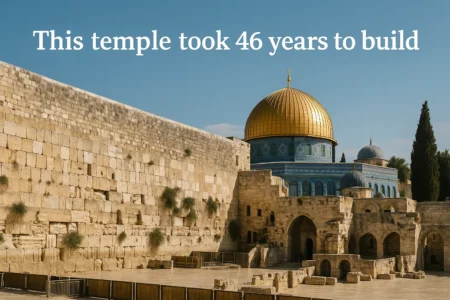
These guys were standing in the shadow of Herod’s Temple. This wasn’t a local chapel. It was an architectural beast. Construction had been dragging on for 46 years and they still weren’t done. It had massive stones weighing tons, gold overlay, marble pillars. It was their national pride. It was their identity.
So when this carpenter from Nazareth says, “Destroy this temple,” they looked at the walls. They did the mental math. Forty-six years of labor, and you’re going to rebuild it in a long weekend? You’re out of your mind.
They couldn’t see past the mortar. They assumed John 2:21 was a construction project. But Jesus wasn’t talking about masonry. He was talking about murder.
Does the Greek Text Hide a Secret?
I’m no linguistic scholar, but sometimes you have to pop the hood to see how the engine works. In English, we use the word “temple” for everything. The Greeks were more specific.
They had a word, hieron, for the whole complex—the outer courts, the porches, the nosebleed seats.
Then they had naos. This word was reserved for the Sanctuary itself. The Holy Place. The Holy of Holies. The dark, terrifying room behind the veil where God’s presence actually sat.
When Jesus says, “Destroy this temple,” He uses naos. He isn’t talking about the gift shop or the outer walls. He is pointing to His own chest and saying, “I am the Holy of Holies.”
This is the core of the John 2:21 meaning. The stone building was just a shell. He was the radioactive core.
How Does John 2:21 Wreck Our Idea of “Church”?
I grew up thinking “church” was a place where I had to wear scratchy pants and sit still. If I wasn’t in the building, I wasn’t “at church.”
Jesus takes a sledgehammer to that idea. By calling His body the temple, He makes God mobile.
In the Old Testament, God had an address. If you wanted to get right with Him, you packed your bags, traveled to Jerusalem, bought an animal, and went through a priest. There were walls. There were curtains. There were “Keep Out” signs.
Jesus says, “I’m the meeting place now.”
If you kill the body of Jesus, you are trying to cut the phone line to heaven. But if He raises it up, He sets up a permanent, unblockable connection. I don’t need a pilgrimage anymore. I don’t need a cathedral. I need Christ. The sacred space is a Person.
What Did He Mean by “Destroy This Temple”?
It’s a daring thing to say to people who hate you. “Destroy this temple.” It’s a challenge. It’s imperative.
He knew what was in their hearts. He saw the way they looked at Him while the money changers were scrambling for their coins. He knew they didn’t just want to debate Him; they wanted to erase Him.
I’ve seen people destroy things they don’t understand. It’s a fear response. The religious leaders were terrified of losing their grip. They thought if they crushed the man, they’d crush the revolution.
They eventually took the bait. They destroyed the “temple” of His body at Calvary. They whipped Him, nailed Him, and shoved Him in a rock tomb. They thought they had bulldozed the problem.
They forgot the punchline: “…and in three days I will raise it up.”
Also Read: John 2:16 Meaning and John 2:25 Explained
Why Is the Resurrection the Only Thing That Matters?
Without the resurrection, Jesus is just another martyr. History is full of dead guys who made big claims.
The resurrection is the receipt. It’s the proof that the check cleared.
When Jesus said, “I will raise it up,” He was claiming authority over his own death. Notice He says, “I will raise it up.” He isn’t just a passive victim getting rescued; He’s an active participant in breaking death’s jaw.
The “three days” part is crucial. It ties the destruction of His body to a specific moment in history. This isn’t a fairy tale “once upon a time.” It’s a schedule.
If the tomb was still full on Monday morning, John 2:21 would be a lie. The temple would still be rubble. But because that grave was empty, the new Temple is open for business.
Did Anybody Understand Him at the Time?
Honestly? No. And that makes me feel a lot better about my own thick head.
John admits it in verse 22: “When therefore he was risen from the dead, his disciples remembered that he had said this unto them.”
The guys who lived with Him didn’t get it! They stood there watching Him clear the courts, hearing this riddle about construction, and probably thought, * “Great, now He’s picking a fight with the architects.”*
It took the empty tomb to decode the message. Hindsight is 20/20. Looking back through the lens of Easter, it all clicked. * “Oh! He meant His body! He meant the cross!”*
Sometimes God speaks truth into our lives that we can’t understand until we’ve bled a little.
How Does This Connect to Paul and Us?
The “body as a temple” idea doesn’t stop with Jesus. It spreads like wildfire.
Paul picks it up later. He asks the Corinthians, “Don’t you know that your body is the temple of the Holy Spirit?”
This is the shockwave of John 2:21. Because Jesus is the ultimate Temple, and He puts His Spirit in us, we become little mobile temples.
I had a health scare a few years back—lying in a hospital bed, hooked up to machines, feeling totally helpless. My physical “temple” felt like it was condemning me. But realizing that God wasn’t limited to a sanctuary, that He was right there in the sterilized room with me? That changed the game.
If Jesus is the Temple, and we are “in Him,” then we carry the presence of God into our cubicles, our gyms, and our messy kitchens.
What Happened to the Real Temple?
Here is the irony that gives me chills. The Jewish leaders killed Jesus to save their nation and their temple. They thought they were protecting their turf.
But in AD 70—about 40 years later—the Roman army showed up. Titus and his legions didn’t just capture the city; they leveled it. They literally pried the stones of the temple apart to get the melted gold.
Jesus’ prophecy about the buildings came true (Matthew 24:2).
The structure they worshipped became dust. It has never been rebuilt. But the Temple Jesus spoke of—His body—was raised up and is untouchable.
This hammers home the John 2:21 meaning. You can burn down a building. You can’t kill the Resurrection.
Why Do We Still Obsess Over Buildings?
I love a good cathedral. I love the smell of old wood and the way light hits stained glass. It feels “holy.”
But there is a trap there. We love things we can touch. We love structures we can control. It is way easier to maintain a building fund than to maintain a relationship with a living God.
We make the same mistake the Pharisees did. We think if we have the right lights, the right seating, and the right coffee in the lobby, we have God.
John 2:21 tells us God isn’t impressed by our architecture. He isn’t impressed by our campuses. He is interested in the body of Christ.
If my church burned to the ground tonight, would we still be the church? Yes. Because the bricks were never the point.
How Do I Apply John 2:21 on a Tuesday?
So, how does ancient theology help me when I’m stuck in traffic?
First, it changes how I pray. I don’t have to “go” somewhere to find God. I don’t have to get clean first. I go to Jesus. He is the door.
Second, it changes how I treat people. The church isn’t the brick pile on the corner. It’s the people. It’s the messy, broken folks sitting next to me.
I have a buddy, Mike. Big guy, rough hands, not your typical “churchy” type. But when my basement flooded last spring, Mike was there at midnight with a shop vac and a bucket. He didn’t quote scripture; he just worked. That was the church. That was the living temple in action.
Applying John 2:21 means seeing the sacred in the people around you. It means valuing the organism over the organization.
What About the “Sign” They Asked For?
Remember, they demanded a sign. “Show us your badge.”
Jesus gave them the sign of Jonah—the resurrection.
The sad part? When the sign actually happened—when the grave was empty—most of them still didn’t believe. They paid off the guards to lie about it.
This teaches me that evidence alone doesn’t save you. You can have the ultimate proof—a dead man walking—and still miss it if you want to stay in control.
Getting the John 2:21 meaning takes spiritual eyes. You have to be willing to see Jesus not just as a teacher, but as the replacement for the whole religious system.
Does This Mean No More Sacrifices?
100%. This is the best news in the book.
In the old temple, the work was never done. Priests were slaughtering animals constantly. The smell of blood was always in the air. It was a visual reminder that sin costs something.
But if Jesus is the Temple, He is also the High Priest. And He is the Lamb.
When He “raised up” His body, the work was finished. The veil in the temple ripped from top to bottom. The “Keep Out” signs were torn down.
We don’t drag goats to an altar anymore. We bring our own lives. We bring praise. The mechanics of worship shifted because the location shifted from a place to a Person.
How Does John Weave This Through His Book?
John wrote this stuff down decades later. He had time to think about it. He builds his whole Gospel around Jesus replacing the old stuff.
- In chapter 2, Jesus replaces the Temple.
- In chapter 6, He’s the new Manna.
- In chapters 7 and 8, He’s the Light and Water.
John wants us to see that the Old Testament was just a shadow. Jesus is the 4K reality. The John 2:21 meaning is a huge piece of that puzzle. Jesus isn’t fixing the old car; He’s giving us a jet.
Why Should Gentiles Care?
I’m not Jewish. My ancestors were pagans in the woods of Europe somewhere. Under the old system, I was an outsider. I could go to the “Court of the Gentiles,” but that was it. There was a literal wall that said they’d kill me if I went further.
I was kept at arm’s length.
But in the Temple of Jesus’ body, that wall is gone (Ephesians 2:14). There are no second-class seats.
Because the true Temple is a person, anyone who is connected to Him has a backstage pass to the Father. That is massive. It means I don’t have to stand in the back.
What Are “Living Stones”?
Peter—who was probably standing right there scratching his head when Jesus said this—later wrote that we are “living stones” being built into a spiritual house.
I love that image. Jesus is the Cornerstone. He sets the angles. But we are the rocks that get piled on top.
This brings me back to my granddad’s shop. It wasn’t the wood walls that made it matter; it was the life inside.
The church today is a sprawling, messy, spiritual temple made of living stones—people from every background cemented together by the Spirit. When we gather, the temple assembles. When we leave, we take the temple to the streets.
Why Do We Still Want Magic Tricks?
People are still asking Jesus for ID. “Prove yourself to me. Fix my finances. Heal my mom. Then I’ll believe.”
We want the fire from heaven. We want the show.
But Jesus points to the empty tomb. He points to John 2:21. He says, “I defeated death. I opened the door to God. That is the sign.”
Faith isn’t about God doing a new trick for me every morning. Faith is trusting that the work He did on Easter is enough.
Conclusion
The first time this verse really clicked for me, I felt a physical weight come off. I realized I didn’t need to find a holy place. I had found a Holy Person.
John 2:21 isn’t just Jesus winning an argument with some Pharisees. It’s an invite. He’s inviting us to stop looking for God in systems, buildings, and performance. He’s inviting us to look at His scars.
The physical temple is dust. You can go visit the ruins. But the Temple of His body is alive and well.
Whenever I feel far from God, I don’t need to drive to a chapel. I just need to turn my head toward the One who was destroyed and raised up. That’s where God lives. That’s where we meet Him.
For a deeper dive into what that massive temple actually looked like, check out this breakdown from Bible Gateway.
Next time you drive past a church, appreciate the brickwork. But remember the real action isn’t in the mortar. It’s in the Risen Savior and the people who follow Him. That’s the temple now.
FAQs – John 2:21
How does John 2:21 challenge traditional ideas of church and worship?
It challenges the idea that church is about buildings or locations, emphasizing instead that the true worship space is in Christ and among His followers, making God accessible everywhere through His Spirit.
What is the main significance of John 2:21 in understanding the concept of the temple?
John 2:21 signifies that Jesus is referring to His own body as the true temple, indicating that God’s presence is now in Christ and that the old physical structure is no longer necessary for worship.
What does the Greek word ‘naos’ imply about Jesus’ statement in John 2:21?
‘Naos’ refers to the Holy of Holies, the sacred inner sanctuary, so when Jesus speaks of destroying this temple, He is indicating that He is the sacred space where God’s presence dwells, not just the physical building.
Why did the religious leaders misunderstand Jesus’ statement about destroying the temple?
They misunderstood it because they saw it as a literal reference to the physical temple’s construction, not recognizing that Jesus was speaking metaphorically about His own body and the coming spiritual reality.
How does John 2:21 impact the way believers understand their relationship with God today?
It teaches that believers are the living temples of God through the Holy Spirit, highlighting that God’s presence is within us and that worship and connection with Him are not confined to physical locations.