

Weddings. You gotta love them, right? The joy, the hope, the dancing, the slightly-too-loud band. And, let’s be honest, the pure, unadulterated panic bubbling just beneath the surface.
I’ve seen it firsthand. I’ll never forget my cousin’s wedding. Everything was A-list. Perfect. Flawless. Until the caterer, his face the color of chalk, pulled the groom aside. The main course for 150 people? Yeah, it was… delayed. By three hours.
The panic in the groom’s eyes was something I’ll never forget.
Every single wedding, it seems, is just one small detail away from chaos. It’s this razor’s edge of human tension that makes the story of the wedding feast at Cana so gripping. It’s not a stuffy theological treatise; it’s a real-life crisis.
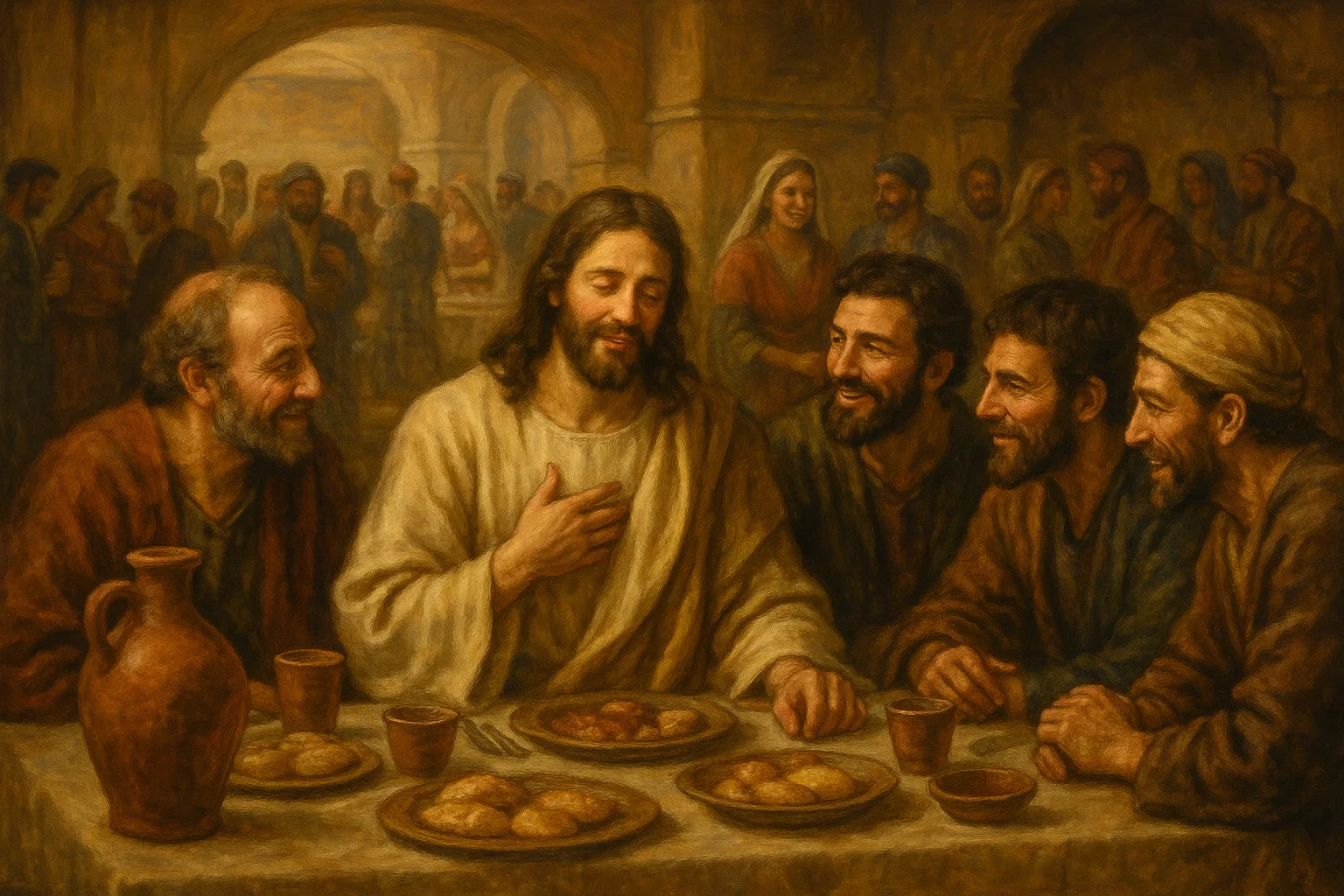
And it all kicks off with this simple, almost mundane line. After finding his first few followers, Jesus gets an invite. The Gospel of John tells us in John 2:2, “and both Jesus was called, and his disciples, to the marriage.” (KJV)
That one sentence. “Jesus and his disciples had also been invited to the wedding.”
That’s the gateway. It’s the ticket stub to one of the most profound, revealing moments in the entire New Testament. This isn’t just about Jesus’s very first public miracle. It’s about why he came, who he is, and what his ministry was truly all about. It’s not just a party. It’s a proclamation.
More in John Chapter 2 Category
Key Takeaways
- John 2:2 explicitly states that Jesus and his disciples were invited guests at the wedding in Cana, establishing his presence at the event.
- This story is the setting for Jesus’s first recorded public miracle (or “sign”), where he turns water into wine.
- Jesus’s presence at a wedding feast validates human celebration, marriage, and participation in ordinary social life.
- The miracle that follows reveals Jesus’s glory, not as a conqueror, but as a provider of joy and abundance.
- The event serves as a foundational moment for his new disciples, causing them to “believe in him” (John 2:11).
- The entire narrative highlights key themes that run through John’s Gospel: transformation, provision, divine timing, and the “newness” Jesus brings.
What’s So Special About a Wedding Invitation?
First, we need to get our heads straight. Forget the modern four-hour reception at a rented hall. A first-century Jewish wedding was the Super Bowl of social events. This was a massive, community-wide celebration that could last for a week.
It was the party of the year.
To be invited was a sign of belonging. It meant you were in. To be left out wasn’t just a slight; it was a public statement.
So, when we read in John 2:2 that Jesus and his crew were invited, that little detail is huge.
Jesus isn’t crashing the party. He’s not showing up on the sidelines to judge the drinking or condemn the celebration. He is a full-on, invited guest. He’s there as a friend, a relative (many traditions hold the groom was family), and a participant. He’s being fully, presently human.
Right out of the gate, this one verse shatters the mold of the joyless, scowling religious figure.
This isn’t a hermit who thinks all pleasure is a sin. This is a man who, at the very start of his public work, says “yes” to a party. He wades right into the most normal, joyful, and messy parts of human life. By simply showing up, he actively endorses the celebration of love, of family, of community.
It’s a divine stamp of approval. He’s not too holy for our happiness. He’s not too transcendent for our traditions. He’s saying that creation, marriage, and the simple, good moments of life are… good.
Who Exactly Were “His Disciples” at This Point?
This is the kicker. This is what makes the story even richer. Who were these “disciples” mentioned in John 2:2?
They were the interns. They had just gotten there.
If you flip back one chapter, to John 1, you see it. Jesus had just called Andrew. Andrew then runs and grabs his brother, Simon Peter. The next day, Jesus finds Philip, who immediately goes and gets Nathanael.
These are the guys. They’ve been “disciples” for maybe a few days. They’ve left their fishing nets, their families, and their skepticism to follow this magnetic man. They probably have no idea what they’ve actually signed up for.
And what’s their first assignment? Their first “work trip”?
A wedding.
Imagine their perspective. You’ve just made the biggest, craziest decision of your life. And your new boss just says, “Great. Glad to have you. Now, we’re all going to a party.”
They must have been completely baffled. Or maybe just relieved. “Okay, so this new gig comes with free food and wine. I can hang with this.”
They are here as observers. They’re watching their new teacher. They have no idea what they’re about to see. They think they’re at a party. They’re actually in a classroom.
Was This Their First Real Look at Jesus’s Character?
This is so foundational. Before they saw the miracles, before they heard the Sermon on the Mount, before they saw him raise the dead, they saw him at a party.
They saw him as a man who was comfortable in his own skin. A man who could laugh, talk, and mingle with his neighbors. A man who wasn’t weird, or spooky, or separate.
Before Jesus asks them to do anything hard, he invites them into a place of joy. He’s showing them who he is. He’s not a drill sergeant first. He’s a friend. He’s a guest. This social, relational side of Jesus is every bit as important as the theological, powerful side.
The disciples who follow him aren’t just signing up for a set of rules. They’re entering into a relationship with a person. And that person, they’re discovering, actually likes people.
Why Cana? Does the Location Even Matter?
Oh, it matters. John doesn’t waste ink.
The Gospel tells us this all happened in “Cana of Galilee.” This isn’t just a random GPS coordinate.
Cana was a small town. A village. It wasn’t Jerusalem, the glittering, powerful center of religion and politics. It wasn’t Athens or Rome, the hubs of philosophy and empire.
It was, respectfully, the sticks.
And this is where Jesus lights the fuse.
He doesn’t launch his ministry with a press conference in the capital. He doesn’t pull his first move at the Temple in front of the High Priest. He does it at a small-town wedding for a couple of nobodies.
This is a profound, earth-shaking statement. It tells us that Jesus’s ministry isn’t about impressing the powerful. It’s about meeting the ordinary. His glory is revealed not in a palace, but at a party. It signals that his kingdom is for everyone, especially those in the overlooked, “unimportant” places.
It reminds me of my own life, in a much smaller way. My first “real” writing gig wasn’t for a national magazine. It was for a tiny, local business newsletter. It paid almost nothing and I’m pretty sure only ten people read it. It felt insignificant.
But it was that small “yes” in that small “Cana” that started everything for me. Jesus honors the small places. He shows up there.
When the Wine Ran Out, Why Did Mary Turn to Jesus?
And here it is. The crisis. The music screeches to a halt.
The celebration hits a wall. The wine—the very symbol of joy and abundance—is gone.
This isn’t a minor “oops.” This is a social catastrophe.
In that culture, for that family, this was the end of the world. It was a failure of hospitality that would bring deep, lasting shame on the host family. It would be the only thing people remembered about this wedding. “Oh, that’s the wedding where they ran out of wine. How embarrassing.”
And Mary, Jesus’s mother, notices.
She doesn’t run to the headwaiter. She doesn’t gasp and cause a scene. She does something incredibly simple and staggeringly profound. She just walks over to her son and says, “They have no wine.”
That’s it. She doesn’t tell him what to do. She doesn’t beg, or scold, or wring her hands. She just presents the problem.
What does that tell you?
She knew. She had thirty years of watching him grow up. She knew he wasn’t just a carpenter. She knew he was different. In that moment, she was probably the only person in the room who understood that this ordinary-looking guest was the solution to an impossible problem. She just laid the need at his feet, with the quiet, unstated faith that he could do something about it.
What’s Really Going on With Jesus’s Response to Mary?
Okay, Jesus’s reply in John 2:4 is one of those verses that makes people squirm.
“Woman, what does this have to do with me? My hour has not yet come.”
To our 21st-century ears, that sounds… cold. Disrespectful. Like a teenager snapping at his mom.
But we have to pull it out of our world and put it back in his. First, the term “Woman” was not a snub. It was a formal, even respectful, term of address, like “Ma’am” or “Lady.” He uses the very same term for her when he’s on the cross, a moment of profound, sacrificial love.
The real meat is in the second phrase: “My hour has not yet come.”
This is the central theme of John’s entire Gospel. Jesus’s “hour” is his divine appointment. It’s the time for his ultimate purpose: his suffering, death, and resurrection. He’s operating on a divine timetable, not a human one.
He is gently, but firmly, telling his mother that his actions are now dictated by his Father’s will. He’s no longer just her son; he is the Son of God on a mission. It’s a subtle but clear declaration that his real work has begun.
And yet…
Even as he says his “hour” hasn’t come, his compassion wins. He sees the need. He sees his mother’s faith. He’s about to act, not because his grand “hour” has arrived, but simply out of love for the people in front of him.
How Did “Do Whatever He Tells You” Change Everything?
This is Mary’s shining moment.
She just got what sounded like a “no.” Or, at least, a “not now.”
She doesn’t argue. She doesn’t wheedle. She doesn’t pout. She simply turns to the servants.
“Do whatever he tells you.” (John 2:5)
This is the pivot. This is the moment the whole story turns. It is a moment of pure, undiluted, active trust. Mary has just handed the entire, impossible problem over to Jesus, and then she tells the staff to give him their full, unquestioning obedience.
This is the kind of faith that unlocks miracles.
It reminds me of my old high school football coach. We were in the regional final, down by 10 at the half. Nothing was working. We were defeated, just sitting there in the locker room, exhausted. Coach didn’t yell. He just calmly walked to the chalkboard and drew up a new, simple, counter-intuitive play. It made no sense to us.
But we were desperate. We looked at each other, shrugged, and said, “Okay, Coach.”
We went out and did exactly what he told us to do, every play. We stopped thinking. We just did.
And we won.
That’s the faith Mary shows. She’s the coach in the huddle saying, “Forget what you think you know. Stop panicking. Just listen to him. Do whatever he says.”
And the servants, to their eternal credit, do exactly that.
Stone Jars for Purification? Why That Detail?
Pay attention when John mentions furniture. He’s a master of symbolism; he doesn’t include details by accident.
John 2:6 says, “Nearby stood six stone water jars, the kind used by the Jews for ceremonial washing, each holding from twenty to thirty gallons.”
Why this specific detail? Why not just say “some jars”? Why not use the empty wineskins?
- They were for “ceremonial washing.” This is critical. These jars held water for ritual purification. They were for washing hands and feet, for the external rites of religion. They were symbols of the Old Covenant law—a system based on externals, on rules, on becoming clean through repetitive acts.
- They were empty. This, too, is symbolic. The old system, John is screaming at us, has run its course. It’s “empty.” It cannot provide the joy, the life, the wine that is needed.
So what does Jesus do? He tells the servants, “Fill the jars with water.”
Think about that. Imagine being that servant. “You want me to do what? Fill the hand-washing jars? With water? Sir, we need wine.”
But they obey. They schlep all that water—six massive jars, filled to the brim. That’s a ton of work. They’re probably sweating, confused, and wondering what this crazy guest is up to.
They fill the symbols of the old, ritualistic law with basic, plain water.
And Jesus, with no magic wand, no loud incantation, no fanfare, transforms it.
He doesn’t just add to the old system. He takes the very symbol of the old, empty, ritualistic religion and turns it into the symbol of new, abundant, celebratory joy.
- Water = the old covenant, the law, ritual.
- Wine = the new covenant, grace, joy, and the blood of Christ.
This isn’t a magic trick to save a host from embarrassment. This is a parable in action. Jesus is declaring, “That old way of just washing your hands? It’s over. I am here to transform the water of religious duty into the wine of a real relationship.”
How Much Wine Did Jesus Actually Make?
Don’t skip the math here. This is wild.
Six jars. Each held “twenty to thirty gallons.”
Let’s be conservative. Let’s say they averaged 25 gallons each.
6 jars x 25 gallons = 150 gallons.
A standard bottle of wine is 750ml. A 150-gallon creation is the equivalent of over 750 bottles of wine.
This is not “just enough.” This is not a refill. This is an explosion of ridiculous, over-the-top, extravagant abundance. This is a statement.
When God provides, He doesn’t just meet the need. He floods it. This isn’t just wine; it’s a tidal wave of grace. This isn’t a top-up; it’s a new creation.
What Did the Headwaiter’s Comment Really Mean?
So the servants, who are the only ones in on the secret (besides Jesus, Mary, and the disciples), draw some of this new “wine.” They take it to the mastor domo—the headwaiter, the party planner.
He sips it.
And he is stunned. His eyes go wide.
He has no idea where it came from. He just knows it’s the best wine he’s ever tasted.
He immediately flags down the bridegroom, not to praise him, but to gently scold him. “What’s the deal, man?” he says. “Everyone brings out the choice wine first, and then the cheaper wine after the guests have had too much to drink. But you… you have saved the best till now.” (John 2:10)
This is pure, beautiful dramatic irony.
The headwaiter thinks he’s talking about party planning. He has no idea he’s preaching a sermon. He has no idea he’s describing the entire economy of God.
The world gives its best first, and then it fades. Its pleasures, its power, its promises… they all run out. They all get cheaper as the night goes on.
But Jesus is different. He shows up when our wine is all gone. He comes into our emptiness, our shame, our lack. And he brings something new. And what he brings is always the best. He saves the best for last. His kingdom, his grace, his joy… it’s the good wine that never, ever runs out.
Why Is This Called the “First of His Signs”?
The story ends with this powerful summary in John 2:11: “Jesus did this, the first of his signs, in Cana of Galilee, and revealed his glory; and his disciples believed in him.”
Notice the word John uses. He doesn’t call it a “miracle.” He calls it a “sign.”
There’s a difference. A miracle inspires awe; it makes you say, “Wow!”
A “sign” (in Greek, sēmeion) does more. It’s a signpost. It points to a deeper truth. It makes you say, “Hmm, what does that mean?” This whole event was a sign pointing to who Jesus is. You can find a deeper dive into the seven signs in John’s Gospel at academic resources like Biola University’s Talbot School of Theology.
What did this sign point to?
It pointed to the fact that Jesus was not just a great teacher. He was the divine Son of God, the one with authority over the natural world. He was the one who could turn emptiness into abundance. He was the one who could transform duty into joy.
He “revealed his glory.” Not with a thunderclap or a legion of angels, but with the quiet, joyful, abundant gift of wine.
How Did This Sign Affect the Disciples?
And here’s the payoff. The punchline.
“…and his disciples believed in him.”
Remember them? The interns? The new recruits?
They came for a party. They saw a crisis. They watched their teacher have a quiet word with his mother. They saw him give strange instructions to the servants.
And then they tasted the result.
Their belief was no longer just based on his compelling words in John 1. It was now based on his power. They saw his glory. This event, this sign, cemented their faith. It was the “Wow” moment. It was the moment they knew, without a single doubt, that they had hitched their lives to someone extraordinary.
This was the real deal.
What Does John 2:2 Mean for Us Today?
It all started with that simple verse: John 2:2. An invitation.
So what does this two-thousand-year-old story mean for you and me, right here, right now?
It means, first, that Jesus isn’t afraid of our humanity. He’s not turned off by our parties, our celebrations, our “secular” lives. He wants to be there. He wants an invitation.
He’s not just “church Jesus” or “Sunday Jesus.” He’s “Monday morning” Jesus. He’s “project deadline” Jesus. He’s “stuck in traffic” Jesus. He’s “wedding reception” Jesus.
He’s not waiting for us to get cleaned up, to become “religious,” before he’ll engage. He meets us right where we are, in the middle of the mess.
Are We Inviting Jesus to Our “Weddings”?
We all have our “weddings.” Our big life moments, our celebrations, our new projects. It’s easy to invite him to those.
But the real question is: are we inviting him when the “wine” runs out?
When the energy is gone? When the money’s tight? When the relationship is failing? When the joy has leaked out of life? When the panic is setting in?
I’ve been there. I remember launching a business project I had poured years of my life into. The launch week was a complete, unmitigated disaster. The website crashed. A key partner backed out. I was in that full-on, white-faced “caterer’s panic,” trying to do everything myself, trying to fix it.
I was my own host, and I had just realized the “wine” of my own energy and resources was completely, totally gone.
The story of Cana just popped into my head. I was trying to solve an impossible problem by myself, too proud and too panicked to stop.
I finally just stopped. Right there in my office. I just said, “Okay. They have no wine. I have no wine.” I consciously, actively invited Jesus into the mess.
It wasn’t a magic wand. The problems didn’t instantly vanish. But it was my “Do whatever he tells you” moment. The panic broke. My perspective shifted from one of frantic, terrified control to one of trust. It changed everything.
The Abundance of Jesus: More Than Just a Drink
That simple invitation in John 2:2… it’s the doorway. It leads to this story of profound, life-altering transformation. In this one event, Jesus shows us his entire resume.
- He transforms water into wine.
- He transforms an embarrassing lack into an extravagant abundance.
- He transforms ceremonial duty (the jars) into celebratory joy (the wine).
- He transforms the disciples’ curiosity into active, grounded belief.
It all started with a “yes” to a party.
That simple note in John 2:2—”Jesus and his disciples had also been invited to the wedding”—is the key that unlocks the whole thing. It’s a reminder that the most profound encounters with the divine often happen in the most ordinary places.
He meets us where we are. In our joy, and especially in our panic. He’s not waiting for us to be perfect.
He’s just waiting for an invitation.
FAQ – John 2:2
Why does Jesus’s first miracle occur at a wedding feast in Cana?
Jesus’s first miracle occurring at a wedding signifies the validation of human celebration, marriage, and ordinary social life, highlighting thatHis ministry embraces joy and the good moments of life, and that his glory is revealed in abundance and transformation.
How does the presence of Jesus and his disciples at the wedding challenge traditional views of religious figures?
Their presence at a joyful, ordinary event like a wedding challenges the stereotype of religious figures being distant or only solemn, showing that Jesus engages fully with human life and endorses celebration, relationships, and community participation.
What is the deeper meaning behind Jesus turning water into wine in John 2?
The miracle symbolizes the transition from the Old Covenant law, represented by the ceremonial jars, to the New Covenant of grace and joy, emphasizing transformation, divine abundance, and the idea that Jesus brings the best, never running out of grace.
What can we learn from John 2:2 about inviting Jesus into our everyday lives?
John 2:2 teaches us that Jesus seeks to be invited into all aspects of life, including joyful celebrations and moments of crisis, and that by extending this invitation, we can experience divine transformation, abundance, and the principle that he is present in our ordinary and extraordinary moments.