
I still have a scar on my left thumb from a deck renovation that was supposed to take two weekends. I told my wife, “Honey, it’s a simple tear-out and replace. I’ll be grilling steaks on it by the Fourth of July.” Famous last words. Three months later, I was still out there in the August heat, sweating through my third t-shirt of the day, wrestling with warped pressure-treated lumber that refused to line up.
When you bleed for a building project, you get irrationally attached to it. You know every screw, every shim, every mistake you had to hide behind trim. If a neighbor had walked over, leaned on my railing, and said, “Hey, tear this junk down, and I’ll build you a better one by Sunday,” I wouldn’t have laughed. I would have swung a hammer at him.
That is the visceral, gut-level tension we walk into with John 2:20.
We often read the Bible with sanitized glasses, picturing Jesus having a polite theological debate in a library. That’s not what happened here. This was a confrontation in a construction zone. When Jesus said, “Destroy this temple, and in three days I will raise it up,” He wasn’t just confusing the locals. He was insulting their national pride, their wallet, and their history.
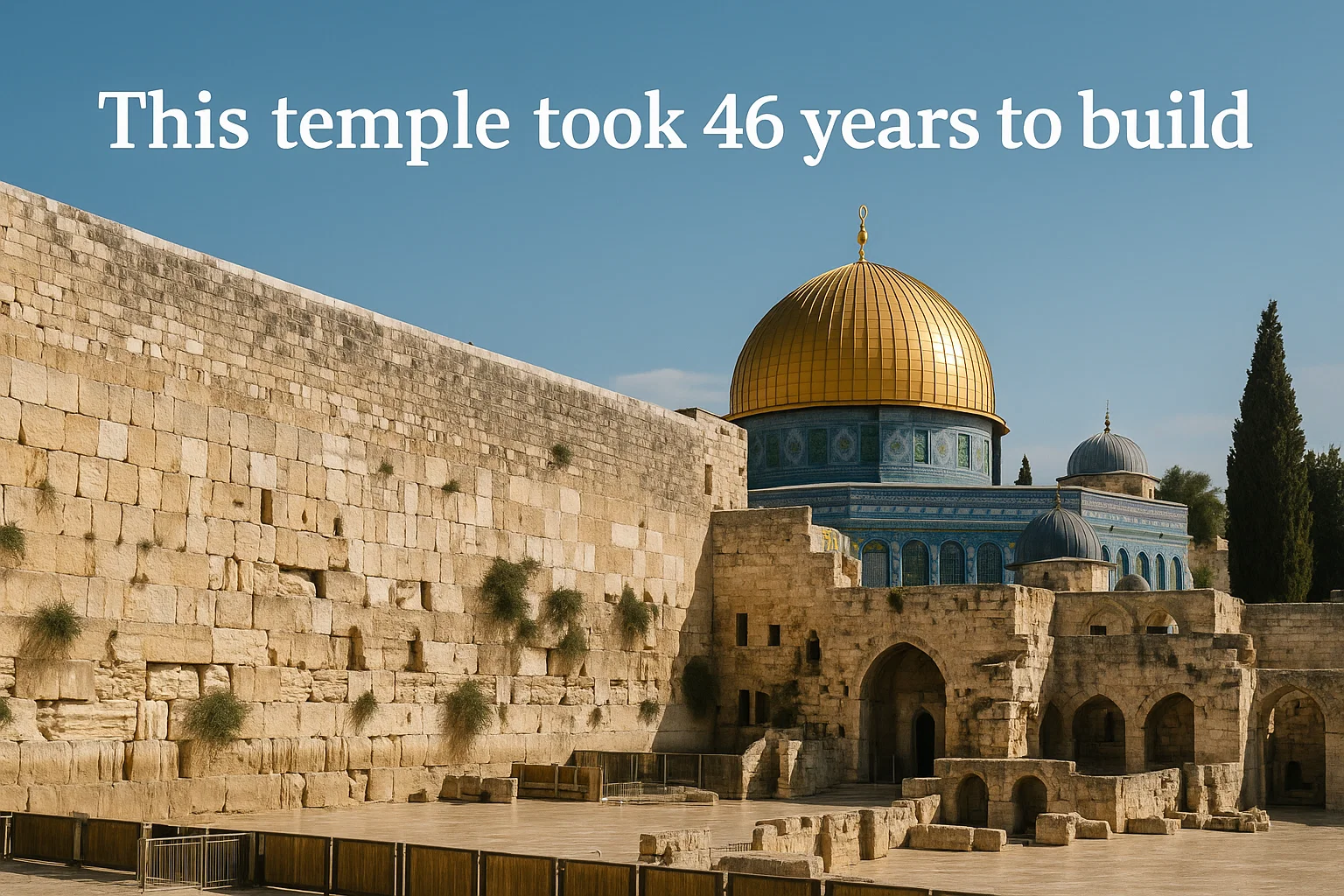
The Jewish leaders snapped back, “It has taken forty-six years to build this temple, and will you raise it up in three days?”
They weren’t just checking a calendar. They were furious.
This verse is the collision point between human effort and divine power. It anchors the Gospel of John in gritty, verifiable history, and it forces us to ask: Are we banking on the buildings we construct over decades, or the life Jesus built in three days?
More in John Chapter 2 Category
Key Takeaways
- The Timeline Anchor: The “46 years” remark is a historian’s dream, allowing us to date the start of Jesus’ ministry to roughly the Passover of 27 or 28 AD.
- Herod’s Ego: This wasn’t a local chapel; it was the largest construction project in the ancient world, representing Jewish identity and Herod’s paranoia.
- Two Different Dictionaries: The Jews were talking about the hieron (the physical complex of stones), while Jesus was talking about the naos (the inner sanctuary) of His own body.
- The Ultimate Bet: Jesus staked His entire credibility on one impossible sign—His bodily resurrection.
- The Shift: This moment marks the end of “holy places” and the beginning of a “holy person” as the center of worship.
Why did the mention of “46 years” hit such a raw nerve?
To understand the insult, you have to understand the building. Stop picturing your local church sanctuary with drywall and a few stained-glass windows.
Herod’s Temple was a monster.
Herod the Great was a complicated guy. He was a tyrant, a murderer, and a paranoid ruler, but the man knew how to build. He wanted to immortalize himself and, hopefully, keep the Jewish population from revolting against him. So, around 20 or 19 BC, he launched a renovation project that spiraled into a massive overhaul of the entire Temple Mount.
By the time Jesus walked into those courts in John 2, the construction crews had been working non-stop for nearly five decades.
Think about that. The “46 years” comment implies that for an entire generation, the sound of chisels and hammers was the background noise of Jerusalem. The men challenging Jesus had likely watched their fathers break their backs hauling stones for those walls. They had grown up in the shadow of the cranes and scaffolding.
The project was the economic engine of the city. It employed thousands of stonemasons, carpenters, and laborers. It consumed the tithes and taxes of the nation. To say “Destroy this temple” was like walking onto the floor of the New York Stock Exchange and telling them to burn the money because you have something better.
It wasn’t just blasphemy to them; it was financial and cultural suicide.
What was the difference between the “Temple” they saw and the one Jesus meant?
This is where the Greek language gives us a backstage pass to the misunderstanding.
When the Jewish leaders spoke about the temple in John 2:20, they generally referred to the hieron. This word encompasses the whole precinct—the outer courts, the porches, the royal portico, the massive retaining walls. It’s the campus.
Jesus, however, used the word naos.
The naos is specific. It refers to the inner sanctuary, the Holy of Holies, the dwelling place of the deity. Jesus was drawing a line in the sand. He was saying, “You are looking at the campus; I am talking about the presence.”
They were obsessed with the container; He was the content.
It’s a mistake we still make today. We confuse the infrastructure of religion with the presence of God. We spend millions on the hieron—the parking lots, the sound systems, the programs—and we often forget the naos. Jesus was signaling that the dwelling place of God was no longer a stone box behind a curtain. It was flesh and blood standing right in front of them.
How does the math of John 2:20 prove the Bible isn’t a fairy tale?
I love this verse because it is a nightmare for skeptics.
If you were making up a story about a messiah one hundred years after the fact, you wouldn’t include a detail like “46 years.” It’s too specific. It’s too messy. You would say “many years” or “a long time.”
But the author of John drops this number like a precise coordinate.
Let’s look at the history. We know from the Jewish historian Josephus that Herod began the temple project in the 18th year of his reign. Historians generally peg this start date to 20-19 BC.
If you do the math—starting at 20 BC and counting forward 46 years (remembering there is no “Year 0” in the transition from BC to AD)—you land squarely in the spring of 27 or 28 AD.
Why does this matter?
It aligns perfectly with Luke 3:1, which tells us John the Baptist started his ministry in the fifteenth year of Tiberius Caesar (around 26 AD). The timeline fits like a glove. This tells us that the Gospel of John wasn’t written by a creative writing student in the second century. It contains the eyewitness details of someone who stood there, heard the argument, and remembered the specific number the Pharisees shouted in anger.
Was Herod’s project really that impressive or just big?
I can’t overstate the scale of what they were defending.
I’ve read reports about the “Western Stone” in the temple foundation. It’s one of the largest monoliths ever moved by humans without modern machinery. It weighs an estimated 500 to 600 tons.
To put that in perspective, a fully loaded Boeing 747 weighs about 400 tons.
Herod’s engineers moved a stone heavier than a jumbo jet, placed it perfectly in a wall, and did it without hydraulics. The craftsmanship was so precise that in many places, you couldn’t fit a knife blade between the stones. They didn’t use mortar; they used gravity and perfection.
Josephus wrote that the exterior of the sanctuary was covered in so much gold plate that when the sun rose, it radiated a fiery splendor that forced people to look away. From a distance, it looked like a mountain covered in snow because of the pure white marble.
So, when Jesus, a carpenter from a backwater town called Nazareth, stood there and spoke about raising it up in three days, it sounded insane. It would be like a guy with a shovel standing in front of the Hoover Dam and saying he could rebuild it over a long weekend.
Why didn’t the disciples get it right away?
One of the reasons I trust the Bible is that the disciples don’t paint themselves as heroes. They paint themselves as clueless.
John 2:22 admits, “When therefore he was raised from the dead, his disciples remembered that he had said this.”
At the moment, they were just as confused as the religious leaders. They were standing in the middle of a riot. Jesus had just made a whip of cords, flipped heavy tables, and scattered money everywhere. Adrenaline was high. Confusion was higher.
The disciples were likely looking at the massive columns, then looking at Jesus, and thinking, “Boss, I don’t think we have the manpower for that.”
It proves that spiritual truth often has a time delay. We want to understand everything instantly. We want the sermon to make sense before we hit the parking lot. But sometimes, the words of Jesus are seeds that sit in the dark for a long time—maybe three days, maybe three years—before they crack open and make sense.
What happens when the “Building” becomes a person?
This is the theological earthquake of John 2.
For centuries, if you wanted to meet with God, you needed a map. You had to travel to Jerusalem. You had to go through the rituals of purification. You had to bring an animal. You had to rely on a priest to facilitate the transaction. God had a zip code.
By calling His body the Temple, Jesus declared that God was moving out.
He was no longer contained by walls. The “Temple” was now mobile. It was relational. It was breathing.
This shift terrified the religious establishment because it threatened their monopoly. If God is accessible through a Person rather than a Place, you don’t need the gatekeepers anymore. You don’t need the temple tax. You don’t need the hierarchy.
When we read “46 years,” we see an establishment clinging to their control. They had spent decades building a system to manage God. Jesus showed up and bypassed the whole thing.
Also Read: John 2:16 Meaning and John 2:25 Explained
How does the resurrection prove He wasn’t crazy?
Anyone can claim to be a temple. I can stand in my driveway and claim to be the Supreme Court. That doesn’t make it true.
The proof is in the power.
Jesus gave them a challenge: “Destroy this temple.” He knew exactly what they would do. He knew the cross was coming. He knew the Romans would pierce His hands and feet. He knew the “temple” of His body would be torn down in the most brutal way possible.
But the promise—”I will raise it up”—is the hinge of history.
Notice the active voice. He says I will raise it up. He claims authority over His own death and life.
If Jesus had stayed in the tomb, John 2:20 would be the ranting of a lunatic. We wouldn’t be reading it today. The only reason we care about this verse is that three days after the destruction, the construction was finished. He walked out.
The physical temple in Jerusalem? The Romans flattened it in 70 AD. They literally pried the stones apart to get the melted gold, fulfilling another one of Jesus’ prophecies. That 46-year project is now a pile of dust and a retaining wall.
But the Temple Jesus raised up? It’s still standing. It’s alive.
Is there a danger in getting too attached to our modern “temples”?
We need to look in the mirror on this one.
It is easy to criticize the Pharisees for loving their marble and gold, but we do the exact same thing. We fall in love with our methods. We get attached to our church buildings, our denominations, our specific styles of worship music, and our traditions.
We spend “46 years” building our religious reputations. We volunteer, we donate, we serve on committees, and we start to feel like we own the place.
Then, something happens. A church splits. A leader falls. The “temple” we built shakes.
If your faith is built on the structure—on the 46 years of human effort—you will be crushed when it falls. But if your faith is built on the Resurrected Body of Jesus, you are safe. Structures crumble. The Savior stands.
Jesus is constantly in the business of clearing the temple. He comes into our lives, flips over the tables of our idols, and reminds us that He is the point. Not the building. Not the budget. Not the program. Him.
How does this verse arm us against modern skepticism?
I have a buddy who loves to argue about religion. He tells me the Bible is full of contradictions and myths.
I like to take him to John 2:20.
It’s a gritty detail. Myths usually happen “once upon a time” in a land far away. Real history happens when a specific guy (Herod) starts a specific project (The Temple) and people get mad about a specific timeline (46 years).
This verse anchors our faith in reality. It invites us to check the facts.
For those interested in the deep dive on the archaeology of this, the Biblical Archaeology Society has incredible resources detailing the Herodian construction. You can see the diagrams of the retaining walls. You can see the scale of what Jesus was standing against.
Our faith isn’t a leap into the dark; it’s a step into history. The resurrection wasn’t a metaphor. It was a physical event that happened in a real place, predicted by a real person, verified by real witnesses.
Why did Jesus choose “Three Days” instead of instant restoration?
He could have said, “Destroy this temple and I’ll fix it instantly.” He’s God. He could have snapped His fingers.
But He chose three days.
Three days is a process. It allows for the reality of death to sink in. Friday was horrific. Saturday was silent. Sunday was glorious.
The 46 years represent human striving—the endless, generation-spanning effort to be good enough, big enough, and impressive enough for God. It never ends. The temple was still unfinished when Jesus spoke!
The three days represent divine accomplishment. It was short, decisive, and final.
When Jesus builds, He finishes. He doesn’t leave us with a punch list of repairs to do on our own. He does the heavy lifting. The religious leaders were exhausted from 46 years of work. Jesus offered a work that was completed.
Final Thoughts on the 46 Years
I eventually finished that deck in my backyard. It looks okay. It’s not perfect—there’s a board on the left side that’s a little crooked if you look close enough—but it holds the grill.
But I know the truth: eventually, the wood will rot. The screws will rust. Someone else will come along in twenty years and tear it down to build something new.
Everything we build with human hands has an expiration date.
The irony of John 2:20 is that the Jews were terrified of losing a temporary building, so they rejected an eternal Savior. They clung to the 46-year project and missed the 3-day miracle.
Next time you feel overwhelmed by the pressure to build your life, to construct a perfect reputation, or to earn your way into God’s favor, stop. Look at the timeline.
You can spend 46 years trying to stack stones that will eventually fall, or you can trust the One who walked out of the grave. The building is already finished. You just have to step inside.
FAQs – John 2:20
What does the ’46 years’ remark in John 2:20 signify?
The ’46 years’ remark refers to the time it took to build Herod’s Temple, starting around 20-19 BC, and helps us understand the historical context of Jesus’ statement about destroying and raising the temple.
Why was the reference to ’46 years’ so emotionally charged for the Jewish leaders?
Because they had invested decades—nearly an entire generation—in building Herod’s Temple, making it a symbol of Jewish identity and their cultural pride, so Jesus’ statement challenged everything they held dear.
What is the difference between the physical temple and the temple Jesus mentioned?
The Jewish leaders saw the ‘temple’ as the physical structure (‘hieron’), while Jesus referred to the inner sanctuary (‘naos’), symbolizing that God’s presence was now embodied in Himself rather than a building.
How does the specific number ’46 years’ support the authenticity of the Bible?
The detailed and specific number ’46 years’ aligns with historical records and dating, indicating that the Gospel of John reflects eyewitness testimony, thus supporting its historical reliability.
Why did Jesus choose ‘three days’ for the resurrection instead of an immediate miracle?
Jesus chose three days to symbolize the process of death and resurrection, emphasizing divine authority and the decisive, complete nature of His work, contrasting human effort with divine accomplishment.