

It’s the nightmare scenario. You’re at a wedding. Not just any wedding—your best friend’s massive reception. The music is loud, people are sweating on the dance floor, and the vibe is electric. Then, you see the wedding planner whispering frantically to the groom. The color drains from his face.
They’re out of wine.
Now, in our world, this is a bummer. You make a run to the liquor store down the street. Crisis averted. But flip the calendar back two thousand years to a village in Galilee, and the stakes are terrifyingly different. This wasn’t just a party foul; it was a social catastrophe. In a culture built entirely on honor and shame, running dry wasn’t an accident—it was a statement. It said, “We don’t care enough about you to provide for you.” It was a black mark on a family’s reputation that could stick for decades.
I’ve felt that pit in my stomach. A few summers ago, I decided to host a barbecue for the guys. I talked it up for weeks. “Best brisket you’ll ever eat,” I promised. I spent all night smoking this piece of meat. Guests arrive, appetites blazing. I go to slice the brisket, and it’s… tough. Not just chewy—I’m talking shoe leather. The smoker had malfunctioned halfway through. The panic was visceral. I had ten hungry men looking at me, and I had nothing but a charred lump of beef and some bag salads.
Now multiply my backyard embarrassment by a thousand. That’s the tension hanging over the wedding at Cana.
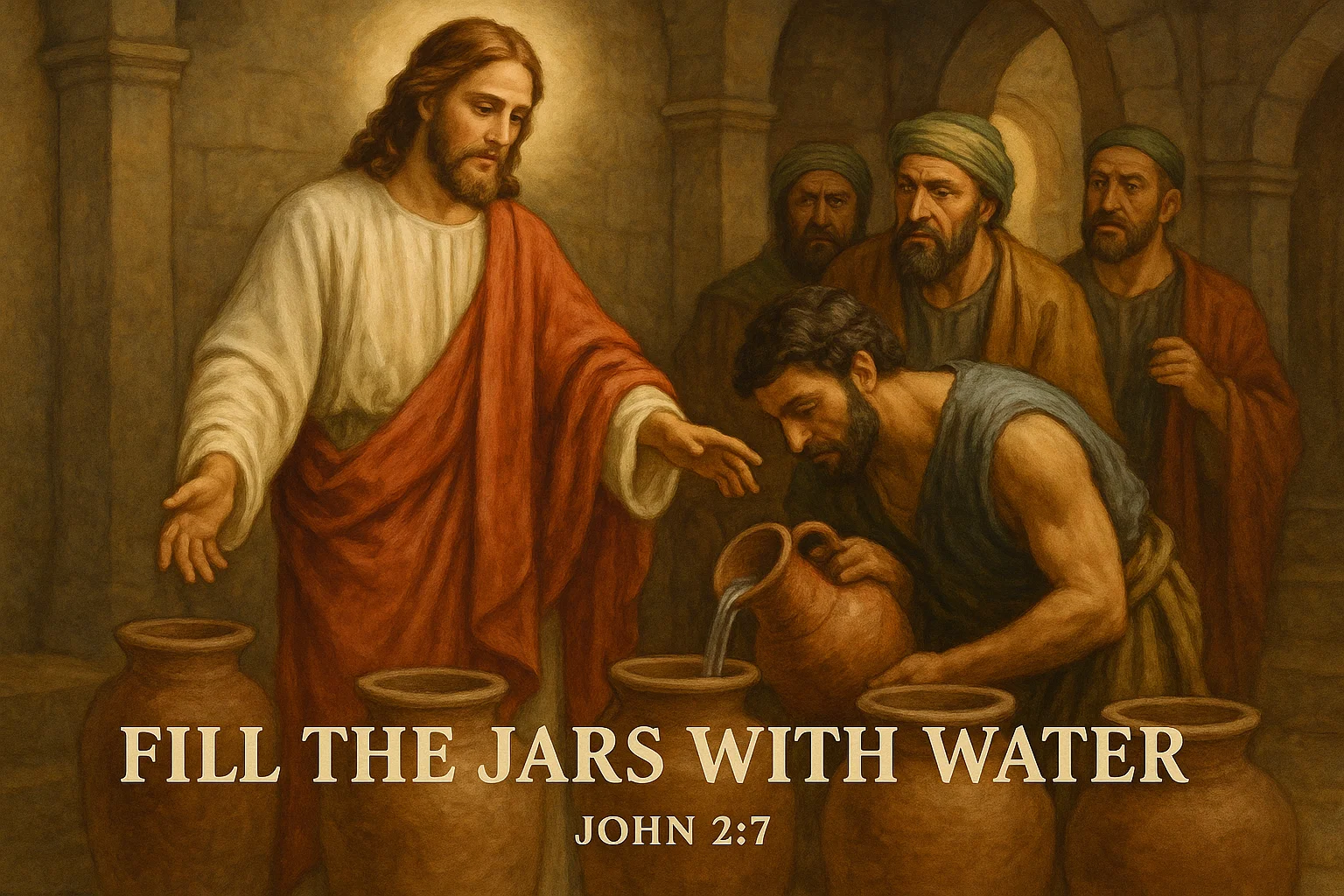
Into this mess steps Jesus. He doesn’t give a speech on inventory management. He doesn’t shame the host. He turns to the staff—the guys in the back doing the heavy lifting—and gives a command that makes absolutely zero sense.
John 2:7 captures it: “Jesus said to the servants, ‘Fill the jars with water’; so they filled them to the brim.”
It sounds simple. It wasn’t. It was heavy, confusing, back-breaking work. But in that command lies a gritty truth about how God operates in the real world. He doesn’t just snap His fingers. He asks us to grab a bucket.
More in John Chapter 2 Category
Key Takeaways
- The Miracle Follows the Sweat. The wine didn’t show up until the servants did the heavy lifting. God usually waits for us to move before He moves.
- God Recycles. Jesus didn’t demand new, holy vessels. He used the crusty old purification jars that were already sitting there.
- No Half Measures. They filled them to the brim. Not halfway. Not “good enough.” The extent of the obedience determined the size of the blessing.
- Logic is Overrated. If you need wine, pouring water into hand-washing pots is insane. Faith often looks like stupidity until the result comes through.
- Insiders Get the Best View. The master of the banquet just tasted the wine. The servants knew where it came from. Service gives you secrets.
Why Was This Such a Massive Disaster?
We really have to fight our modern instincts here. We are used to convenience. If I run out of chips at a party, I have three delivery apps on my phone that can fix it in twenty minutes.
First-century Palestine didn’t have a backup plan. A wedding feast wasn’t a four-hour reception; it was a week-long festival. It was the community event of the year. To run out of wine halfway through was a breach of contract with your neighbors. It signaled that you were either broke or stingy.
Imagine standing in front of everyone you know and respect, realizing you have failed them. That’s the headspace Mary is in. She sees the cliff edge approaching. She goes to Jesus.
Her instructions to the servants are my favorite part of this whole story. She doesn’t tell them, “He’s going to do a magic trick, just watch.” She says, “Do whatever he tells you.”
She knew that whatever Jesus was about to do, it was going to require participation. It was going to require work.
What on Earth Were These Stone Jars?
John 2:6 gives us the specs: “Nearby stood six stone water jars, the kind used by the Jews for ceremonial washing, each holding from twenty to thirty gallons.”
Stop and look at those numbers.
These weren’t delicate vases for flower arrangements. These were industrial-sized tanks. They were hewn from stone because stone doesn’t hold “ritual impurity.” These were the bathroom sinks of the ancient world. People washed their dusty feet in this water. They washed their hands before eating.
The text says there were six of them. If they held 20 to 30 gallons each, we are talking about 120 to 180 gallons of water.
Have you ever carried a five-gallon bucket of water? It weighs over 40 pounds. It sloshes around. It hits your shins. It’s a pain. Now imagine hauling enough water to fill a small swimming pool, using nothing but clay pitchers, likely drawing from a well that wasn’t right next to the jars.
When Jesus said, “Fill the jars,” He wasn’t asking for a quick favor. He was asking for hours of manual labor.
Does God Often Ask Us to Do Things That Are illogical?
This is the friction point for most of us. We want the miracle, but we want it to make sense. We want A + B to equal C.
John 2:7 throws a wrench in that. The servants need wine. Jesus asks for water. The servants need a miracle. Jesus asks for sweat.
I remember a time in my late twenties when my career was effectively dead. I was working in sales, cold calling people who hated me, making zero commission. I was broke and angry. I prayed every morning, “God, get me out of this. Give me a new job.”
I wanted the “wine”—the result, the escape.
But I felt a weird, nagging conviction to start mentoring a kid in my neighborhood. He was failing math. I hate math. I didn’t have time. I was stressed about money. It made no sense to give away my time when I felt like I was drowning.
Mentoring that kid felt like hauling water. It was tedious. It was unconnected to my career problem. But I did it. I showed up on Tuesdays. We did algebra.
About six months later, I’m at a school event with him, and I start chatting with his uncle. We hit it off. The guy owns a logistics company. He asks what I do. I tell him. He says, “You’re wasting your time there. Come work for me.”
That job changed my life. But the connection wasn’t linear. The solution to my career problem was hidden inside a math textbook on a Tuesday night.
God’s commands in John 2:7 rarely draw a straight line to the solution. He asks us to do something physical, something humble, something that seems like a distraction, because He is testing our willingness to trust Him over our own logic.
Are We Willing to Sweat for the Solution?
Let’s give some credit to the servants.
Jesus is a guest. He’s not the host. He’s not the boss. He’s a carpenter-turned-rabbi from Nazareth. When He tells them to fill the purification jars, they could have easily laughed.
“Look, buddy, we’re busy. We have a crisis here. We don’t need to wash hands right now; we need beverage service.”
But they didn’t. They moved.
I think about the physical reality of John 2:7. The sweat dripping down their backs. The burning in their forearms. The whispers of the guests wondering what the heck was going on.
“Why are they filling the foot-washing pots?”
Obedience is usually invisible and often exhausting. We want the platform; God wants the practice. We want the lightning bolt; God wants the bucket brigade.
If those servants had stopped after five gallons, saying, “This is stupid,” the miracle would have stalled. The water became wine only because they finished the job.
What Does “To the Brim” Actually Mean for Us?
The text says they filled them “to the brim.”
That detail kills me. It’s the difference between doing a job and doing it right.
It’s human nature to cut corners. Especially when the task seems pointless. If I’m told to dig a hole and I don’t know why, I’m probably not going to dig it perfectly square. I’m going to do the bare minimum to get the guy off my back.
The servants could have filled the jars halfway. “There, Jesus. It’s got water in it. Happy?”
But they maxed it out. They topped it off until surface tension was the only thing holding the water back.
This challenges me as a husband and a father. How often do I love my family “halfway”? How often do I do my work just enough to not get fired?
- I’ll apologize, but I’ll keep a little resentment tucked away.
- I’ll play with my kids, but I’m checking my phone every three minutes.
- I’ll pray, but my mind is on my fantasy football lineup.
That’s not filling it to the brim. That’s phoning it in.
The abundance of the miracle in John 2:7—the sheer volume of wine—was directly proportional to the servants’ effort. If they had been lazy, there would have been less wine. God used their capacity to determine His output.
Is There Something Deeper in the Water?
You can’t talk about this without hitting the symbolism. It’s too rich.
These were jars for the Law. They were for the Old Covenant rituals of cleansing. You wash on the outside, you get clean for a moment, you get dirty again, you wash again. It was a cycle.
Jesus looks at that old system and says, “Fill it up.” He fulfills the Law. And then He transforms it.
He turns the water (external cleansing) into wine (internal celebration). Wine represents blood, life, joy, the Spirit. It’s internal. You don’t wash with wine; you drink it. It becomes part of you.
Jesus is signaling a shift from rule-following to life-giving. He takes the structure of religion (the stone jars) and fills it with the substance of grace (the wine).
If you want to geek out on the history of these vessels, Bible Gateway has some solid resources on the archaeology of Galilee. It’s worth a look to see just how heavy these things really were.
How Do We Handle the “Not Enough” Moments?
We all have a scarcity mindset. It’s hardwired into us.
- I don’t have enough money to be generous.
- I don’t have enough time to volunteer.
- I don’t have enough patience to deal with my teenager.
The Wedding at Cana is the ultimate “not enough” moment. The resources were gone. The social capital was spent.
Jesus’ response to scarcity is aggressive abundance. He doesn’t just provide enough wine to finish the toast. He provides 150 gallons of the best vintage anyone has ever tasted. That’s like 750 bottles. For a village wedding! They were probably drinking leftovers for months.
But—and this is the kicker—He used what was already there to do it.
He didn’t make wine appear out of thin air. He asked for water. He asked for the jars. He asked for the servants’ hands.
God usually asks us to give Him what we have in our hands before He releases what He has in His.
“Lord, I need patience.” God says, “Okay, use the little bit you have. Don’t snap at your wife right now. Fill that jar.”
“Lord, I need financial help.” God says, “Okay, be faithful with the twenty bucks in your wallet. Fill that jar.”
He takes our natural, limited “water” and transmutes it into His supernatural “wine.”
Who Really Knows the Truth?
Verse 9 is the secret handshake of the Kingdom of God. The master of the banquet—the guy in charge, the guy with the clipboard—he tastes the wine and is blown away. He calls the groom over. He thinks the groom is a genius.
He has no idea what happened.
Then John adds this parenthetical whisper: (though the servants who had drawn the water knew).
The big shots didn’t know. The religious leaders didn’t know. The guys sweating in the back knew.
There is an intimacy with God that is reserved exclusively for those who serve. You don’t get it by sitting in the pew. You don’t get it by reading books. You get it by carrying the bucket.
I have a buddy, Dave, who runs the soundboard at our church. He’s there at 6 AM every Sunday. dragging cables, taping down wires. He’s usually covered in dust by the time service starts. He told me once, “Man, when the music starts and I see people engaging, I feel God more back here in the dark than I ever did sitting in the front row.”
Dave is a servant who drew the water. He knows where the wine comes from.
Can We Trust Him With the Outcome?
The groom got the credit. Jesus saved the day, and He let someone else take the bow.
That tells me everything I need to know about His character. He isn’t in it for the applause. He’s in it for the restoration.
He saved that family from shame. He covered their mistake. He provided the best when they deserved the worst.
When we step out in faith on John 2:7, when we do the illogical thing He asks us to do, we are trusting that He is good. We are trusting that He isn’t going to let us look like fools.
We might feel foolish while we’re carrying the water. I’m sure the servants did. But when the ladle is dipped, the foolishness turns into glory.
What if the Water is Your Pain?
Let’s strip the metaphor down. Sometimes, the only thing we have to put in the jar is our tears.
My dad passed away a couple of years ago. It was sudden. It wrecked me. I felt empty—completely tapped out. I didn’t have any “wine” to offer God. No joy. No praise. Just a lot of anger and confusion.
I felt like God was pointing to the empty jar of my heart and saying, “Fill it with that. Fill it with the grief. Fill it with the questions.”
We try to sanitize our relationship with God. We think we need to clean up the water before we bring it to Him. But John 2:7 says, just fill the jar. Use the tap water. Use the common stuff. Use the messy stuff.
If you bring Him your brokenness, He can turn it into something that brings life to others. He turns our mourning into dancing. But He can’t transform what we won’t pour out.
Making It Real Tomorrow Morning
Okay, great theology. But what do you do with this when your alarm goes off at 6:30 AM?
How do you live out John 2:7 on a Tuesday?
- Find the Empty Jar. Where is the stress in your life right now? Where are you running on fumes? That’s the jar.
- Listen for the “Stupid” Command. What is the small, nagging thing you know you should do? It probably feels too small to make a difference.
- Write the thank-you note.
- Go for the run even though you’re tired.
- Sit in silence for ten minutes instead of scrolling.
- Go to the Brim. Do it all the way. Don’t half-ass your obedience. If you’re going to do the dishes to serve your wife, scrub the sink afterwards. If you’re going to work on that presentation, make it the best one the client has ever seen.
- Hands Off. Once the jar is full, your job is done. Transforming the water is His department. Stop trying to force the miracle and just trust the process.
Stop Waiting for the Feeling
Here is the trap: We wait to feel spiritual before we act.
“I don’t feel like loving my neighbor today.” “I don’t feel like being generous.”
Do you think those servants felt inspired while they were hauling 150 gallons of water? No. They were probably annoyed. They were tired. They were skeptical.
They didn’t act because they felt; they acted because they were told. And the feeling—the awe, the wonder, the joy—came after the obedience.
Motion creates emotion. Action sparks faith.
The Bottom Line
John 2:7 is the standing order for the Christian life.
We are the servants. Our lives are the jars. Our effort is the water.
Jesus is looking at the empty spots in your life today. He isn’t asking you to be a superhero. He isn’t asking you to perform a miracle. He’s just asking you to pick up a bucket.
He’s asking you to trust Him enough to do the work, even when it doesn’t make sense. Even when it’s heavy. Even when you’re tired.
So, grab the handle. Fill it up. To the brim. And get ready to see what He does with it.
FAQ – John 2:7
What is the significance of Jesus’ command to fill the jars with water in John 2:7?
Jesus’ command to fill the jars with water illustrates that God often requires our participation and effort before performing miracles, emphasizing that obedience and hard work are essential steps in experiencing His blessings.
Why did Jesus instruct the servants to fill the jars to the brim, and what does this symbolize?
Filling the jars to the brim signifies doing the task thoroughly and completely, symbolizing wholehearted obedience and the realization that God’s abundance depends on our full effort and dedication.
What can we learn from the physical labor involved in the miracle at Cana?
The physical labor shows that divine blessings often require our willingness to work diligently and trust God, even when the task seems tedious or illogical, highlighting that obedience and effort are integral to God’s work in our lives.
How does the story of Cana relate to the idea of trusting God’s seemingly illogical commands?
The story demonstrates that God’s ways often defy human logic; trusting His commands, even when they seem irrational or pointless, is essential because He works through our obedience to bring about miracle results.
What does the water turning into wine symbolize in the context of Christian faith?
The transformation from water to wine symbolizes God’s ability to turn external rituals and limitations into internal joy and spiritual life, representing the shift from legalism to grace and inner transformation through faith.