

It’s a party. A wedding. You can hear the music from down the street, smell the food, feel the laughter. In the ancient world, a wedding wasn’t just a Saturday night affair; it was a week-long block party. It was the social event of the year for a small town like Cana.
And right in the middle of it all, a quiet crisis is unfolding.
It’s a complete disaster. The kind of social nightmare people would whisper about for the next fifty years. The wine—the very symbol of joy, the fuel for the celebration—is gone.
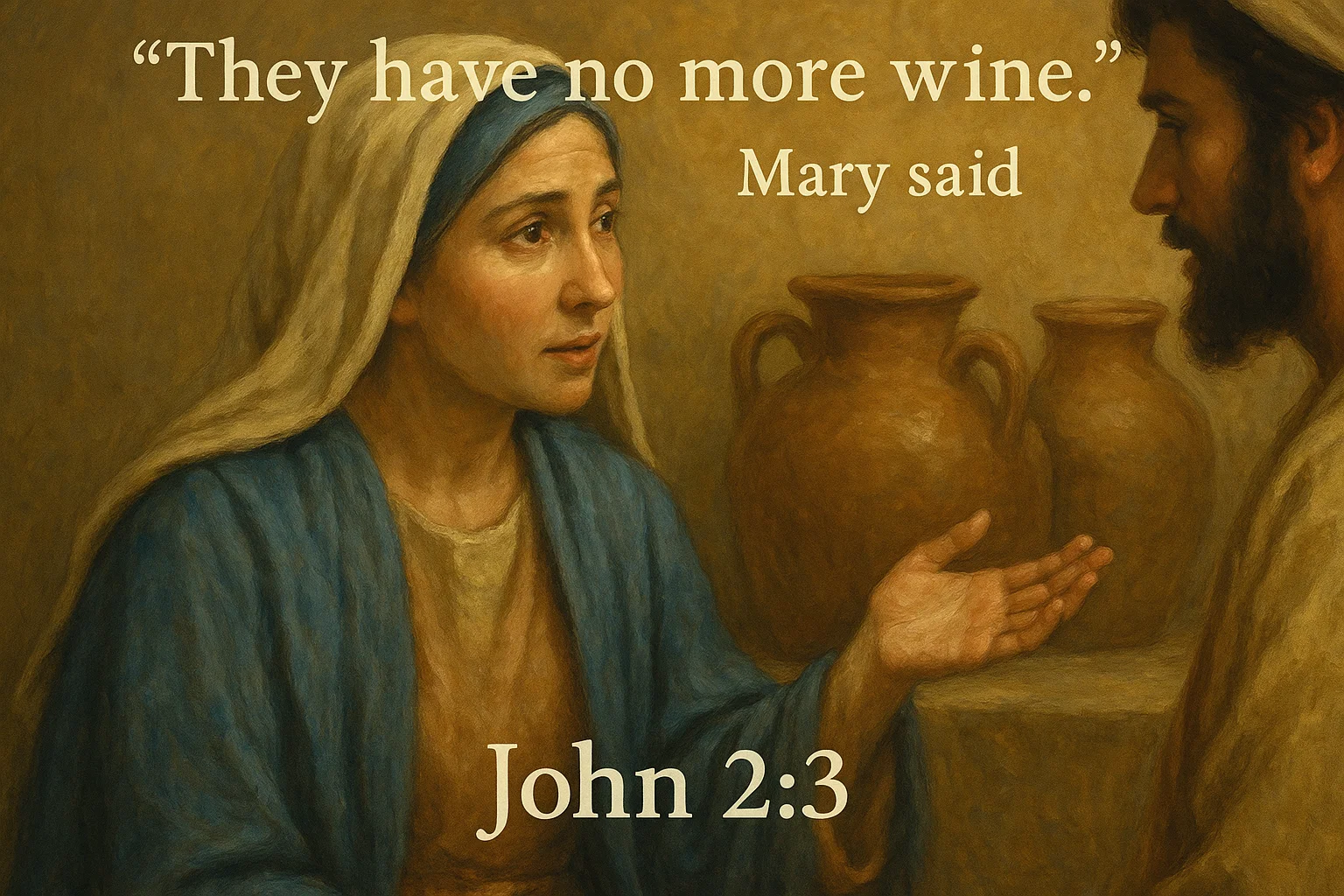
It’s in this moment of rising panic that we get the simple, loaded words of John 2:3. Jesus’s mother, Mary, finds him, leans in, and says, “They have no more wine.”
This simple observation isn’t just a catering note. It’s a hinge point. It’s the quiet whisper that triggers the very first public “sign” of Jesus’s ministry. This verse, tucked into the second chapter of John, is a powerful moment. It shows us Mary’s unique faith, it shines a light on a deep human need, and it sets the stage for a miracle that defines the rest of Jesus’s mission.
We’re going to dive deep into this single sentence. We’ll explore the cultural panic, the hidden symbolism, and what Mary’s simple, six-word statement of fact really means for us.
It’s a lot.
But understanding this moment changes how you read the rest of the story.
More in John Chapter 2 Category
Key Takeaways
- John 2:3 captures the moment at the Wedding at Cana when Mary, Jesus’s mother, identifies a critical human and social crisis.
- The phrase “They have no more wine” points to a social catastrophe that would have brought deep shame on the host family and ruined the wedding.
- Mary’s statement is a profound model of faith. She doesn’t demand a fix or offer a solution; she simply presents the problem to the one person she trusts to handle it.
- This event kicks off Jesus’s first public “sign” (miracle), which John’s Gospel uses to reveal his glory and establish the theme of his ministry: transformation, abundance, and new joy.
- The verse serves as a powerful pattern for our own prayer life—it shows the power of just being honest about our emptiness and our needs.
Why Was a Wine Shortage at a Wedding Such a Catastrophe?
We read this story from our 21st-century perspective and think, “Okay, so send someone on a liquor run. It’s an inconvenience, right?”
Wrong. This was a full-blown, five-alarm disaster.
To get John 2:3, you have to get the world it happened in. This wasn’t just a party foul. This was a public disgrace.
Understanding Hospitality in the Ancient Near East
In first-century Jewish culture, hospitality wasn’t just a nice-to-have. It was a sacred duty. It was the bedrock of your family’s honor. When you threw a wedding, you were making a public covenant of joy with the entire community. You were promising to provide, to celebrate, to host.
And wine was the non-negotiable symbol of that joy. It was the life of the party. The Psalms connect wine directly to gladness: “wine to gladden the heart of man” (Psalm 104:15).
A wedding that ran out of wine wasn’t just poor planning. It was a failure of joy. It was a deep insult to the guests and, more tragically, a terrible omen for the new couple. It suggested their life together would be one of lack, of joy running out far too soon.
Wasn’t It Just a Party Foul?
No. This was a deep, lasting shame. The host family would be humiliated. The bride and groom would carry this stain for years. It’s the kind of thing that would make people whisper when they walked by in the market: “That’s them. The ones who ran out of wine at their own wedding.”
This is the tension in the air. This is the social bomb Mary sees ticking. Her words, “They have no more wine,” aren’t a casual complaint. She is reporting a catastrophe. She is pointing to a moment of profound lack and shame.
The party is about to die. The family’s honor is about to be lost. The joy is gone.
And that’s when she turns to her son.
What Did Mary See That Others Missed?
This is where the story pivots from a social crisis to a spiritual one. Think about it. The party is still going. The guests are laughing, unaware. The servants are probably whispering, frantic, in a back room. The host is likely oblivious, still smiling and shaking hands.
But Mary sees it.
She has that kind of awareness. She’s not just a guest; she’s present. She’s tuned in to the needs around her. She sees the fear in the servants’ eyes. She sees the supply running low. She sees the impending crash. And she decides to do something.
Was Mary Just Being a Concerned Mother?
It’s easy to read this as just a “mom” moment. Maybe she was related to the family. Maybe she was just trying to help out. But her response is so specific, so unique.
She doesn’t run to the host and cause a panic. She doesn’t start rationing the last few drops herself. She doesn’t cause a scene.
She goes, quietly and directly, to the one person in the universe she knows is different.
This tells us everything about Mary. She’s a woman of deep compassion. She can’t stand by and watch this family be humiliated. She feels their shame and wants to stop it. But it also tells us everything about her faith.
“They Have No More Wine.” Why Is Her Statement So Simple?
This, for me, is the most powerful part of the verse.
Notice what she doesn’t say. She doesn’t say, “Jesus, you have to fix this.” She doesn’t say, “Jesus, I have an idea. Go to the market. Create a diversion. Do something.” She doesn’t hand him a solution.
She just hands him the problem.
“They have no more wine.”
This is faith in its purest form. It’s not about telling God how to solve our problems. It’s about having the confidence to just lay the problem at his feet, trusting that he sees, he cares, and he is able.
I had to learn this the hard way in college. I was drowning in a physics class I needed for my major. I mean, completely, hopelessly lost. I was pulling a C-, and my pride kept me from asking for help. I thought I had to figure it out myself. Finally, after bombing the midterm, I walked into my professor’s office. I was humbled and totally embarrassed. I sat down, and I didn’t say, “Can you curve my grade?” or “Can I do extra credit?”
I just said, “Professor, I’m lost. I’m not getting it. I have no more wine.”
It was that simple, honest statement of my lack that changed everything. He didn’t just give me answers. He saw the real problem, and he taught me a new way to study. Mary models this perfectly. She just states the need. She trusts Jesus to know the best response.
The Big Question: What Did Mary Expect Jesus to Do?
This is the question that theologians have debated for centuries. If this is his first miracle, how did she know he could do… well, anything?
He was a carpenter. He hadn’t turned water into wine at home. He hadn’t healed any neighborhood kids. This is the starting gun. So what was going on in Mary’s head?
What Had Mary “Treasured in Her Heart”?
We have to remember who Mary is. This is the woman who was visited by the angel Gabriel. This is the woman who was told her son would be “Son of the Most High” and that “his kingdom will have no end” (Luke 1:32-33).
She’s the one who watched shepherds and magi come to worship her newborn. She’s the one who, as the Gospel of Luke tells us twice, “treasured up all these things and pondered them in her heart” (Luke 2:19, 2:51).
For thirty years, Mary had been holding onto these explosive, world-changing secrets. She knew who he was, even if she hadn’t yet seen what he could do. She didn’t just see her son, the carpenter. She saw the promise of God, walking and talking beside her.
So, did she expect a miracle? Maybe not in the way we think. She didn’t have a category for “turning water into wine.” But she had a category for “Son of God.” She knew he was the answer, even if she didn’t know the formula.
Was She Pushing Him Into the Spotlight?
It certainly seems like it. Her statement is the catalyst. She is, in effect, tapping him on the shoulder and saying, “It’s time.”
And Jesus’s response confirms this.
It’s a jolt.
He says to her, “Woman, what does this have to do with me? My hour has not yet come” (John 2:4).
This verse is a whole other article. But we have to touch on it to understand John 2:3.
Why Does Jesus’s Answer to Mary Sound So Harsh?
Let’s be honest. If I ever called my mother “Woman,” I wouldn’t be alive to write this article. It sounds incredibly disrespectful to our modern ears.
“Woman” – Is That a Disrespectful Way to Talk to Your Mom?
In the original Greek, the word is gynai. And it’s not the disrespectful “Hey, woman” we might imagine. It’s a formal, serious, and even noble term. It’s the same word Jesus uses for her on the cross (“Woman, behold your son!”), a moment of profound love and care.
So, it’s not disrespectful. But it is distant.
He’s signaling a change. By calling her “Woman” instead of “Mother,” he’s gently and firmly establishing that their relationship has shifted. He is no longer just her son, accountable to her. He is now the Messiah, accountable to his Father. His public ministry has begun, and it’s on a divine timetable.
What Did Jesus Mean by “My Hour Has Not Yet Come”?
This is the key. “My hour” is John’s code phrase for Jesus’s ultimate purpose: his passion, death, and resurrection. It’s the “hour” he was born for.
When Jesus says, “My hour has not yet come,” he’s essentially saying, “The ultimate miracle, the ultimate transformation, isn’t scheduled for today. My public ‘unveiling’ is supposed to be later.”
And yet… he does it anyway.
Mary’s simple, faith-filled statement in John 2:3, “They have no more wine,” seems to pull that divine “hour” forward. She prompts him to act, to reveal a glimpse of his glory, to give a “sign” of what’s to come.
Is “John 2:3” Really Just About Wine, or Is It Something More?
Here’s where the story blows open. If you think this is just a story about Jesus saving a party, you’re missing the punchline. John’s Gospel is famous for its symbolism. Everything means something.
“They have no more wine” isn’t just a fact. It’s a metaphor for the human condition.
When the Old Joy Runs Dry
The wine of the old way has run out. The old religion, the old systems, the old ways of trying to find joy… they are empty.
I’ve felt this in my own life. I remember being in charge of putting together a big slideshow for my parents’ 40th anniversary. I’d spent weeks scanning photos, picking music. It was my big contribution. A few hours before the party, I plugged in the hard drive… and nothing. The file was corrupted. Everything was gone.
My heart just sank into my shoes. It was total panic. I felt the exact same dread that the servants at Cana must have felt. The “wine” of my big plan, the thing I was counting on, was gone. I had nothing.
That is the feeling John 2:3 is pointing to. It’s the moment we realize our own efforts, our own plans, our own religious boxes, are empty. They’re no longer producing joy. “They have no more wine.”
Water Jars for Purification: The Clue We Almost Missed
This is the detail that confirms it. Where does Jesus get the new wine?
He tells the servants to fill up six stone water jars. John, the author, makes sure we know what they were for: “They were for the Jewish rites of purification” (John 2:6).
This is not a throwaway detail. This is the whole point.
These jars represented the old covenant. They were for ritual washing, for the outward cleansing of hands and feet. They were a symbol of a religious system based on external works.
And, at this moment, they were empty.
Jesus doesn’t just snap his fingers and make new wine appear. He takes the very symbol of the old, empty system and transforms it. He fills the “water” of religious duty with the “wine” of grace and joy.
This is his first “sign.” It’s a mission statement. He’s not here to add a little more water to the old system. He’s here to transform it into something new, something alive, something that brings real joy.
If His “Hour” Hadn’t Come, Why Did He Do It Anyway?
Because of Mary’s faith. Because of his compassion.
Mary’s statement in John 2:3 shows that faith doesn’t always have to be a loud declaration. Sometimes, it’s just a quiet, trusting statement of need. She didn’t force his hand, but her trust opened the door for grace to act.
And Jesus’s response shows his heart. He saw the human need—the shame, the lack of joy—and he was moved. He may have had a different timetable, but his compassion overruled his schedule.
Why So Much Wine? And Why the Best Wine?
Jesus’s solution is not a patch. It’s not a “just enough” fix.
John tells us the six jars held “twenty or thirty gallons each.” Let’s do the math. That’s 120 to 180 gallons of wine. That’s the equivalent of 600 to 900 bottles of wine.
For a party that had already run out.
This is not moderation. This is outrageous, scandalous abundance. This is a flood of grace.
And it’s not just any wine. When the master of the feast tastes it, he’s stunned. He pulls the bridegroom aside and says, “Everyone serves the good wine first… but you have kept the best wine until now” (John 2:10).
This is the nature of Jesus’s ministry. He doesn’t just meet the need. He overwhelms it. He doesn’t just restore the old joy. He replaces it with something infinitely better. The world gives its best first, and it runs out. Jesus comes last, and he brings the best.
“He Revealed His Glory”
The story ends by telling us the whole point. This was the first of his signs, and “he revealed his glory” (John 2:11).
The glory wasn’t just the magic trick. The glory was the compassion. The glory was the transformation. The glory was the outrageous, abundant, best-wine-last grace.
Mary’s words in John 2:3 were the invitation for that glory to step onto the public stage.
What Happens When Our Wine Runs Out?
This, in the end, is what this verse means for us today. Because we all have moments where the wine runs out.
We know this feeling. It’s the end of a long day when your patience is gone and your kids are still yelling. It’s the moment you look at your marriage and feel like the joy has dried up. It’s the project at work, the bank account, the creative well—it’s just empty.
We all have our “they have no more wine” moments.
- When our energy for our job is depleted.
- When our patience with our family is gone.
- When our hope for the future feels empty.
- When our spiritual life feels dry and dutiful, like those empty stone jars.
- When our own solutions and plans have all failed.
Are We Supposed to Just State the Problem to God?
Mary gives us the perfect model.
Too often, our prayers are a list of instructions. “God, I need you to do X, Y, and Z. And please do it by Tuesday.” We try to hand God our solutions.
Mary shows us a different way. The way of faith is to simply be honest about the problem. To stand before God and say, “I’m empty. This is broken. The joy is gone. They have no more wine.”
It’s a prayer of raw honesty. It’s a prayer of vulnerability. And it’s a prayer of profound trust, because it leaves the solution, the how and the when, in his hands.
This type of honest, vulnerable prayer is a vital part of a real relationship. As a resource on spiritual practices from Yale Divinity School explains, this kind of honest “lament” or statement of need is not a failure of faith; it is an act of faith.
Looking for Transformation, Not Just a Quick Fix
When we run out of wine, we’re usually just praying for a little more wine. Just enough to get us through.
Jesus’s response at Cana shows us that he’s interested in something so much bigger. He’s not just a problem-solver; he’s a transformer. He wants to take the empty, dutiful “water” of our lives and turn it into the joyful “wine” of his kingdom.
He wants to do more than just restock our supply. He wants to give us a new supply altogether, one that is abundant, joyful, and better than anything we had before.
The Statement That Started It All
So, what does John 2:3 mean?
“They have no more wine” is the quiet, compassionate, and faith-filled observation that launched a ministry.
It’s the recognition of a deep human need: our joy runs out. Our systems fail. Our water jars sit empty.
It’s the model of perfect intercession: to see the need, to feel the compassion, and to bring the problem straight to Jesus without any attached instructions.
And it’s the invitation that Jesus is still waiting for. It’s the prayer he still responds to. He’s waiting for us to stop trying to fix our emptiness and just be honest about it.
“They have no more wine.”
It might be the most powerful, honest prayer we can ever say. It’s an admission of our “not enough” that opens the door for his “more than enough.” It’s the emptiness he’s waiting to fill with his glory.
FAQ – John 2:3
Why was a wine shortage at a wedding considered a social catastrophe in ancient Jewish culture?
In first-century Jewish culture, hospitality was a sacred duty, and wine symbolized joy and celebration; running out of wine was a failure of joy, a cause of shame for the host family, and a serious social and spiritual insult.
What does Mary’s statement ‘They have no more wine’ reveal about her faith and awareness?
Mary’s simple declaration shows her deep compassion and awareness of the social and spiritual crisis, trusting Jesus to handle the problem without dictating how, exemplifying her faith and understanding of his divine power.
Why did Jesus respond harshly when he called Mary ‘Woman,’ and what does ‘My hour has not yet come’ mean?
In Greek, ‘Woman’ is a formal term signifying a divine shift in their relationship, and ‘My hour has not yet come’ refers to Jesus’s ultimate purpose—his passion, death, and resurrection—indicating the miracle was not yet scheduled but was prompted by faith.
What deeper symbolism does the story of turning water into wine carry in the context of human need and spiritual renewal?
The story symbolizes the transition from the old, empty systems of religion and joy to the new covenant of grace and abundance, illustrating how Jesus transforms despair into divine joy and reveals his glory through compassion and miraculous abundance.